
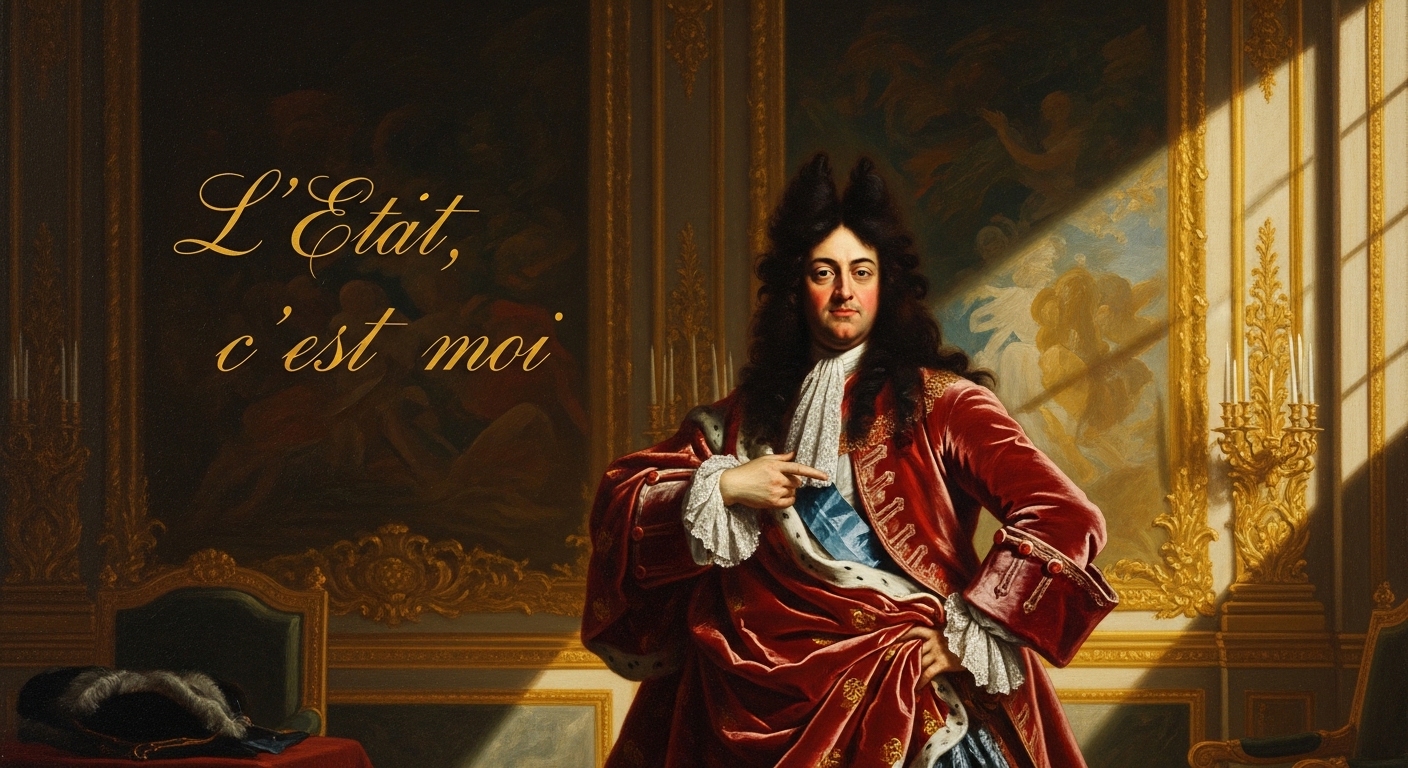
Ever stumbled upon a phrase that just makes you pause, tilt your head, and wonder, “Wait… did someone really say that?” That’s exactly what happened to me when I first heard L’état, c’est moi.
Candace, a historian friend of mine, told me about it over coffee one rainy afternoon, with her signature mischievous grin. She said, “It’s like King Louis XIV basically shouting to France, ‘Y’all, don’t bother me, I am the state.’” I laughed, but inside, I was fascinated.
How could a simple string of French words carry the weight of absolute power, autocracy, and one-man rule across centuries? And why do we still drop it in English conversations, like a borrowed gem of authority?
This phrase isn’t just some historical footnote; it’s a metaphor for power and influence, a symbol that a single person, sometimes, can feel like the embodiment of the state itself.
Let’s journey into its origin, the historical context, its translation, and how people today still invoke it to describe leaders, rulers, or even a stubbornly controlling tech CEO.
| Aspect | Details |
|---|---|
| Phrase | L’état, c’est moi |
| Pronunciation | leta-say-mwa |
| Literal Translation | “It’s me” |
| Contextual Translation | “I am the state” |
| Language | French |
| Attributed To | King Louis XIV of France |
| Time Period | Mid-1600s to early 1700s |
| Meaning / Significance | Symbol of absolute power, autocracy, one-man rule, and the embodiment of the state |
| Historical Context | Centralized monarchy, absolute monarchy, ruler’s authority was unquestioned |
| Modern Usage | Metaphor for leaders, tech CEOs, managers, or anyone with centralized control |
| Cultural Note | Popularized historically, no concrete evidence Louis XIV actually said it; used in literature, boardrooms, and casual speech |
| Concepts Highlighted | Influence, control, governance, leadership style, organizational authority, metaphorical description of power |
The Phrase in Its Historical Cocoon
L’état, c’est moi literally means “It’s me” or more contextually, “I am the state.” Pronounced in French as leta-say-mwa, it captures the essence of centralized monarchy during the mid-1600s to early 1700s.
King Louis XIV of France, often called the Sun King, ruled with what historians describe as unquestioned authority. Candace explained it like this: “Imagine waking up and knowing every law, every decree, every court decision flows through you. That’s Louis XIV.”
Though widely attributed to him, there’s no solid evidence he ever actually said it. Some scholars argue it’s more a historical popularization, a way later writers summarized his absolute monarchy and the idea that the ruler embodies the state.
It’s almost poetic, a phrase that transcends time, turning into a loanword/loan phrase we sprinkle into discussions about leadership and governance.
Why People Remember It
So why does a phrase with dubious attribution survive centuries? It’s because it encapsulates power and authority so perfectly. In literature, history classes, even boardrooms, L’état, c’est moi becomes shorthand for a head of the organization who wields influence like Louis XIV did sometimes with charm, often with an iron-fist management style.
The phrase’s survival is a testament to the allure of absolute power, the kind of control most of us daydream about at 3 a.m., then laugh nervously about at breakfast.
Breaking Down the Words
Let’s look at each word, just a bit:
- L’état – The state, the nation, the collective machinery of law, culture, and administration.
- C’est – Literally “it is,” connecting subject and object, giving the phrase a declarative punch.
- Moi – Me. The personal pronoun, small but mighty, turning the nation into a reflection of one individual.
Together, it’s deceptively simple. Candace always says, “It’s like French minimalism meets dictatorship.” The phrase is metaphorical usage of power, perfect for describing anyone from a medieval monarch to a protagonist in a novel who seizes control without consultation.
The English Translation and Cultural Adoption

In English, the phrase often appears as “I am the state.” Sometimes people just say “It’s me,” playfully or sarcastically, when asserting control. But in more formal discussions, historians and political theorists use it to describe absolute monarchy, single individual control, and embodiment of the nation.
Interestingly, it’s been borrowed not just in literature but in everyday metaphor. A CEO who refuses board input? Someone in a friend group who insists on choosing the restaurant every time?
Boom L’état, c’est moi energy. That’s the charm of French expressions in English: they carry gravitas and a hint of sophistication while staying slightly ironic.
Historical Context: Louis XIV and Absolutism
Louis XIV’s reign was long, flamboyant, and immensely centralized. The mid-1600s to early 1700s saw him consolidating power, building Versailles, and setting cultural standards across France.
He ruled as an autocrat, a dictator of his court, embodying the state in both governance and pageantry. Candace points out that leadership style wasn’t just about laws or battles it was performance. “He wore his crown like armor, every public appearance a subtle reminder: I am the protagonist here,” she says, smirking.
This is important because L’état, c’est moi isn’t just a line about ego it’s about organizational control, influence, and centralized governance. It encapsulates the essence of absolutism, the political philosophy that a monarch’s power is both complete and unquestionable.
Metaphors and Modern Usage
Today, we use it metaphorically. Writers describing a tech CEO who micromanages might whisper L’état, c’est moi in parentheses. A satirical cartoon of a school principal enforcing arbitrary rules? C’est moi vibes.
In short, the phrase evolved into a metaphorical description of power, keeping its historical weight but applying to contemporary hierarchies.
Why We Love Borrowed Phrases

There’s something almost magical about loanwords/loan phrases. They sound exotic, carry precise nuance, and often resist exact translation.
Candace explains that English speakers love sprinkling French expressions in English because it elevates the conversation: suddenly, discussing a manager’s authoritarian style isn’t boring it’s cultured, historical, slightly cheeky.
It’s also a reminder that language evolves along with culture. L’état, c’est moi isn’t just about a king; it’s about influence, control, and the seductive allure of leadership without consultation.
Common Misinterpretations
People sometimes think saying L’état, c’est moi implies sheer narcissism or tyranny. Sure, in literal terms, it’s ego-heavy. But historically, it was also a reflection of centralized monarchy, an era when power wasn’t shared, and the ruler embodied the state physically, politically, and culturally. Misinterpretation risks losing the historical significance of the phrase.
For instance, Candace once explained: “If you call a modern CEO L’état, c’est moi, you’re not just insulting them—you’re highlighting a very old, very specific type of control that shaped nations.” Context matters.
Pronunciation and Playful Usage
The French pronunciation leta-say-mwa is worth practicing. It rolls off the tongue with authority, and saying it incorrectly sounds almost cute, unintentionally undercutting the gravitas.
Playfully, some English speakers whisper it during office debates: “No, I’ll handle this project. Léta-say-mwa.” It’s tongue-in-cheek, ironic, yet historically resonant.
Using it casually is like wearing history on your sleeve. You’re signaling awareness of monarchy power, absolutism, and organizational control without needing a lecture.
Read this Blog: https://marketbellione.com/red-vs-read/
Fun Anecdotes Across Cultures
Interestingly, celebrations of power and authority have their quirks. In France, contemporaries of Louis XIV often used satire in plays and pamphlets to mock the Sun King’s ego, much like memes today. Candace tells me, “People made tiny dolls of Louis with golden crowns and scepters, joking he literally thought L’état, c’est moi.”
Across cultures, rulers have asserted similar ideas. In Japan, the Emperor once held a position so central that officials treated his words as law. In modern corporate Japan, top managers sometimes exercise iron-fist management, echoing centuries-old absolutism. The metaphor transcends geography.
The Leadership Lesson Hidden in the Phrase
Beyond its historical drama, L’état, c’est moi teaches something profound about leadership: centralized control can inspire efficiency but risks alienation.
Candace points out that while Louis XIV dazzled, his absolutism eventually burdened France with debt and social unrest. Today, any head of the organization or protagonist seeking total authority can take a lesson from history absolute power might be seductive, but it has consequences.
It also sparks reflection on modern workplaces. When we say a manager has L’état, c’est moi energy, we’re recognizing someone’s influence, control, and tendency to lead without consultation. It’s a metaphor that’s both playful and sobering.
Using the Phrase in Writing and Conversation
If you’re a writer, speaker, or even someone sending playful office messages, L’état, c’est moi works beautifully. Candace suggested a few ways:
- Use it to describe a character who dominates the narrative.
- Sprinkle it in dialogue for humorous exaggeration.
- Refer to it in blog posts or presentations when discussing leadership styles.
In all cases, it’s about context. The phrase shines brightest when readers recognize its historical attribution yet see it applied creatively to contemporary situations.
Frequently Asked Questions
etat cest moi
This phrase is the simplified English typing of the French “l’état, c’est moi,” meaning “I am the state,” often used to describe someone with absolute power.
l’état c’est moi
A French expression meaning “I am the state,” historically linked to King Louis XIV and used to convey ultimate authority.
“l’état, c’est moi!”
An emphatic version of the phrase, expressing a ruler or person’s total control and identification with the state or organization.
l’etat c’est moi meaning
It translates to “The state, it is I” or “I am the state,” signifying that a leader embodies all authority and power of the state.
l’état, c’est moi
A famous French phrase illustrating absolute power, often metaphorically applied to people with unquestioned control or influence.
Conclusion: More Than Just Words
At the end of the day, L’état, c’est moi is more than a fancy quote. It’s a lens into French absolutism, centralized monarchy, and the age-old fascination with absolute power.
From King Louis XIV to a controlling tech CEO, the phrase captures the tension between authority and responsibility, charisma and ego, leadership and hubris.
Candace likes to end her history lectures with a smile, saying, “Remember, you can have all the power in the world, but if people hate you, C’est moi won’t save you.”
In English, we borrow it, adapt it, play with it, yet beneath the charm and sophistication lies a story about human ambition, leadership, and the enduring allure of control.
So next time someone casually asserts L’état, c’est moi, you’ll know it’s not just words it’s centuries of history, philosophy, and culture rolled into three French syllables.
And maybe, just maybe, it’ll inspire you to reflect on your own moments of control and authority, whether in a meeting, a household, or in your personal dreams.
History isn’t just something you study it’s something that can whisper across time, saying, “Power is real, responsibility is heavier, and yes, sometimes you are the state.