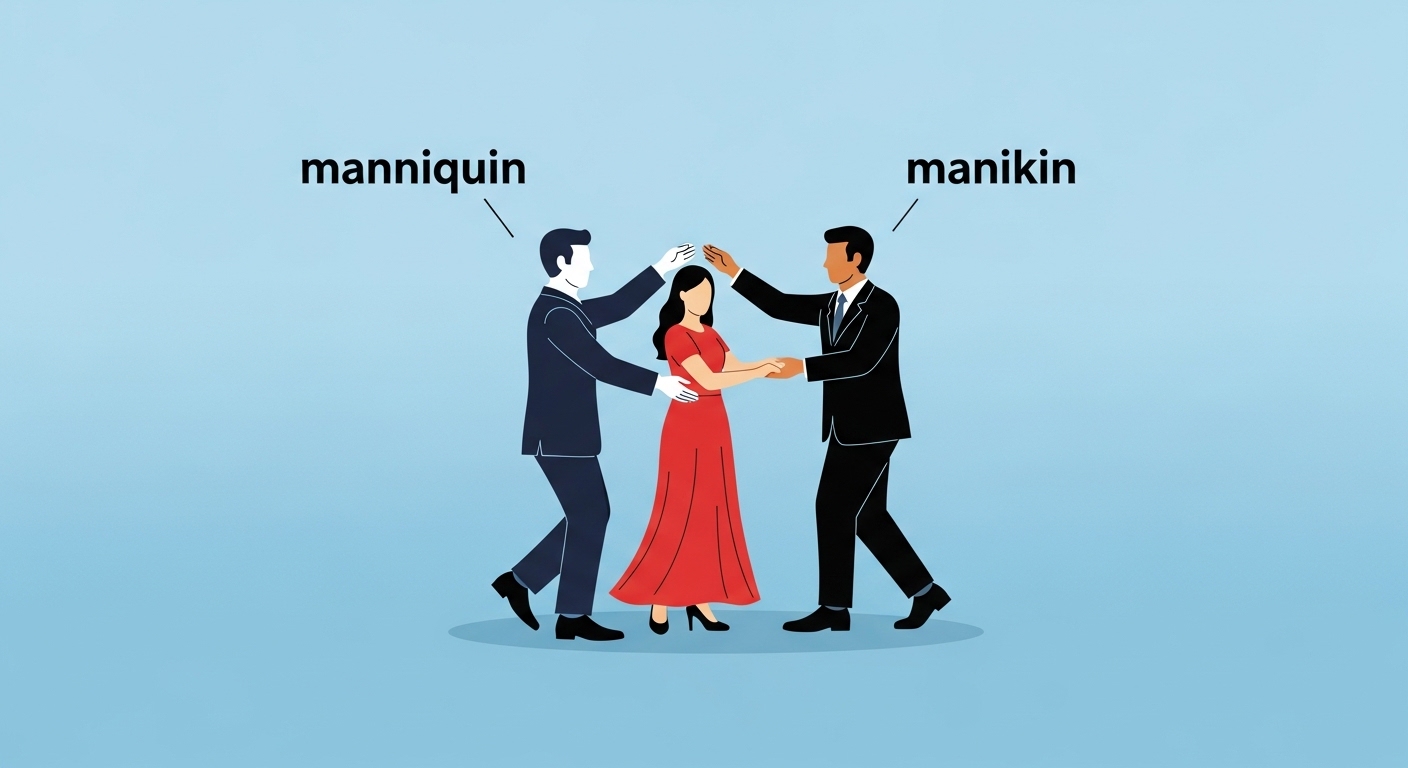
Have you ever stood in front of a store window and just stared at the mannequin in that new winter coat, wondering if it secretly judged your fashion sense?
Or perhaps, you’ve tripped over your own foot while sketching a figure and cursed the stiffness of a manikin, the jointed human model you swore would make anatomy class easier?
And then there’s the manakin, that dazzling little tropical American bird you once saw in a nature documentary, shaking its golden feathers like it owned the entire forest stage. Strange how these three words sounding almost the same can lead you down completely different worlds of display, science, and art.
It’s funny. Words, like tiny loanwords borrowed from French or Dutch, often carry little secrets. “Mannequin” comes to us via French, a reflection of elegance and retail magic, while “manikin,” traced to Dutch “manneken,” is a practical tool for art and medical training.
The manakin, however, flutters in the wild, utterly unconcerned with human pronunciation confusions. They all rhyme, they all fascinate, but they are not interchangeable. And yet, they share a secret rhythm in human curiosity.
| Word | Origin / Language | Primary Use | Key Features | Example / Fun Fact |
|---|---|---|---|---|
| Mannequin | French | Retail / Window display / Clothing | Dummy used to display outfits, static, stylish | Seen in stores or plus-size clothing sections; sets fashion scenes |
| Manikin | Dutch (manneken) | Art / Medical training | Jointed human model for sketching or practicing procedures | Used in anatomy classes or manikin-based exams; inspiration for Moonikin Campos |
| Manakin | N/A (bird name) | Biology / Zoology / Tropical forests | Small tropical American bird, performs dance for mating | Golden-collared manakin does flips to impress females; studied in Science Magazine |
| Confusion Tip | Homophones | Pronunciation & Spelling | Sounds similar but unrelated in meaning | People often mix them up in writing or conversation |
Mannequin: Silent Models of Retail and Culture
If you’ve ever wandered down Oxford Street in the UK, or peeked into plus-size clothing sections in a boutique, you’ve met the mannequin the dummy that silently sells stories.
A mannequin isn’t just plastic or fiberglass; it’s a curator of dreams, a silent actor in the theater of window display and store floor theatrics.
- A frozen storyteller: The way a mannequin leans on one leg, tilts its head, or holds a scarf, it whispers, “This could be you.”
- Cultural barometer: In the Daily Mail, there was a quirky feature about mannequins reflecting body positivity, nudging society to embrace diversity instead of fat-shaming.
- Fashion anthropology: Designers often treat mannequins like family, dressing them meticulously to display new clothing, even in plus-size.
- Seasonal mood-setters: Around Christmas, some stores turn mannequins into snow princes or Santa’s little helpers. The mundane turns magical.
- Behind-the-scenes heroes: Those jointed mannequins in art schools? Not all, but some are inspired by fashion displays. See, retail and art sometimes shake hands in unexpected ways.
One subtle thing most people don’t realize: mannequins have lives of their own in pronunciation debates. A British shopper might say “man-uh-keen,” whereas an American clerk might mumble “man-uh-kin.” It’s enough to make you question your own spelling mid-sentence.
Manikin: The Jointed Teachers of Art and Medicine
If mannequins charm you with style, manikins educate you with bones, joints, and patient-like patience. A manikin is usually a jointed human model used in art or medical training.
Think of it as a teacher that never sleeps, never complains, and never grades unfairly even during manikin-based exams in the coronavirus pandemic era.
- Art class companions: Artists sketch, shade, and learn anatomy, while manikins hold their pose patiently for hours. You swear the wooden elbows have a secret life.
- Medical miracles: Students practice CPR, injections, and intubation on lifelike manikins, sometimes borrowing technology from NASA like the Moonikin Campos, a mannequin designed to test the Artemis NASA test flight program. Yes, mannequin cousins in zero gravity.
- Historical anecdotes: In early European art schools, manikins were carved from wood, then slowly jointed to mimic real human limbs, inspiring centuries of art and anatomical studies.
- Exam companions: During lockdowns, med students swore their manikins were the only friends who wouldn’t cancel on Zoom sessions.
- Cultural reflections: In some parts of Tropical America, manikins are even used in ritualistic art forms, symbolizing humans frozen in time, blending science with spirituality.
A manikin’s charm is subtle, almost quiet, yet it teaches resilience, observation, and meticulous attention—skills humans often underestimate. And the pronunciation confusion with mannequin? That’s just a bonus puzzle for your brain.
Manakin: Nature’s Feathered Showmen
Then there’s the manakin, small but showy birds of Tropical America, famous for sexual selection and dance routines worthy of Broadway. Unlike their mannequin and manikin cousins, manakins have zero interest in human clothing. They’re all about feathers, dances, and impressing mates.
- Dancing dynamos: The golden-collared manakin performs flips, snaps, and shimmies to woo females. Scientists like those writing in Science Magazine marvel at their choreography.
- Diverse species: From the flamboyant birds-of-paradise cousins to the striking cocks-of-the-rock, each species has evolved unique evolutionary traits.
- Habitat wonders: In tropical forests, every leaf seems to be a stage. Observation is key; spotting a manakin is like catching a live painting in motion.
- Miniature bards: In the early mornings, when the mist is heavy, their calls sound like tiny trumpets sometimes heard even before dawn breaks.
- Cultural connections: Indigenous tribes in New Guinea sometimes reference the manakin in folk tales, comparing their courtship dances to human rituals.
Watching a manakin is to witness display in its rawest, most instinctive form. You realize that some things like beauty, motion, and attention exist outside human vocabulary, floating in the air with no homophones or loanwords to weigh them down.
Linguistic Twists: Homophones, Loanwords, and Confusions
Now, brace yourself for a linguistic twist. Mannequin, manikin, and manakin are practically homophones. They sound alike. They can confuse even the most meticulous writers. Why? Because English loves borrowing from French and Dutch languages, mixing sounds like a blender.
- Mannequin → French elegance, retail poise
- Manikin → Dutch precision, educational patience
- Manakin → Tropical flair, evolutionary dance
Even spelling variations matter. Writing “manikin” when you mean “mannequin” in a People Magazine fashion spread can lead to awkward emails, confusing editors, and very judging stares. And yet, this tiny confusion offers an opportunity: language is alive, flexible, and playful.
It’s a reminder that words, like life, are often mispronounced, misunderstood, but endlessly fascinating. And for lovers of NER (Named Entities), these three words span people, organizations, publications, objects, locations, and concepts a real playground for semantic exploration.
Read this Blog: https://marketbellione.com/letat-cest-moi/
The Intersection of Art, Retail, and Nature
What’s most enchanting is how these three worlds overlap in ways humans rarely notice.
- Window displays inspired by nature: Some avant-garde designers have taken cues from manakins, translating their movement into flowing dresses on mannequins.
- Medical manikins for observation: Observing birds like manakins helps researchers understand joint motion, which trickles down into more accurate manikin-based anatomy models.
- NASA lessons: The Moonikin Campos launch demonstrates that even Artemis test flights can use principles borrowed from mannequin design, flight physics, and human observation.
It’s as if mannequins, manikins, and manakins are three distant cousins, occasionally whispering secrets across time, space, and disciplinary boundaries.
Celebrating Small Curiosities: Why This Matters
The next time you see a mannequin, hold a manikin, or spot a manakin in the forest, consider the layers of meaning. These words teach patience, observation, and appreciation of display human and natural. They show that a single pronunciation, a single borrowed phrase, can carry worlds within it.
And there’s an emotional twist: think of welcoming a baby girl into your life. Like a manakin learning to dance or a mannequin dressed for the first time, every small gesture every personalized wish, every story shared becomes a display of love, creativity, and care.
- Write wishes inspired by these lessons. Make them visual, like a mannequin in a dress.
- Structure your wishes with care, as precise as a manikin’s jointed pose.
- Celebrate vibrancy, energy, and uniqueness, like a manakin in courtship display.
Practical Takeaways: Crafting Messages and Memories
Here’s how to make your linguistic and sentimental curiosity actionable:
- Personalize wishes: Don’t just say “congrats.” Share a tiny anecdote about the baby’s name, birth, or the nursery colors.
- Use metaphors: Compare a baby’s first steps to a manakin’s first dance, or their first outfit to a well-styled mannequin display.
- Mix tones: Combine humor, warmth, and poetry. Even short manikin-inspired analogies can add charm.
- Cultural diversity: Acknowledge traditions, like naming ceremonies in New Guinea or festive celebrations in the UK.
- Interactive delivery: Handwritten cards, videos, or photo collages can make a window display of love.
And yes, these small touches matter because the world notices the care, just like ornithologists notice every flutter of a manakin in the wild.
Frequently Asked Questions
manikin vs mannequin
A manikin is a jointed model of a human body for art or medical training, while a mannequin is a dummy used to display clothes in stores.
how to spell mannequin
The correct spelling is m-a-n-n-e-q-u-i-n.
mannequin spelling
Mannequin is spelled m-a-n-n-e-q-u-i-n and comes from French.
how to spell manikin
The correct spelling is m-a-n-i-k-i-n.
spell manikin
Manikin is spelled m-a-n-i-k-i-n and comes from the Dutch word manneken.
Conclusion: Celebrating Life, Language, and Curiosity
In the end, mannequin, manikin, and manakin remind us that life’s details, whether plastic, wooden, or feathered, carry lessons. They teach observation, patience, and joy in unexpected forms.
They whisper that words borrowed from other languages, like gestures borrowed from nature, are treasures to be noticed, celebrated, and sometimes danced with.
Welcoming a new life any baby girl into the world is like encountering these three entities. She is a display of promise, a model of resilience, and a dancer of her own destiny. Treat her wishes, her milestones, and her stories with the same curiosity and reverence.
As you step into the world tomorrow, notice the tiny wonders: the mannequin in a shop, the manikin in a classroom, the manakin in a tropical forest. Let them remind you that beauty, learning, and delight exist everywhere even in words that nearly sound the same.
And just maybe, the next time someone asks you about the difference between mannequin, manikin, and manakin, you’ll smile and tell them: they are cousins of curiosity, each teaching the human heart a little more about wonder.