
There’s something quietly magical about putting things in order. I remember the first time I tried to explain to my niece why lists matter it was in Fort Worth, Texas, during one of those long rainy afternoons when the sky just won’t stop crying, and we were huddled over a notebook full of scribbles.
I told her, “If you don’t list your ideas properly, your thoughts fall like marbles down the stairs, everywhere and nowhere at once.” She nodded solemnly, pretending to understand, but I swear, she got it.
That’s the subtle power of listing items in a sentence: it’s not just grammar, it’s a way to untangle chaos and make your audience breathe easier when reading.
Whether you’re jotting down ingredients for a bread-making class, preparing a detailed travel itinerary from Banff, Alberta, Canada to Moab, Utah, or crafting dialogue lists for a school play, learning how to properly list things in a sentence can be the difference between
clarity and confusion. Let’s dig into the art, the rules, and even the small rebellions you can pull off to make lists readable, organized, and kind of fun.
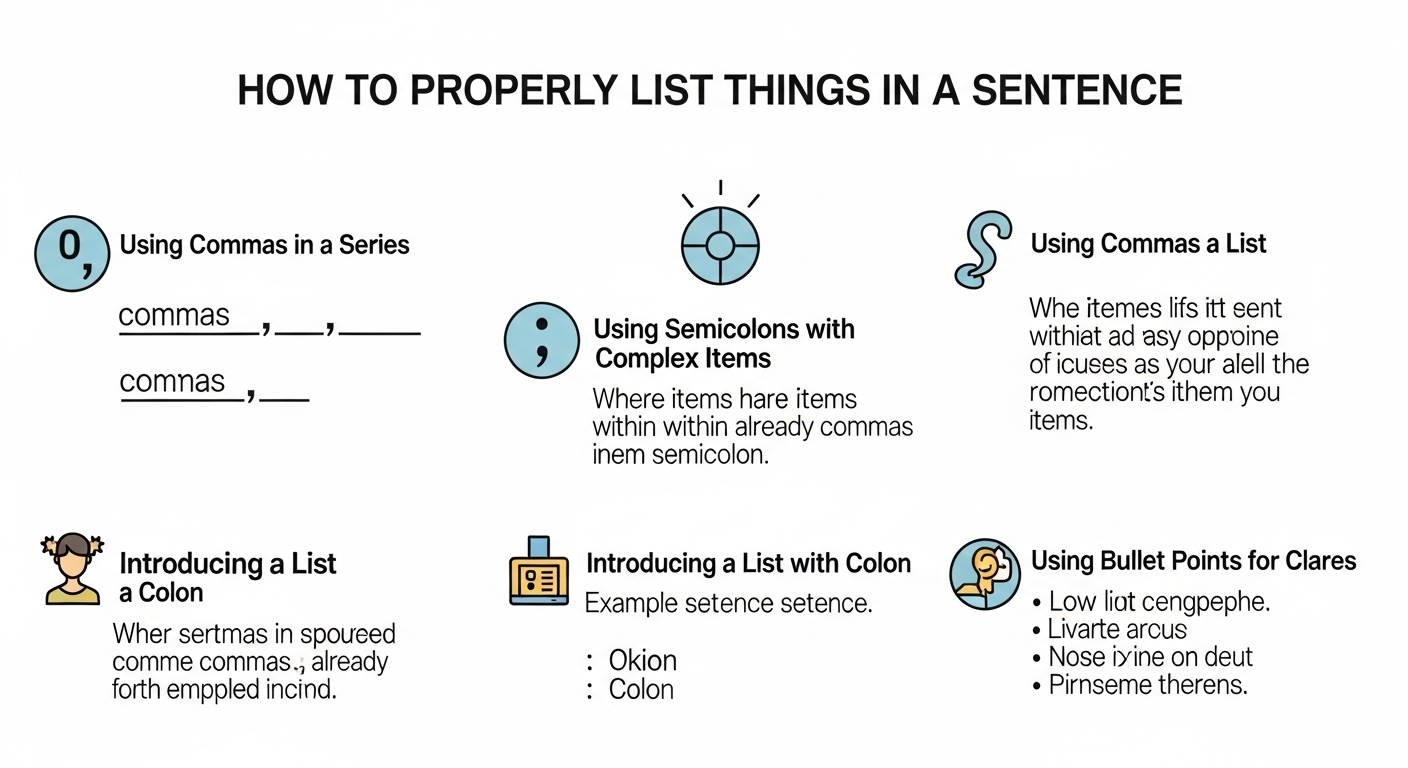
| List Type | Format | Punctuation | Best Use | Example |
|---|---|---|---|---|
| Horizontal List | Inline, separated by commas | Commas; use semicolon if items have commas | Short/simple items; casual writing | Apples, oranges, and bananas |
| Vertical List | Stacked with bullets or numbers | Use colon to introduce; full sentences end with periods | Complex or long items; step-by-step instructions | – Apples – Oranges – Bananas |
| Complex Horizontal | Inline, items with internal commas | Semicolons separate each item | Items contain clauses or commas | San Francisco, California; Portland, Oregon; Kennedy Space Center |
| Formal List | Full sentences, parallel structure | Colons, semicolons, proper capitalization | Reports, lesson objectives, professional documents | Students must: identify clauses; practice comma rules; create example sentences |
| Informal List | Fragments, playful style | Commas, optional punctuation | Notes, personal tasks, casual communication | Bake bread, feed dog, hug Mykayla, think about Moab trip 🌵 |
Why Lists Matter More Than You Think
Lists are everywhere. Grocery lists, task lists, idea lists, directions, step-by-step instructions, storyline lists heck, even our lesson objectives in English classes sometimes masquerade as mini lists on the board. When used properly, they transform messy thoughts into readable, digestible chunks.
- Lists provide visual separation, giving the reader a mini breather between ideas
- They prioritize information, so the most important things don’t get buried
- They avoid confusion, especially in formal writing where you’re juggling clauses, prepositional phrases, and semicolons
Think about it: if you’re emailing your team at the Student Youth Program (SYP) in Orlando, Florida, about scholarship deadlines, dumping all dates and instructions into one giant paragraph is like throwing spaghetti at the wall. Break it into bullet points or numbered steps, and suddenly everything makes sense.
Horizontal vs. Vertical Lists: Choosing Your Weapon
Most people don’t even realize there are two main styles of listing: horizontal and vertical. And oh, the subtle art of choosing between them is where readability and audience engagement can soar or crash.
- Horizontal lists: These are inline, separated by commas or semicolons. Perfect for casual sentences or small groupings. Example: “Bring bread, milk, eggs, and butter for the baking class.”
- Vertical lists: Stack them up with bullet points. Ideal when your items are complex, have clauses, or require detailed instructions. Example:
- Bread
- Milk
- Eggs
- Butter
Here’s a little secret: semicolons often sneak into horizontal lists when items themselves contain commas. Like if you were writing a travel itinerary to San Francisco, California; Portland, Oregon; and Kennedy Space Center, a simple comma just wouldn’t cut it. That’s where your semicolon usage shines like a lighthouse in foggy syntax seas.
The Grammar Rules You Actually Need
Ok, so full disclosure: some grammar rules are made to torture us, but a few really do save lives. When listing in a sentence, here’s what you gotta keep in mind:
- Commas separate simple items.
- Oxford/serial comma: optional in casual writing, essential in clarity-heavy contexts. (“I love my parents, Mykayla, and my dog” vs “I love my parents, Mykayla and my dog.” One could mean your dog’s name is Mykayla… awkward.)
- Colon usage: perfect to introduce a list that follows a full sentence. Example: “Please bring the following ingredients: flour, sugar, eggs, and butter.”
- Semicolon usage: for lists where items themselves contain commas, like in complex descriptive lists.
Fun tip: if your sentence feels like it’s running a marathon and gasping for air, you might be missing a colon or semicolon somewhere.
Creative Uses of Lists Beyond the Obvious
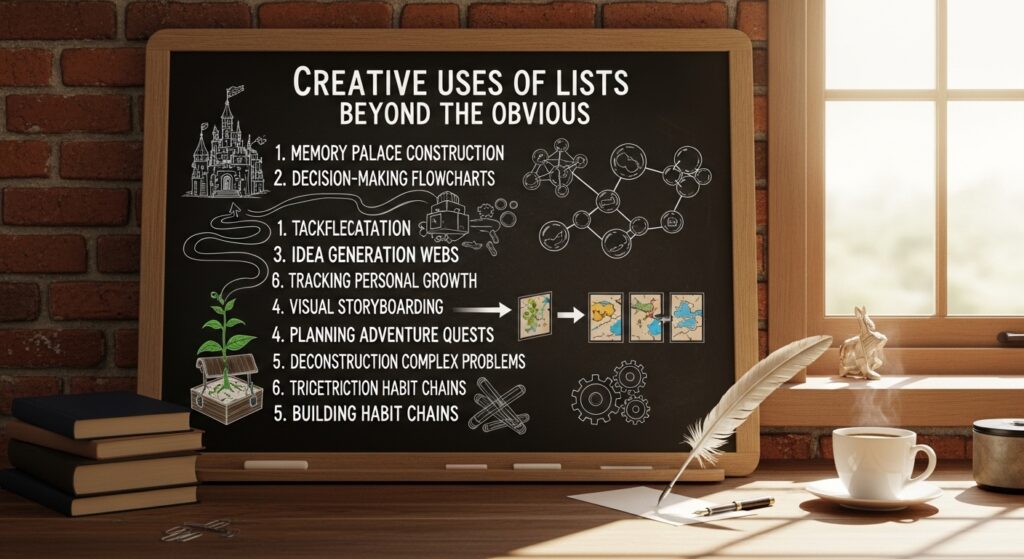
Lists are not just about groceries or assignments. They’re tools for creativity, storytelling, even humor. Think about storyline lists for a short play about a baby shower in Garden City, South Carolina, or a dialogue list for a silly skit at a birthday party.
You can mix sentence fragments, full sentences, prepositional phrases, and clauses, all in one vertical list and still keep your audience following.
- Listing a series of ideas: “He bought flour, because he wanted to bake; sugar, because the cake must be sweet; and love, because every recipe deserves it.”
- Claim lists: “I will always remember the smell of fresh bread, the giggles of Mykayla, and the way the sunset looked over Moab, Utah.”
- Directions lists: “Turn left at the oak tree, then right at the red mailbox, and finally, smile at the dog in the driveway.”
The key is that sentence structure in lists doesn’t need to be robotic it can breathe, expand, contract, even dance a little.
Formal vs. Informal Writing: Lists in Different Contexts
How you format lists depends heavily on your audience. Imagine sending a task list to a friend versus submitting lesson objectives for an English class in Portland, Oregon.
- Formal writing: full sentences, proper punctuation, parallel structure, and clarity first. Use colons to introduce vertical lists and semicolons in complex horizontal lists. Example: “The lesson objectives for today are: students will identify clauses; students will practice comma rules; and students will create example sentences using prepositional phrases.”
- Informal writing: fragments, playful punctuation, and small misspellings are okay (sometimes fun!). “Things 2 do today: bake bread, feed dog, hug Mykayla, think about Moab trip 🌵”
Even when you’re informal, information clarity is still king. People may forgive typos, but confusing lists? That’s unforgivable.
Examples of Properly Listed Sentences

Here’s where things get juicy. Below are real-world examples you could steal, adapt, or totally remix. Each illustrates different ways of organizing lists without making your reader cry.
- Grocery list (horizontal): Apples, oranges, bananas, and kiwis.
- Grocery list (vertical):
- Apples
- Oranges
- Bananas
- Kiwis
- Complex descriptive list: “For the Student Youth Program in Orlando, Florida, participants need: a notebook for notes, preferably spiral-bound; a pen, black ink only; a water bottle, clearly labeled with name; and a snack, healthy or otherwise, to survive the 3-hour session.”
- Dialogue list:
- “Are we really going to San Francisco, California?”
- “Yes, but first Portland, Oregon.”
- “Don’t forget Kennedy Space Center!”
Notice how punctuation changes depending on the complexity of items and whether they’re independent clauses.
Common Mistakes to Avoid When Listing
Even seasoned writers stumble on these:
- Forgetting the Oxford/serial comma in complicated horizontal lists
- Mixing sentence fragments and full sentences inconsistently
- Overstuffing horizontal lists that need vertical layout
- Ignoring semicolons in lists with internal commas
- Using colons randomly without a preceding independent clause
Remember, lists are supposed to improve readability. If your audience has to re-read a list, something is off.
Personal Touches That Make Lists Memorable
Here’s where your writing gets that sparkle. Adding tiny personal touches maybe a location, a favorite student, or a little anecdote—makes lists more human.
- “Items for the bread-making class Mykayla loved: 2 cups flour, the sugar that smells like Christmas, eggs from the neighbor’s chickens, and laughter (always a necessary ingredient).”
- Travel itinerary list with personality:
- Banff, Alberta, Canada hike until your legs scream
- Moab, Utah stare at rock formations until the sunset steals your breath
- Kennedy Space Center pretend you’re an astronaut, even if just for selfies
Even a subtle inclusion of Named Entities like people, places, or programs, gives your lists context and life.
How to Write a Custom List or Message
Ok, so you’ve mastered the basics. Now let’s get practical:
- Know your audience: Are you writing for friends, a formal report, or a Student Youth Program?
- Decide format: Horizontal if short and simple, vertical if long or complex.
- Check punctuation: Colons, semicolons, and commas are your best friends.
- Add personality: Little anecdotes, emojis (if informal), or references to locations like Garden City, South Carolina make your list unique.
- Test readability: Read it out loud. If it trips you up, it’ll trip your readers too.
You can even mix formal and informal elements creatively: maybe a vertical list with casual language, or a horizontal list with short explanatory notes.
The Joy of Well-Crafted Lists
There’s a quiet satisfaction in seeing chaos turn into order. A properly listed sentence is like a tiny poem, a roadmap, and a lifeline all in one.
It’s the reason we can navigate the whirlwind of daily tasks, complex directions, or lesson objectives without losing our minds. And it’s why we remember things longer when they’re organized our brains just love that structured information.
So next time you sit down to write a list whether it’s grocery items for Portland, Oregon, or a dialogue list for a play in Moab, Utah pause a moment, consider your punctuation, think about your audience, and maybe sneak in a little story or a beloved name.
Because when you do it right, your lists don’t just communicate. They resonate.
Read this Blog: https://marketbellione.com/duplicate-vs-duplicity/
Frequently Asked Questions
how to write a list in a sentence
Use commas to separate items, and if needed, introduce the list with a colon; for clarity, include an Oxford (serial) comma before the last item.
listing things in a sentence
List items by separating them with commas or semicolons for complex lists, keeping the sentence clear and readable.
how to list things in a sentence
Start with a complete sentence if introducing a list, then add items separated by commas, semicolons, or colons depending on complexity.
grammar listing items
Follow proper punctuation rules: use commas for simple lists, semicolons for complex items, and colons to introduce lists after a full sentence.
listing in a sentence
Organize items clearly within a sentence by using punctuation correctly and maintaining logical order for easy reading.
Conclusion: Making Lists Your Own
Properly listing things in a sentence isn’t about rigid rules or sterile structure. It’s about clarity, readability, and connection. Vertical lists give your items breathing space. Horizontal lists can keep your writing fluid.
Colons, semicolons, commas they’re not just punctuation; they’re your guides. And sprinkling in personal touches, Named Entities, or a dash of humor makes your lists unforgettable.
Next time you’re jotting down tasks, directions, or idea lists, remember: your lists can do more than just inform. They can inspire. They can entertain. They can turn a simple set of instructions into a story worth reading.
Start experimenting. Mix horizontal and vertical formats. Add anecdotes from Garden City, South Carolina or Fort Worth, Texas. Reference students like Mykayla, or programs like the Student Youth Program (SYP).
Play with punctuation, embrace imperfections, and watch your sentences breathe. Your audience and your sanity will thank you.
Because at the end of the day, listing things properly isn’t just grammar. It’s kindness. To your reader, to yourself, and to the chaos that tries to sneak into every sentence.