

Language is kinda funny, isn’t it? Like, you see a word and think you know it, but then bam English throws a suffix on it and suddenly it’s a whole new beast.
Today we’re diving into the world of -able and -ible, those tiny little endings that can flip a verb, adjective, or even a concept into something completely capable of existing in your brain differently.
I remember my old highschool English teacher, Ms. Lark, saying once, “Suffixes are like magic potions one drop, and a word is magically transformable.” And boy, she wasn’t kidding.
Suffixes might feel like dry grammar lessons in textbooks, but if you squint a little, they’re kinda alive. -able is what linguists call a living suffix. It’s energetic, adaptable, endlessly coining new words you wouldn’t expect.
-ible, on the other hand, is historical, like it’s wearing a powdered wig from Shakespeare’s time. It hangs on to the dictionary like a relic, reserved, a little rigid, but oh so dignified.
Let’s unpack this, get messy with examples, toss in a few -able examples like sanctionable and movable, and -ible examples like accessible and credible, and see why knowing these little endings can make you feel like a word wizard.
| Suffix | Word Example | Meaning / Use |
|---|---|---|
| -able | movable | capable of being moved |
| -able | redoable | can be done again |
| -able | extendable | able to be extended |
| -able | sanctionable | can be punished or sanctioned |
| -able | torturable | capable of being tortured |
| -ible | accessible | able to be reached or approached |
| -ible | credible | believable, trustworthy |
| -ible | perceptible | noticeable, detectable |
| -ible | invincible | impossible to defeat or overcome |
| -ible | admissible | allowed or acceptable |
The Living Magic of -able
When you slap -able onto a word, you’re basically saying, “Yo, this is capable of being done.” You can almost hear it in your head: overthrowable, redoable, extendable. It’s playful, ready to join new verbs in new adventures. It’s a suffix that refuses to retire.
- Sanctionable something that can be punished legally. Sounds scary, but think about it: we just made a law verb into an adjective. Language flexing.
- Movable not just furniture, but also ideas. Ideas are movable if you can convince someone.
- Torturable okay, grim, but it exists. Shows that -able can carry any weight, light or heavy.
- Extendable like those USB cables you never know how long you need. Also a metaphor for patience, maybe.
- Channelable the creative energy you can somehow focus into a project, even when Netflix is screaming your name.
- Redoable life’s gift. Everything is redoable, in English and in real life.
- Overthrowable reminds me of history books and those “oops, empire down” moments.
Notice how all these words feel like they can jump off the page into action. That’s the hallmark of a living suffix: it wants to grow, mutate, experiment. You can even coin new words with it if you dare your friends may give you side-eye, but linguistically, it’s fair game.
The Aristocrat: -ible
Now, meet -ible, the snooty cousin at the grammar party. It’s historical, a tad formal, less willing to play with just any verb. It feels like it’s hanging onto its Latin roots, whispering “not everything is for you to touch”.
Words like accessible, credible, perceptible, invincible they’re established. They’ve been vetted by the English dictionary police.
- Accessible like knowledge or a cozy cafe with ramps. Actually, it’s very socially friendly despite sounding posh.
- Admissible courtroom vibes. Evidence, logic, maybe excuses from your teenager.
- Audible yes, you can hear it. That late-night fridge hum or your neighbor’s drum practice.
- Convertible not just cars. Ideas, furniture, attitudes. This one sneaks into -able territory sometimes.
- Invincible childhood dreams, superhero capes, Monday mornings you somehow survive.
- Credible trustworthy info, that friend who actually shows up, the articles you dare to quote in essays.
- Perceptible the subtle smell of rain on concrete, or sarcasm in an email.
-ible is less productive; you don’t make new words with it casually. It’s preserved, like fine wine or your grandma’s cookie recipe, and part of its charm is that restraint.
The -able vs -ible Distinction
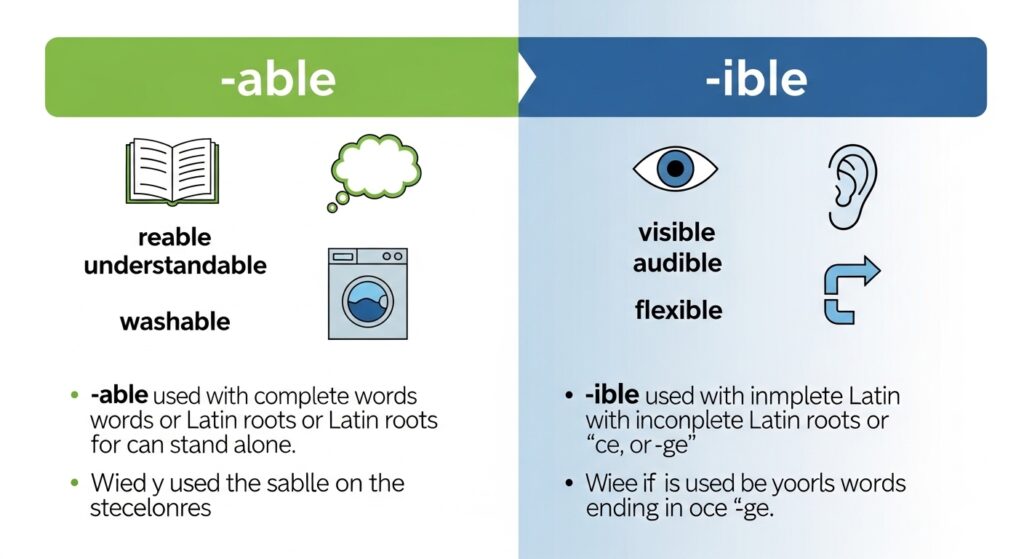
Ah, the eternal question. Which one do you pick? Honestly, there isn’t a one-size-fits-all. But here’s a secret: dictionaries love -ible for older words, retained from Latin, and -able is your modern-day playground.
There are rules, yes, like morphological transformation rules. Drop an e from the root before adding -able: move movable, force forceable. For -ible, no dropping. It’s rigid.
Some pairs confuse even pros: forcible vs forceable. Both exist, but one is more legally or historically standard (forcible), the other feels invented (forceable). Same with extendable vs extendible both legit, but -able is more common in everyday speech.
Lexical Productivity
Think of -able as energetic and -ible as preserved. Linguists call -able “productive” it can jump onto new verbs and adjectives. -ible is mostly historical, non-productive. That doesn’t make it boring it makes it dignified. Like, some words simply refuse to be touched.
Morphology in Action
Understanding -able and -ible is not just academic it’s practical. Especially in writing. Writers often mix them, get flagged by spellcheck, and panic. Morphology teaches: break the word down. Is it a verb? Usually -able. Retained from Latin? Probably -ible. Need a new coinage for a blog post? Probably -able.
Participles? Yeah, they morph too: movable moving, audible hearing. Adjective formation, verb transformation they’re not just grammar terms. They’re your toolkit for playing with words.
Hyphenation and Spelling Quirks
Some words need hyphenation, some don’t. For example, when a coinage is awkward, writers sometimes hyphenate: channel-able idea. It’s clunky, but readable.
Dictionary verification is your friend English loves exceptions. Spelling rules like dropping e before suffixes save your sentences from looking like medieval scribbles.
Read thiis blog: https://marketbellione.com/list-things/
Making Words Emotional
Words with -able and -ible aren’t just grammar they carry emotion. Redeemable could describe your bank balance, or your mistakes. Invincible is Saturday morning cartoons and childhood confidence. Accessible can be literal, like a library, or metaphorical, like a friend who listens.
Even in celebrating life events say, welcoming a baby girl you can sprinkle suffix magic. Think about the adjectives you use in wishes: adorable, perceptible joy, extendable happiness, credible love. Suddenly, your messages aren’t generic they’re morphologically enriched.
Real-Life Examples and Mini-Stories
I remember a cousin of mine, Priya, who had twins. Her cards were filled with -able and -ible words by friends who were linguistics nerds. One read: “May your nights be torturable only by diaper changes, and your smiles indiscernible from sunshine.” Weirdly poetic. People laughed, cried, and remembered it forever.
In France, they celebrate babies with a “couronne de fleurs” (flower crown). Imagine a card saying: “May your new daughter’s laughter be audible across the street, convertible into endless giggles at bedtime.” Suddenly, suffixes meet culture, and language becomes part of memory-making.
Creative Ways to Use -able and -ible in Communication

Suffixes are perfect for gifts, letters, social media captions, even poetry. Some ideas:
- Personalized cards: “Your courage is extendable to anyone who meets you.”
- Baby announcements: “Our joy is visible and movable into every heart.”
- Work emails: “Your ideas are channelable, and totally credible.”
- Poetry: “The sunlight is perceptible, the rain digestible, the wind forcible but gentle.”
See how these endings add weight, texture, subtle emotion? They make messages stick.
Practical Takeaways for Writers
- When creating new words, -able is your playground, -ible is your archive.
- Remember to check spelling rules: drop the e before -able, don’t mess with -ible.
- Use participles to transform adjectives into active feelings: movable moving.
- Hyphenate if readability suffers, but don’t overdo it.
- Sprinkle suffix magic in personal communication it makes messages feel crafted, thoughtful.
Frequently Asked Questions
ible suffix meaning
The suffix -ible means “capable of” or “suitable for” and is mostly found in words inherited from older English.
what does the suffix ible mean
It shows that something can be done, as in “edible” (able to be eaten).
how do you spell able
The suffix -able is spelled A-B-L-E and is used with verbs to form adjectives, often creating new words.
able ible suffix meaning
Both -able and -ible mean “capable of” or “suitable for,” but -able is productive while -ible is mostly historical.
what does ible mean
-ible indicates ability or suitability, as in words like “audible” or “perceptible.”
Conclusion: Why Suffixes Matter
In the end, -able and -ible aren’t just grammar lessons they’re tiny levers that lift your words into new meanings. They connect past and present, history and creativity, logic and emotion.
From the desk of a linguist to the baby announcement card, from courtrooms to coffee chats, these endings are alive, waiting for you to experiment.
So next time you see a word, don’t just read it wonder if it could be redoable, extendible, invincible, or perceptible. Think about what it could do for you, for your writing, for your memories. The suffixes are small, but the magic? Absolutely limitless.