
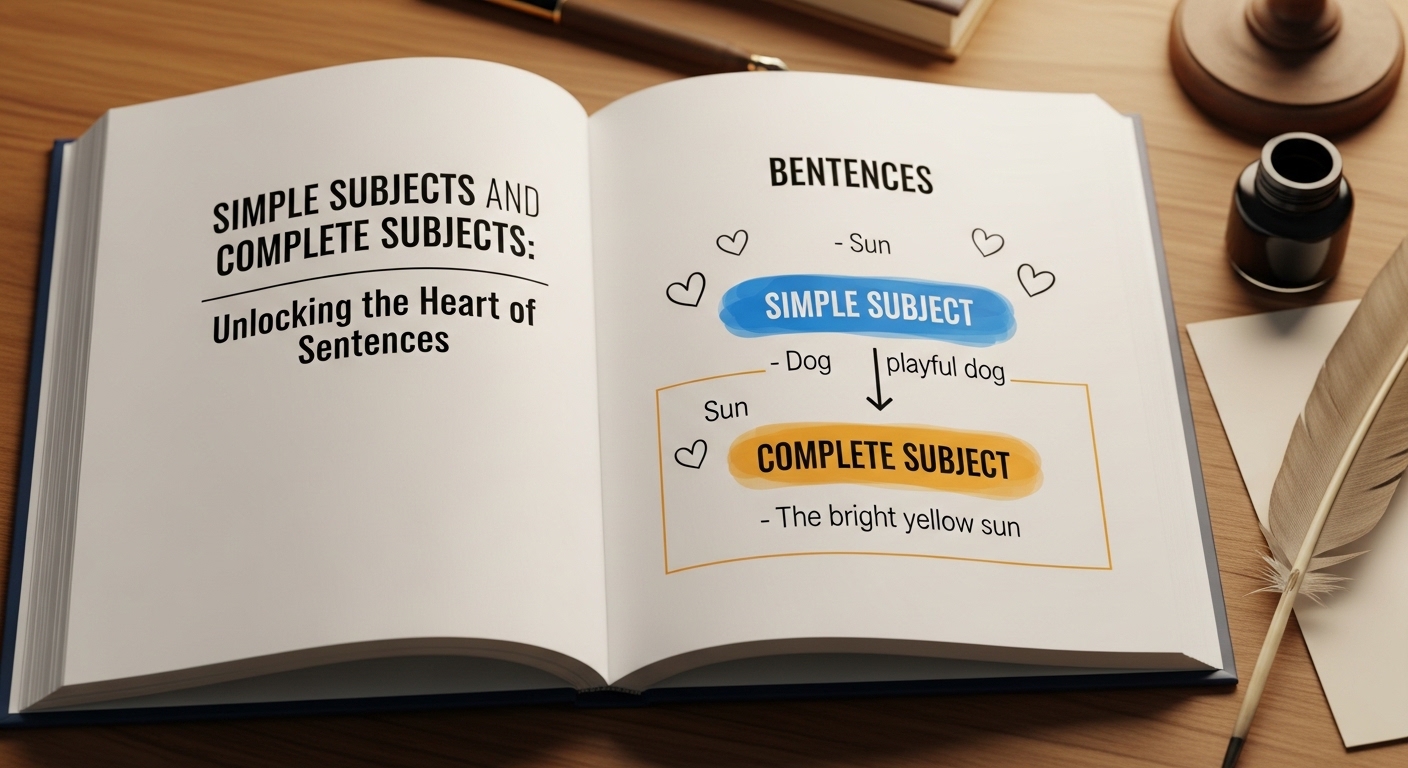
There’s something magical bout sittin’ in a quiet corner, notebook open, a cup of warm tea steamin’ beside ya, and watchin’ words dance across the page.
I remember once, sittin’ in my grandma’s living room, tryin’ to explain to my little cousin why the tired, elderly man trudged down the street didn’t just have a “man” in it it had layers, little hidden pieces that mattered more than ya think.
That’s the kinda thing that makes grammar concepts feel alive, y’know? Not just rules in a dusty book, but tiny doors into how our thoughts, feelings, and stories come to life. And today, we’re gonna peek into two of those doors: the simple subject and the complete subject.
Now, I ain’t gonna bore ya with a bunch of stiff definitions first. Instead, let’s imagine for a sec: every sentence you write is a little stage. On this stage, the subject (grammatical) is the star whether it’s a person, a place, a thing, or even a wild little idea. And like any star, it deserves its spotlight.
Sometimes it’s just the actor itself the simple subject. Sometimes it’s surrounded by all the costumes, props, and background dancers that’s your complete subject.
Stick with me, and we’ll unravel these layers with a mix of stories, quirky examples, and yes, a few instructional videos you might wanna check out later.
| Feature | Simple Subject | Complete Subject |
|---|---|---|
| Definition | The main person, place, or thing the sentence is about | The simple subject plus all modifiers that describe it |
| Includes Modifiers? | No | Yes (adjectives, phrases, clauses) |
| Example Sentence | “The tired, elderly man trudged down the street.” | “The tired, elderly man trudged down the street.” |
| Identifies | Who or what is performing the action (verb) | Gives full context and adds descriptive detail |
| Purpose | Core grammar concept, main idea | Provides complete picture, helps retain/understanding |
| Tips | Ask: “Who or what is this sentence about?” | Circle simple subject, then include all modifiers to get complete subject |
Understanding the Simple Subject: The Heart of the Sentence

The simple subject is like that one friend who’s always the center of attention without even tryin’. It’s the main person, place, or thing that’s doin’ the action (verb) or simply being talked about.
Think about it like this: in the sentence “The quick brown fox jumps over the lazy dog,” the simple subject is just fox all the adjectives, like quick and brown, are just extra bling, embellishments, little modifiers that dress up the star.
Sometimes, though, the simple subject can hide in plain sight. In “Her friends who live on Main Street are stopping by tonight,” the simple subject is friends, even though your eye first catches the entire phrase.
Recognizin’ the simple subject is like findin’ the core of a melody in a Spotify playlist it might be surrounded by layers, but it’s the thing that keeps the rhythm goin’.
Here’s a quirky tip: if you ever get lost, just ask: “Who or what is this sentence really about?” That’s your simple subject.
Complete Subject: Giving Context and Flavor
While the simple subject is the heartbeat, the complete subject is the whole song. It includes the simple subject plus all the modifiers, adjectives, and extra words that make it sparkle.
So in “The tired, elderly man trudged down the street,” the complete subject is “The tired, elderly man”. See how those adjectives give personality, mood, even history? That’s the difference: simple subject = star, complete subject = star in a costume with a whole entourage.
Learning this distinction is easier when you use visual cues. You might grab a worksheet, underline the simple subject once, and circle the complete subject twice.
Over time, you start seein’ patterns in grammar-in-context. Your brain retains it not as a rule but as a story: “Ah yes, the fox isn’t just quick, it’s the fox with pizzazz!”
Some teachers swear by long-form instructional videos on platforms like GrammarFlip education platform for grammar learning, where you watch examples unfold in real time.
Others like short, snappy short-form instructional videos with engaging visual associations and catchy chorus / verses. Either way, the key is makin’ the learning process interactive so your understanding sticks like gum on a shoe memorable but in a good way.
Recognizing Subjects in Real-Life Writing
Ever noticed how stories or news articles have subjects all over the place? “Our favorite movie from our childhood was on TV”—here, movie is your simple subject, our favorite movie from our childhood is your complete subject.
Practicin’ this with sentences you see in your daily life tweets, captions, even song lyrics on Apple or Amazon—helps the concept leap off the page.
Teachers often say, “If ya can point it out in your favorite music music videos, you can point it out anywhere.” Imagine your favorite singer on Spotify the subject is the singer, the complete subject might be “The talented singer with the sparkling jacket on stage”. Suddenly, grammar isn’t abstract; it’s the scene in front of your eyes.
Simple Subjects in Complex Sentences
Now, not all sentences are straight shooters. “The cat that chased the mouse under the old oak tree disappeared suddenly.” Here, the simple subject is cat, even though your attention is tempted by the clause that chased the mouse under the old oak tree. Those modifiers add drama, tension, even humor.
An easy trick? Use definition cards or instructional worksheets to break down sentences into bite-sized pieces. Circle simple subjects, highlight adjectives, underline actions (verbs), and suddenly your sentences feel like little puzzle boxes open one, and the world inside is yours to explore.
Complete Subjects Across Different Styles of Writing
From poetry to social media posts, the complete subject can bend, stretch, and even hide. Poets love packin’ adjectives and modifiers into the complete subject for memorable images: “The lonely, flickering streetlamp in the foggy alley whispered secrets.” Journalism prefers leaner sentences: “The mayor of the city announced new policies.”
By comparin’ these styles, you get a real-world sense of how grammar concepts function differently depending on your student engagement goal.
In classrooms, some teachers combine quick review, visual cues, and interactive learning to solidify understanding. At home, you might just write your own silly sentences while playin’ a catchy chorus from Spotify in the background learning sticks when it’s fun.
Why Understanding Subjects Matters

Some folks shrug at simple subjects and complete subjects, sayin’ “meh, it’s just grammar.” But think of it like buildin’ a house: the simple subject is the foundation, complete subject is the walls, roof, and decorations. Miss one, and the house feels wobbly. Miss the other, and the house has no personality.
Even in day-to-day life, knowing your subjects helps with clarity. You can watch, learn, and even play (video/music) games where you spot the subjects in random sentences great for memory retention and a funny way to sneak in interactive learning.
And when you’re teachin’ others, whether in a classroom or just to your cousins, it becomes way easier to explain why “Her friends who live on Main Street are stopping by tonight” isn’t confusing at all once you unpack the complete subject.
Tips for Mastering Simple and Complete Subjects
- Break sentences down into visual cues circle, underline, color-code.
- Use instructional videos from GrammarFlip education platform for grammar learning or download a worksheet to practice.
- Make it musical pair sentences with a catchy chorus / verses from Apple or Amazon playlists; rhythm helps retain / retention.
- Create your own silly sentences and highlight the action (verb) and modifiers.
- Share with friends and family; explaining is the ultimate test of your knowledge.
Even professionals swear by reviewing examples aloud: “The tired, elderly man trudged down the street” say it, act it out, see the person, place, thing. Suddenly, it’s not grammar; it’s storytelling.
Making It Personal: Bringing Grammar to Life
One of my favorite exercises is makin’ grammar-in-context personal. Pick a sentence about yourself: “My dog with the spotted tail chases squirrels every morning.” Simple subject: dog. Complete subject: my dog with the spotted tail. Your modifiers tell a story, create memorable images, and solidify understanding.
Parents often say, “Show them once, they remember for life.” I’d add let them play (video/music), sing along, review, learn in little bursts, and watch comprehension bloom like spring flowers.
Frequently Asked Questions
Complete Subject
A complete subject includes the main subject of a sentence along with all its modifiers, adjectives, or descriptive words.
Simple Subject
A simple subject is the main word in the subject of a sentence, usually a noun or pronoun, without any modifiers.
What is a Complete Subject
A complete subject consists of the main noun or pronoun plus all words that describe or modify it.
Complete Subject Examples
Examples of complete subjects include: “The tired, elderly man” and “Our favorite movie from our childhood.”
Simple Subject Examples
Examples of simple subjects include: “man” in “The tired, elderly man trudged down the street” and “movie” in “Our favorite movie from our childhood was on TV.”
Read this Blgo: https://marketbellione.com/subjects-and-predicates/
Conclusion: The Beauty of Knowing Your Subjects
At the end of the day, learning simple subjects and complete subjects isn’t about memorizing boring rules. It’s about discovering the rhythm of language, the heartbeat of your ideas, the way a person, place, or thing can step onto a page and live.
Whether you’re crafting a story, writing a social media post, or teaching a classroom, understanding these grammar concepts gives you the freedom to play, adapt, and shine.
So grab a worksheet, queue up a short-form instructional video, and start noticing your world in sentences. Watch, learn, and maybe even sing along—your subjects are waiting to tell their stories, and now you can listen.