
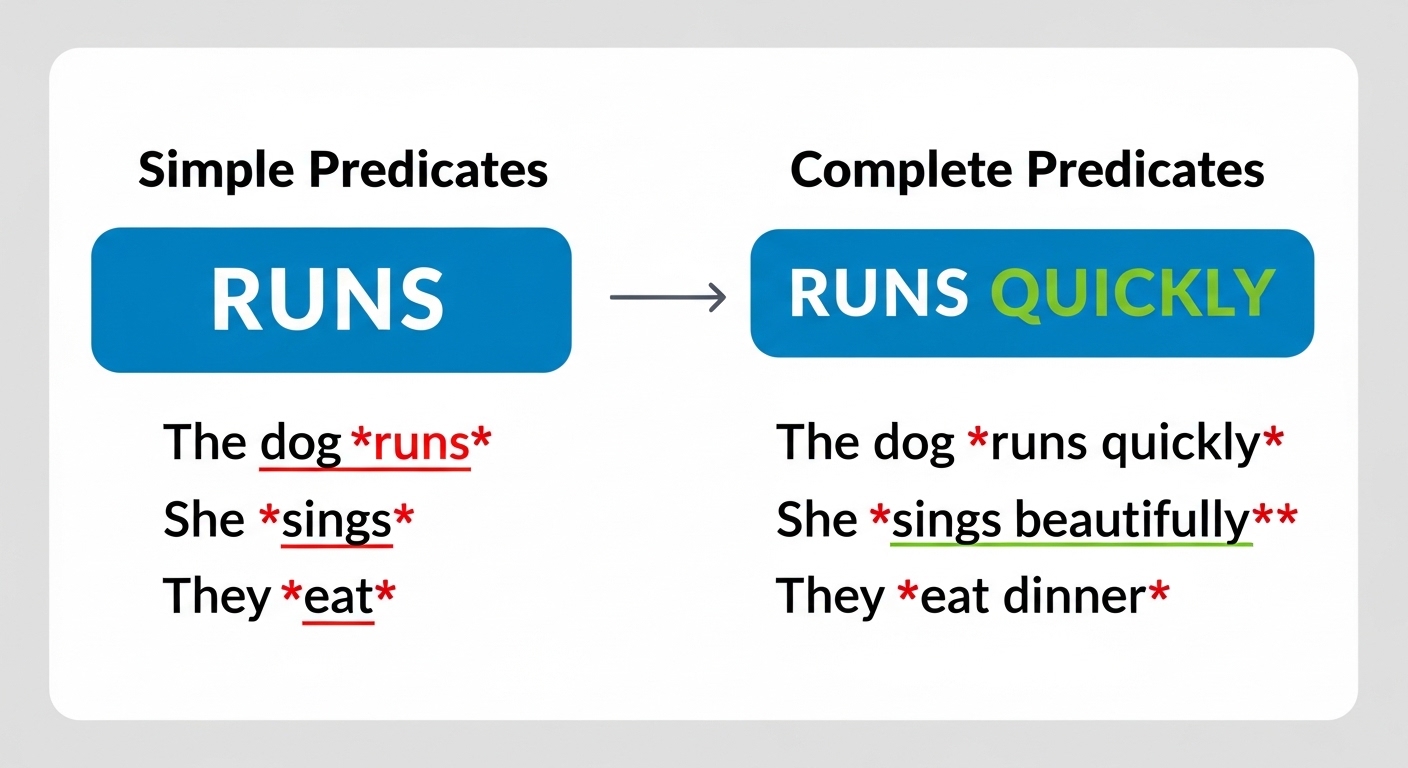
There’s something almost… enchanting about how words gather together, isn’t it? Like when you see a tiny taxi-driver zooming past on a rain-slick street, or an injured player limping off the field, you instinctively know who’s doing what, even before parsing the full sentence in your mind.
That’s the invisible magic of simple predicates and complete predicates the unseen engines of language that tell us who’s acting and what’s happening.
Today, let’s take a journey into these core grammar realms, exploring how verbs, verb phrases, modifiers, and all those wondrous parts of speech come together to form complete subjects and complete predicates, all while making it surprisingly fun and memorable.
It might seem dry on the surface like a neighborhood parched for water supplies but once you see the patterns, the connections, and the stories hiding inside parts of sentences, your understanding transforms into something almost alive.
Imagine you’re watching a winning goal unfold in slow motion: every movement, every action, every subject and predicate in harmony. That’s grammar in context, that’s sentence structure revealing its poetry.
| Feature | Simple Predicate | Complete Predicate |
|---|---|---|
| Definition | The main verb or action the subject does | The verb plus all words describing the action (modifiers, complements, phrases) |
| Focus | Action itself | Action + details about the action |
| Example Subject | Injured player | Injured player |
| Example Sentence | Injured player limps. | Injured player limps slowly across the muddy field, grimacing in pain. |
| Components | Verb (or compound verb) | Verb + verb phrases + modifiers + complements |
| Use | Identifying the core action | Showing complete meaning and context of the action |
| Tip | Think espresso shot – concentrated | Think latte layered, detailed, flavorful |
Understanding the Heart: Simple Predicate
A simple predicate is basically the heartbeat of your sentence it’s the verb (or sometimes a compound verb) that tells what the subject does. No fluff, no extra baggage. Just the action, pure and bare.
Think of it like this: the injured player limps. “Limps” is your simple predicate. That’s all it is an action performed by the subject, nothing more. Now, sprinkle in some modifiers, and you’re nudging it toward a complete predicate, but hold that thought we’ll get there.
A quirky tip for remembering: the simple predicate is like a coffee shot short, concentrated, hits the point immediately. Whether you’re making worksheets for students or producing grammar-in-context videos, identifying this little nugget first can really help reinforce understanding and solidify learning.
The Bigger Picture: Complete Predicate
Now, if the simple predicate is the shot of espresso, the complete predicate is the latte more complex, layered, flavored, carrying the story forward. It includes the verb and all the words that tell what the subject does. That’s verbs, verb phrases, modifiers, and any complements.
For example: The taxi-driver sped down the narrow street, honking at pedestrians and narrowly missing the corner café. Here:
- Simple predicate: sped
- Complete predicate: sped down the narrow street, honking at pedestrians and narrowly missing the corner café
See how much richer it is? That’s where sentence structure and mechanics & usage truly shine. In teaching scenarios, this is where memorable images and audio cues (music) in instructional videos can help learners visualize the action, giving them something to anchor their concept retention to.
Why Predicates Matter More Than You Think

Predicates aren’t just grammar fluff they’re the soul of communication. Without them, sentences would be empty shells: The neighborhood… What? Did it collapse? Did it thrive? The predicate gives life, motion, intention.
Parents often tell me, “I never realized grammar was like storytelling for everyday life.” Whether you’re drafting a congratulatory note for a baby girl, recounting a winning goal, or describing the actions performed by subject in a neighborhood story, the complete predicate paints the scene, gives color and texture.
A small anecdote: in some cultures, like parts of India, people often write elaborate blessings for newborns, weaving together multiple clauses.
One grandmother shared, “I write what she will do, what she will become, and how she’ll touch lives all in one sentence.” That’s practically an exercise in grammar instruction, combining simple predicate and complete predicate in real-life storytelling.
Breaking Down the Core Concepts
What is a Verb and Verb Phrase?
Every simple predicate starts with a verb, right? That’s the action itself: runs, sings, dances, builds. But sentences aren’t just isolated commands. The verb phrase can include auxiliary verbs, modifiers, and complements: has been running swiftly, will be dancing under the moonlight.
Using long-form videos or two-minute instructional videos can really help learners see these grammar concepts in action. Even a short slide show review with a visual cue of a taxi-driver or water supplies being delivered makes the abstract concrete.
Modifiers: The Flavor of Sentences
Modifiers sprinkle magic dust on your predicates. Adjectives, adverbs, prepositional phrases they enhance the story. For example:
- The injured player limped slowly across the muddy field.
“Slowly” modifies “limped,” giving the verb phrase more meaning, more life. Teaching aids like definition cards and worksheets can encourage students to spot these in context, reinforcing student comprehension.
Connecting to the Simple Subject
You can’t have a predicate without a subject. The simple subject names the who or what, while the complete subject may include descriptors: The tall, grumpy taxi-driver is your complete subject.
Pairing it with a complete predicate makes the sentence whole: The tall, grumpy taxi-driver honked loudly as he sped through the rainy streets.
This is where parts of sentences come alive in storytelling real-life examples like neighborhood stories or injured players give learners a hook to attach the core concepts / grammar entities to something tangible.
Read this blog: https://marketbellione.com/simple-subjects-and-complete-subjects/
Crafting Sentences Like a Storyteller
Understanding predicate, simple predicate, and complete predicate is one thing. Using them creatively? That’s where it gets fun.
Using Humor
- The taxi-driver screamed at the pigeons and spilled coffee everywhere pure chaos in a complete predicate package.
- My cat sleeps, dreams of world domination, and occasionally steals socks from my neighbor who knew a simple predicate could be so funny?
Poetic Flair
- The water supplies danced along the riverbank, glinting in the morning sun.
- A winning goal flew like a comet across the pitch, leaving defenders frozen in awe.
Inspirational Spin
- The injured player fought pain, embraced recovery, and inspired the entire team every verb shining in the complete predicate.
- In classrooms, actions performed by subject can remind us all: even small steps are mighty when done consistently.
By mixing tones like these, you’re helping students or readers grasp sentence parts intuitively while also enjoying the process a kind of interactive learning where concept retention is natural.
Creative Teaching Tools for Predicates
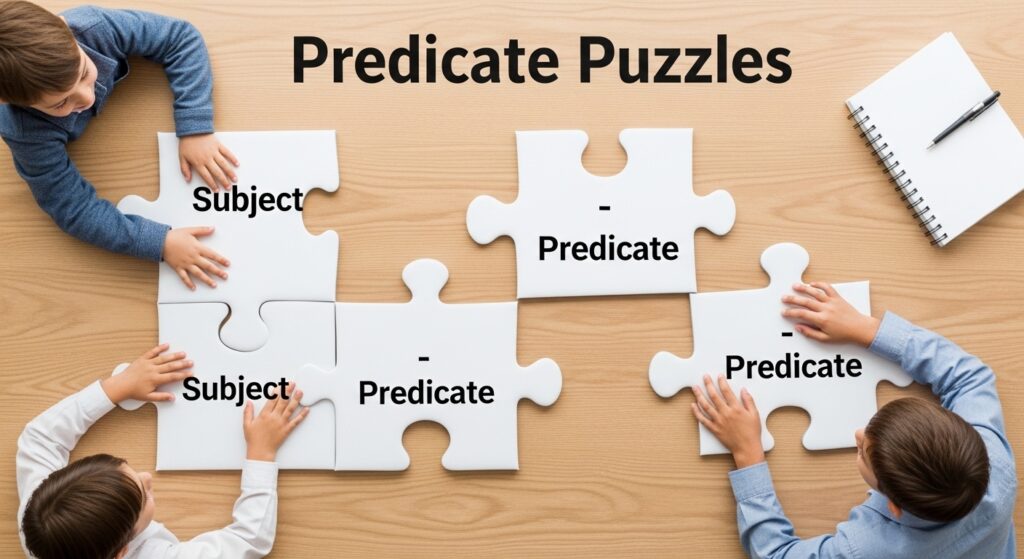
You don’t have to just lecture. Platforms like GrammarFlip, Spotify, Apple (Music), and Amazon (Music) can be unconventional aids:
- Pairing short-form videos with audio cues (music) for verb recognition
- Using worksheets with mini-stories: The taxi-driver delivered water supplies to the neighborhood before breakfast. Identify simple and complete predicates.
- Long-form videos for deep dives into sentence structure
- Slide show reviews for visual reinforcement
Each tool reinforces grammar instruction, individualizes student learning, and builds a foundational knowledge that sticks.
Practical Application: Writing Your Own Sentences
Here’s a fun exercise to solidify your learning: take any subject and pair it with a simple predicate first, then build a complete predicate with modifiers:
- Subject: Injured player
- Simple predicate: limps
- Complete predicate: limps slowly across the muddy field, grimacing but determined to reach the goal
- Subject: Taxi-driver
- Simple predicate: honks
- Complete predicate: honks impatiently at the red light, gesturing wildly at distracted pedestrians
This mirrors real-life mechanics & usage, helping learners connect grammar rules with storytelling, humor, and observation of everyday life.
Advanced Tips: Making It Memorable
- Combine visual association with audio cues: see a pigeon, hear a horn, identify the predicate
- Create definition cards with examples: “Predicate = tells what the subject does”
- Build interactive learning activities where students craft mini-stories using simple predicates and complete predicates
The more senses you involve, the better the learning reinforcement and memorability / retention.
Frequently Asked Questions
Simple Predicate
A simple predicate is the main verb or verb phrase in a sentence that tells what the subject does.
Complete Predicate
A complete predicate includes the main verb along with all its modifiers, describing everything the subject does.
What is a Simple Predicate
It is the single word or verb phrase that expresses the action of the subject without any additional details.
What is a Complete Predicate
It consists of the main verb plus all words that describe or modify the action performed by the subject.
Complete Predicate Examples
Examples include: “The taxi-driver drove very quickly through the neighborhood,” and “Our team’s injured player scored the winning goal.”
Conclusion: The Beauty of Grammar in Life
Understanding simple predicates and complete predicates isn’t just about rules. It’s about seeing the actions performed by subject, the motion, the drama, and even the humor in every sentence.
Whether you’re writing baby girl congratulations, recounting a winning goal, or narrating how a taxi-driver saves the day, these grammar entities are your storytelling engine.
So next time you’re crafting a sentence, pause and ask: Who is the subject? What is the verb? What makes this predicate complete? Then watch as your words bloom into something vivid, memorable, and alive.
The neighborhood of your mind is filled with life, the water supplies of your imagination flowing freely, and every sentence you write carries the potential to inspire, amuse, or teach.
And remember: grammar isn’t just mechanics & usage. It’s poetry hiding in parts of speech, magic in sentence structure, and a playground where verbs, verb phrases, and modifiers dance together. Master it, and every story big or small becomes unforgettable.
Now grab a pen, a keyboard, or a voice recorder, and start noticing the actions performed by subject around you. Your core concepts / grammar entities are waiting for their next adventure.