
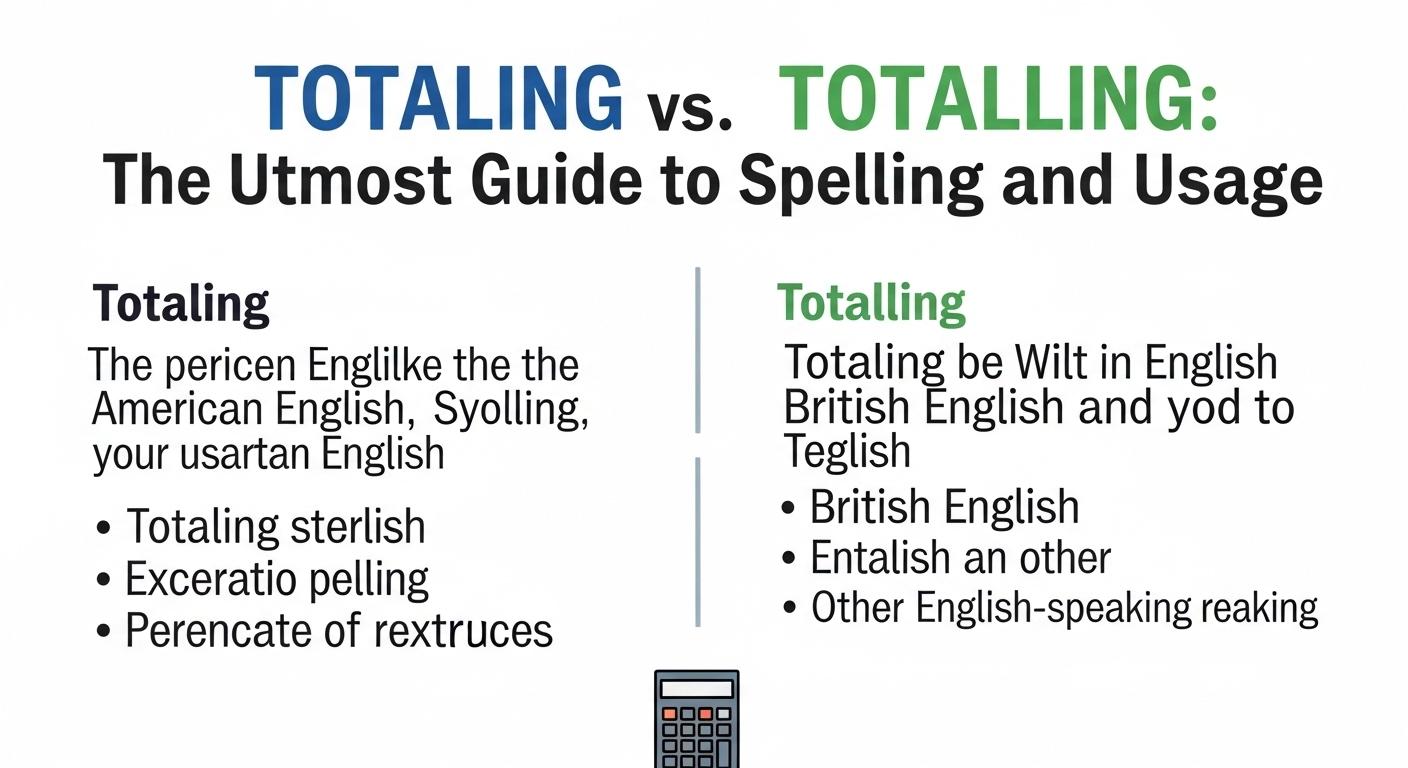
English, as we all kinda know, is a sneaky little critter. You think you’ve got it figured, and then bam two spellings, same meaning, slightly different vibes. “Totaling” and “totalling” are the perfect microcosm of this.
One whispers American English vs. British English, the other shouts it from the rooftops, waving style guides and dictionaries like flags. But don’t worry, we’re gonna unpack this in a way that’s… well, messy, human, but totally enlightening.
Ever noticed how language feels like a living diary of culture? Just like baby girl congratulations messages morph depending on where you are, spelling adapts depending on your country, your digital keyboard, and sometimes, just your mood.
Today, we’ll explore why “totaling” might feel clean and crisp to an United States accountant, while “totalling” fits snug in a United Kingdom finance report.
And we’ll sprinkle in some genuine, heartwarming insights from people who actually use these words because language isn’t just rules, it’s life.
| Feature | Totaling | Totalling |
|---|---|---|
| Region | United States, American English | United Kingdom, Australia, New Zealand, India (British-influenced) |
| Spelling Rule | Simplified, single ‘l’ | Double final consonant following British rule |
| Style Guides | Merriam-Webster, Chicago Manual of Style (US) | Oxford English Dictionary (OED), The Economist Style Guide, BBC News |
| Usage Context | Finance, accounting, technology, digital platforms (US) | Finance, accounting, formal writing, education (UK/Commonwealth) |
| Verb Form | Present participle of “total” | Present participle of “total” |
| Phonetics | Stress on first syllable, simplified | Stress on first syllable, doubles consonant for orthography |
| Synonyms / Related | Summing up, tallying, counting, tabulating, aggregating, computing | Same as above, just British spelling |
| SEO / Digital Impact | Preferred in American audiences, platforms, US websites | Preferred in UK/Commonwealth audiences, formal publications |
Why Spelling Choices Matter
Alright, so here’s the thing spelling isn’t just about letters lining up in some boring dictionary. It’s cultural, emotional, and yes, sometimes political. When you write totaling expenses in the United States, it’s as natural as sipping a latte while your email ding sounds.
In Canada, though, you might see either version, depending on the editor’s mood or the publication’s style. Meanwhile, in Australia, “totalling” gets a polite nod, because the doubling consonants rule is still alive and kicking.
Noah Webster American lexicographer, author of An American Dictionary of the English Language (1828) famously simplified a lot of English spellings to make reading faster, less fussy. Hence, “totaling” loses the extra ‘l’.
Across the pond, the Oxford English Dictionary (OED) and the Chicago Manual of Style often prefer the double consonant especially when you stress the syllable before the ending. It’s subtle, but if you ignore it in formal writing, editors will notice. Trust me, I’ve been there.
Totaling vs. Totalling in Everyday Life
So, when do we even use these words? Basically anywhere you’re summing up, tallying, counting, tabulating, aggregating, or computing.
In finance / accounting, it’s the bread and butter. Imagine a spreadsheet full of earnings and repairs. One click, one formula, and bam you’re totaling profits or totalling evidence.
In tech and software, especially American-influenced platforms, “totaling” reigns supreme. Check any US-based app for calculating the total of hours or expenses, and you’ll see that single ‘l’ everywhere. In contrast, if you’re reading a UK manual for the same app, it’ll often insist on “totalling,” which just feels… proper.
Here’s a quirky anecdote: a friend of mine in India recently wrote an international business report, switching between “totaling” and “totalling” depending on whether the clients were in Canada, Australia, or the United States. He said it felt like juggling cultural identities, and honestly, isn’t that what English is these days? A global tango of letters.
How Style Guides Influence Spelling
Let’s geek out a little. If you peek into the Merriam-Webster, they’ll give “totaling” as the main entry. Simple, American, efficient. Flip over to the The Economist Style Guide or the BBC News UK broadcaster manual, and suddenly it’s “totalling,” double-l, because British orthography still loves a good consonant double.
This matters more than you think. Imagine writing for The New York Times US newspaper versus The Guardian – UK newspaper. One expects American simplification; the other expects traditional doubling.
And in digital content optimization, this choice can subtly affect SEO: yes, Google indexes differently, and local audiences subconsciously trust the spelling they’re used to.
Linguistic Norms and Conventions
Here’s where it gets juicy: the stress on syllables in English affects whether you double the consonant. “Total” as a verb? Stress falls on the first syllable, so American simplification drops the extra ‘l’. British orthography, following older medieval Latin ‘totalis’ rules, doubles it to preserve the phonetic integrity when adding -ing.
This isn’t just academic. Writers, teachers, accountants, software developers, and anyone blogging internationally need to care. And thanks to AI autocorrect and global digital communication influence, even your phone might auto-change your “totaling” to “totalling,” or vice versa, depending on location.
Totaling Wishes: A Creative Twist

Let’s bring this back to heart and warmth language is about communication, and nothing communicates joy like welcoming a newborn. Just like we debate spellings, we also debate the perfect way to say baby girl congratulations.
Warm & Heartfelt Wishes
- Wishing you a bundle of joy that makes every “totalling up” of sleepy nights worth it.
- May your little girl grow up adding laughter to every corner of your home, like a living, breathing total of happiness.
- Sending love that multiplies, just like your heart will after welcoming her.
- May each day with your daughter be a totaling of tiny wonders and big hugs.
- Congratulations on your new little accountant of giggles and kisses!
Humorous & Light-Hearted Messages
- Get ready for midnight snack runs and diaper tallies it’s a full-time totalling job now!
- She’s here to disrupt your spreadsheets and totaling strategies welcome to parenthood chaos.
- Warning: Cuteness levels may total beyond safe limits.
- Sleep is now a mythical concept, but laughter? That’s totalling up fast.
- Who knew tiny socks could cause such big messes? Total chaos = total love.
Poetic & Inspirational Sentiments
- Her first cry is a note in your life’s symphony, totalling beauty in echoes.
- Tiny fingers, endless dreams the sum of miracles is now tangible in her little hands.
- May she grow fearless, compassionate, and always curious, a totaling force of goodness.
- Like stars tallying the night sky, may your moments with her multiply into constellations of memories.
- She is the arithmetic of love, totalling beyond what numbers can hold.
Personalized & Adaptable Notes
- Insert her name, and suddenly every “totaling” of joy becomes a personal story.
- For multicultural families: highlight the differences in celebrations India, New Zealand, Australia how gifts and rituals differ but love remains the same.
- Grandparents’ perspective: “Every laugh she makes totals up the years of wisdom we hoped to pass on.”
Cultural Anecdotes
- In Canada, some families create small “totalling jars,” counting tiny milestones in her first year.
- In Australia, parents might use the phrase “totaling the first year’s adventures” in scrapbooks, embracing British spelling.
- Indian families often recount stories of how each newborn’s arrival is celebrated across regions, totaling up blessings from neighbors and relatives.
Practical Advice: Making Wishes Personal

Here’s the kicker all the spellings in the world mean nothing if the message isn’t personal. To customize your baby girl congratulations, consider:
- Using nicknames or special traits of the baby.
- Adding a funny anecdote from the parents’ life.
- Combining cultures, like a totalling of traditions, especially if the family has roots in multiple countries.
- Using your spelling preference consciously American or British to match your audience or platform.
Digital messages? Emojis are your friends. Nothing sums up joy like a sparkling ✨ or a little 👶. Physical cards? Handwriting adds warmth no style guide can dictate.
Frequently Asked Questions
totalling or totaling
Both are correct; use “totaling” for American English and “totalling” for British English.
totaling vs totalling
The difference lies in regional spelling conventions: American English prefers totaling, British English prefers totalling.
totaling or totalling
Choose based on your audience: totaling for US readers, totalling for UK or Commonwealth readers.
spell totaling
American English spelling: totaling with a single “l” in the present participle.
spell totalling
British English spelling: totalling with double “l” in the present participle.
Read this Blog: https://marketbellione.com/yfm-in-texting-decoding-the-digital-shorthand/
Conclusion: Language, Love, and the Joy of Totals
So, “totaling” or “totalling”? Context, audience, and tradition decide. But the beauty of it isn’t just in the letters it’s in the act of summing up feelings, experiences, and life itself. Just like welcoming a baby girl is more than a biological event, spelling is more than a rule: it’s identity, culture, and love in written form.
Next time you calculate the total of your thoughts, or total repairs in your budget, remember: language evolves, digital autocorrect interferes, but your genuine touch, your warmth, your intent that’s timeless. And when you wish someone a baby girl well, the letters matter less than the heart behind them.
So go ahead, pick your spelling, craft your message, and maybe share a story of your little ones, your “totalling adventures,” or a cultural twist you love. Because in the end, every heartfelt word is a sum of joy, perfectly totaled across hearts everywhere.