
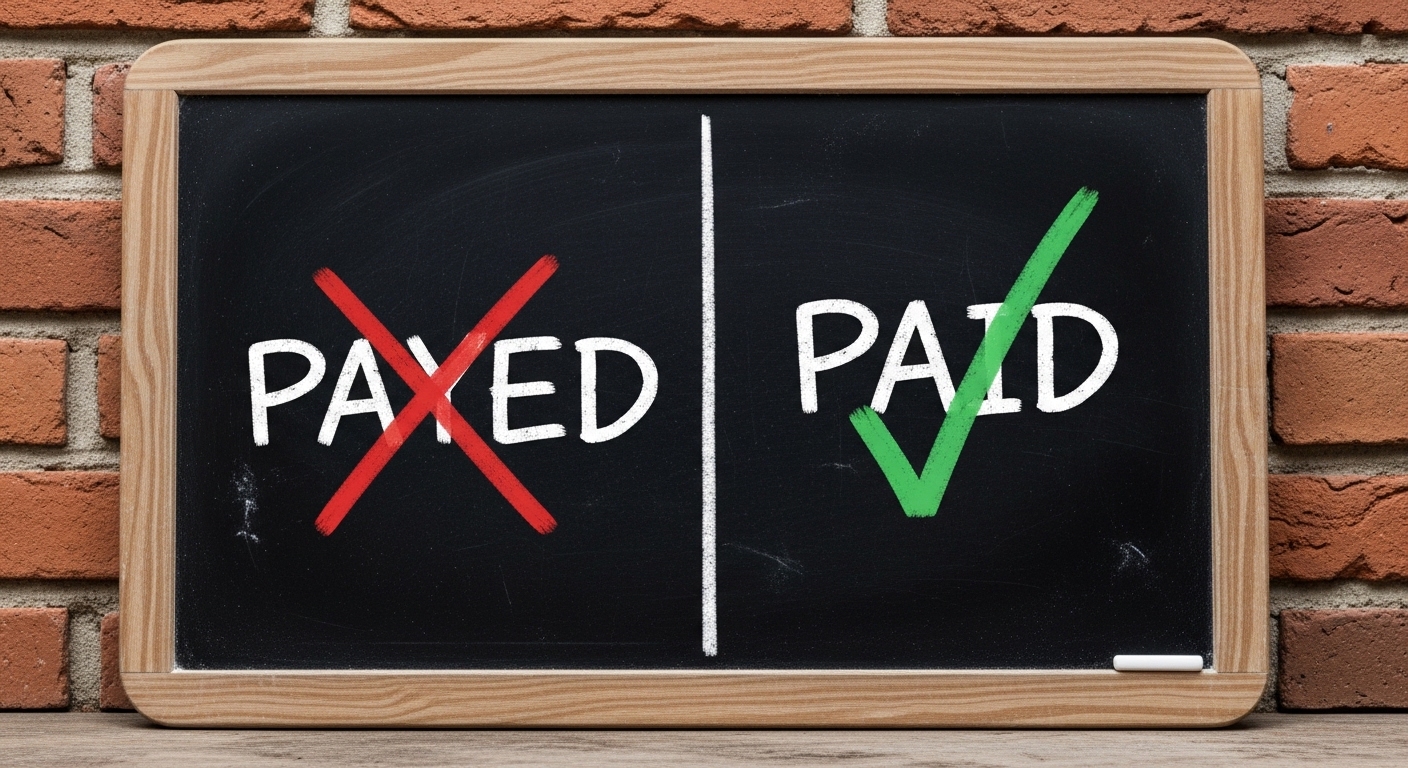
There’s this odd moment that happens to almost everyone who writes English, even the people who think they’ve got it all figured out. You’re typing fast, maybe half thinking about dinner or a message you forgot to reply, and suddenly your brain hesitates: is it payed or paid? You stare at it like it personally offended you a bit. Then you guess. And sometimes… you guess wrong, no shame really.
This tiny confusion sits in that weird corner of English where spelling meets history, and grammar rules quietly argue with old language habits. The phrase Payed vs Paid looks simple on surface, but underneath it hides layers of verb conjugation, irregular grammar behavior, and even nautical history that most people never expect. It’s not just about writing correctly, it’s about understanding why English behaves like it sometimes forgot its own rules, honestly.
And yeah, even fluent speakers slip. Someone might payed attention in a sentence and not even notice it, which is why this topic stays alive in ESL classrooms and grammar forums forever.
| Feature | Paid | Payed |
|---|---|---|
| Word type | Irregular verb form of pay | Rare verb form of pay |
| Correct usage (modern English) | ✔ Yes (standard English) | ❌ No (almost always incorrect) |
| Meaning | To give money, settle a bill, compensation, or completion of action | To let out rope/chain (nautical context only) |
| Grammar form | Past tense + past participle of Pay (verb) | Rare past tense of pay in maritime usage |
| Common usage | Financial transactions, jobs, bills, results, expressions like “paid off” | Sailing, rope handling, anchor chain control |
| Example | I paid the bill yesterday. | The sailor payed out the rope. |
| Everyday English | ✔ Very common | ❌ Not used |
| ESL note | Correct form to always use in writing | Often mistaken spelling of “paid” |
Payed vs Paid: Why This Confusion Happens in English Language Usage
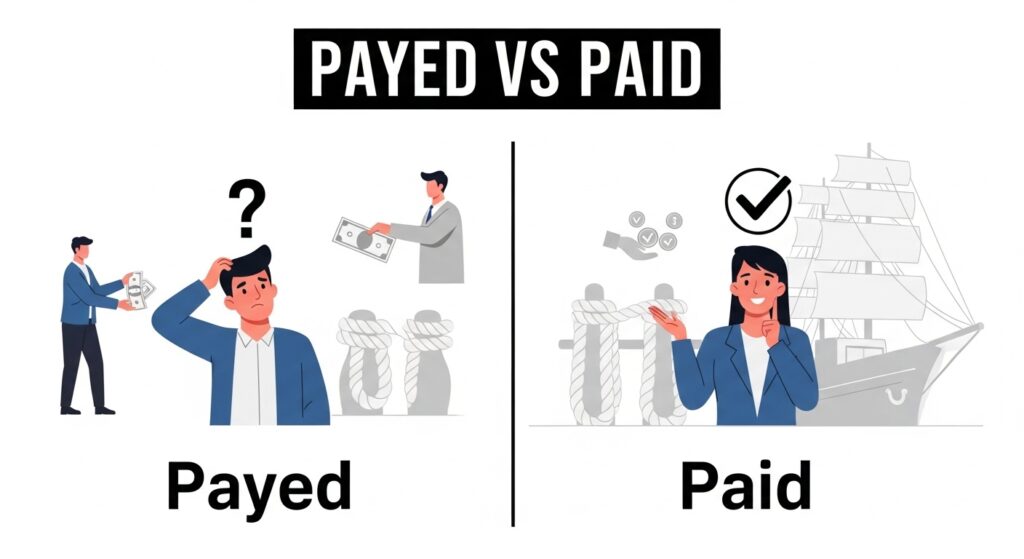
The confusion between Payed vs Paid usually starts with how English mixes regular verb patterns with irregular verb exceptions. Most verbs in English are kind of polite they follow a predictable system. You add “-ed” and boom, past tense done. But pay is not that cooperative guest at the grammar party.
The verb Pay (verb) becomes Paid (past tense / past participle of “pay”), not payed. That alone breaks the expectation pattern for many learners who assume English is always logical (it really isn’t, lol).
So when someone writes “I payed the bill,” it feels correct because it follows the regular structure. But grammatically, it’s a spelling variation / spelling error in standard usage. The correct form is “I paid the bill,” even if your fingers sometimes disagree.
This confusion also grows because English has many commonly confused words where pronunciation doesn’t match spelling history. People hear /peɪd/ and assume there must be a “y” in there somewhere, like “played” or “stayed.” But nope, English decided to be unpredictable again.
And funny thing, even autocorrect sometimes lets it slip, which makes learners more confused than they started.
Payed vs Paid in English Language Usage and Grammar Rules
When we talk about Payed vs Paid, we’re really talking about how English language usage handles irregular verbs. The word “pay” belongs to a group of verbs where the past tense form is not formed by simply adding -ed. Instead, it changes internally.
So we say:
- I pay today
- I paid yesterday
- I have paid already
Notice how paid works as both past tense and past participle usage. That dual role is important in grammar because it connects with perfect tenses and passive voice structures.
Now here’s where people trip: they think “payed” should exist because English sometimes allows -ed forms everywhere. But in standard grammar rules, it does not.
Still, “payed” does exist but not where most people think.
In rare cases, especially in older or technical contexts, payed appears, which we’ll get into soon. But for now, just remember: in everyday writing, correct spelling of paid is always paid, no debate.
Even teachers sometimes say: if you’re unsure, trust paid, it rarely betrays you.
Paid (Past Tense / Past Participle) and Its Everyday Power

The word Paid (past tense / past participle of “pay”) carries a lot more weight than people realize. It doesn’t just mean money exchanged. It represents closure, completion, sometimes even emotional release.
We use it in financial situations like:
- paying bills
- settling debts
- receiving salary or compensation
But also in broader life meanings:
- “hard work paid off”
- “they paid attention during the lecture”
- “someone paid the price for mistakes”
Here paid becomes almost symbolic, not just grammatical.
It also functions as an adjective form (“paid” as adjective) in expressions like:
- paid vacation
- paid employment
- paid services
In these cases, it modifies nouns and describes a status, not an action. That’s a subtle shift many learners miss when studying English grammar rules.
So yeah, paid is not just a past action word it’s a multi-functional grammar tool quietly doing heavy lifting in sentences.
Payed vs Paid in Nautical Terminology and Rare Usage
Now here comes the twist that surprises almost everyone. The word Payed vs Paid isn’t only about grammar mistakes it also has a maritime life.
In nautical terminology, payed is actually correct in very specific contexts. It comes from marine operations, especially when handling ropes or anchor chains.
For example:
- “The sailor payed out the rope slowly into the water.”
Here, Payed (rare nautical verb form) means letting out rope or chain in a controlled way. It’s part of rope and chain handling, not money at all.
This connects with seaworthiness and ship control, where precision matters. You might also hear:
- Pay out rope meaning in sailing instructions
- Anchor chain usage during docking
- Even waterproofing / tar coating boats in older maritime descriptions involving “paying” seams with tar
So yes, payed is not wrong in that universe. It just doesn’t belong in your email about rent or exams.
It’s one of those beautiful language oddities where meaning depends entirely on context. A single word can live two completely separate lives, like it forgot to introduce itself properly.
Commonly Confused Words and ESL Grammar Tips
Learners often struggle with common English mistakes, and Payed vs Paid sits right near the top of that list. ESL students especially get trapped because pronunciation hides the difference.
A big issue is overgeneralization. If learners see:
- played
- stayed
- prayed
They assume:
- payed
But English is full of exceptions, and pay is one of them.
Another related confusion appears in phrases like:
- “paid attention vs payed attention correct form” → only paid attention is correct
- “payed attention” is considered incorrect in standard usage
This falls under ESL grammar tips where memorization helps more than logic sometimes, sadly.
Teachers often suggest learning it as a fixed irregular verb:
- pay → paid → paid
No shortcuts, no patterns to rely on. Just memory.
Still, once you internalize it, it becomes automatic. Like muscle memory for writing.
Financial Transactions and Paid Meaning in Real Life Usage

In daily life, financial transactions are where paid shows up the most. Every time you:
- pay a bill
- settle payment
- receive salary
You’re using this verb family in action.
The word connects strongly with financial compensation, whether in jobs or services. For example:
- paid position meaning a job that offers salary
- paid vacation benefits provided by employers
- paid services in digital subscriptions or consulting
In all these, Paid (past tense / past participle of “pay”) signals completion of exchange.
It also appears in emotional expressions like:
- “paid the price” (consequences of actions)
- “what does paid off mean in English” (success outcome after effort)
So here, paid expands beyond money into results, consequences, and rewards.
Language really loves stretching meanings like that, it kind of refuses to stay in one box.
Payed vs Paid in Phrasal Verbs and Everyday Expressions
When we explore phrasal verbs in English, pay becomes even more interesting.
Take:
- pay off → success or debt completion
- “All his studying paid off in exams.”
- pay out → to distribute money or release rope (context matters a lot here)
- pay attention → focus carefully on something
These expressions shift meaning depending on context, which is part of semantic distinction in linguistics.
For example:
- “The investment paid off” (success)
- “The company paid out dividends” (financial distribution)
- “Please pay attention” (focus instruction)
But never:
- “payed attention” ❌
That one stays incorrect in modern English language usage, no matter how it looks.
It’s interesting how a small verb like pay can stretch across finance, emotion, learning, and even nautical life. Not many words do that honestly.
Examples of Payed vs Paid in Real Sentences
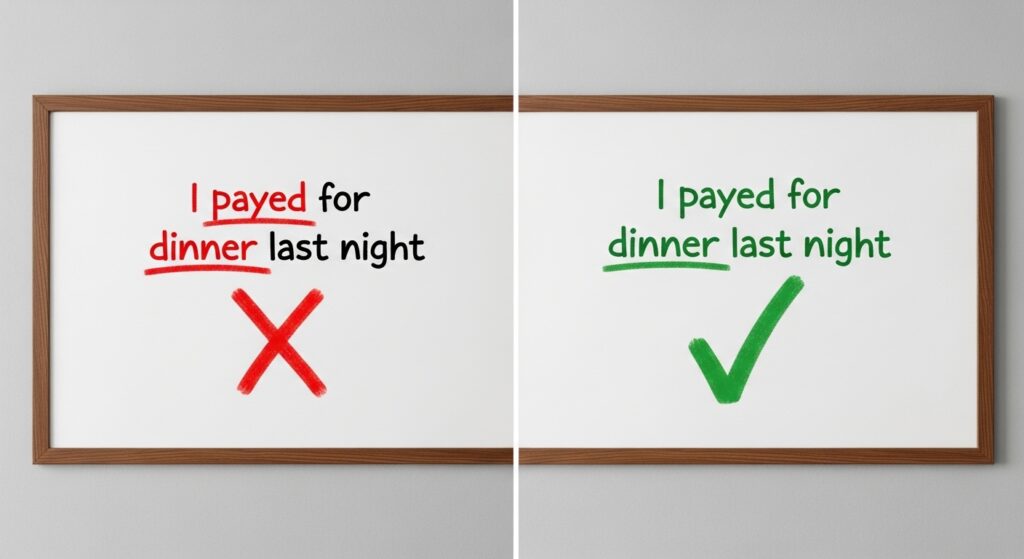
Let’s make things clearer with word usage examples, showing both correct and incorrect forms:
- I paid the electricity bill yesterday and finally relaxed a bit after that
- She has paid all her fees before the deadline, no stress now
- They paid attention during the lecture even though it was kinda boring
- His hard work paid off when he passed the exam with good marks
- The sailors payed out the rope carefully during the storm (nautical context only)
- Incorrect: I payed the rent last night (should be paid)
- Incorrect: He payed attention in class (should be paid attention)
These examples highlight how irregular verbs in English behave differently depending on context, and how one small spelling change can shift correctness completely.
Frequently asked Questions
payed
“Payed” is rarely correct in modern English and is mainly used in nautical contexts, such as letting out rope or applying waterproof coating to a boat.
payed vs paid
“Paid” is the correct past tense of “pay” in almost all situations, while “payed” is only used in specific marine-related meanings.
paid or payed
Use “paid” when referring to money, bills, or consequences, as it is the standard and correct form in English.
payed or paid
“Paid” is correct in general usage, while “payed” is only used in specialized nautical contexts and is very uncommon.
paid vs payed
“Paid” is the standard past tense of “pay,” whereas “payed” is limited to rare nautical meanings like handling ropes or waterproofing boats.
Read this Blog: https://marketbellione.com/navy-blue-color-meaning/
Conclusion: Understanding Payed vs Paid without overthinking it too much
At the end of the day, the difference between Payed vs Paid is not just about spelling it’s about understanding how English carries history inside its grammar.
One word belongs to modern everyday usage, the other survives in specific nautical vocabulary that most people never encounter unless they’re on a ship or reading old manuals.
The irregular nature of Pay (verb) reminds us that English is not always logical, sometimes it just evolved in messy, human ways. And that’s okay, honestly.
If you remember anything, remember this simple anchor:
- Paid = correct for money, actions, results, and everyday English
- Payed = rare, mostly nautical rope/chain usage
Everything else is just practice and exposure.
And if you ever mix them up again, don’t stress too much. Even fluent speakers slip, and language is more about communication than perfection anyway.
If you want to make this knowledge stick, try noticing paid vs payed examples in sentences while reading books, captions, or even random posts online. You’ll start spotting patterns without even trying.
Feel free to share your own confusing grammar moments or examples—you’d be surprised how many people still debate this tiny word in comments, forums, and classrooms all over the world.