
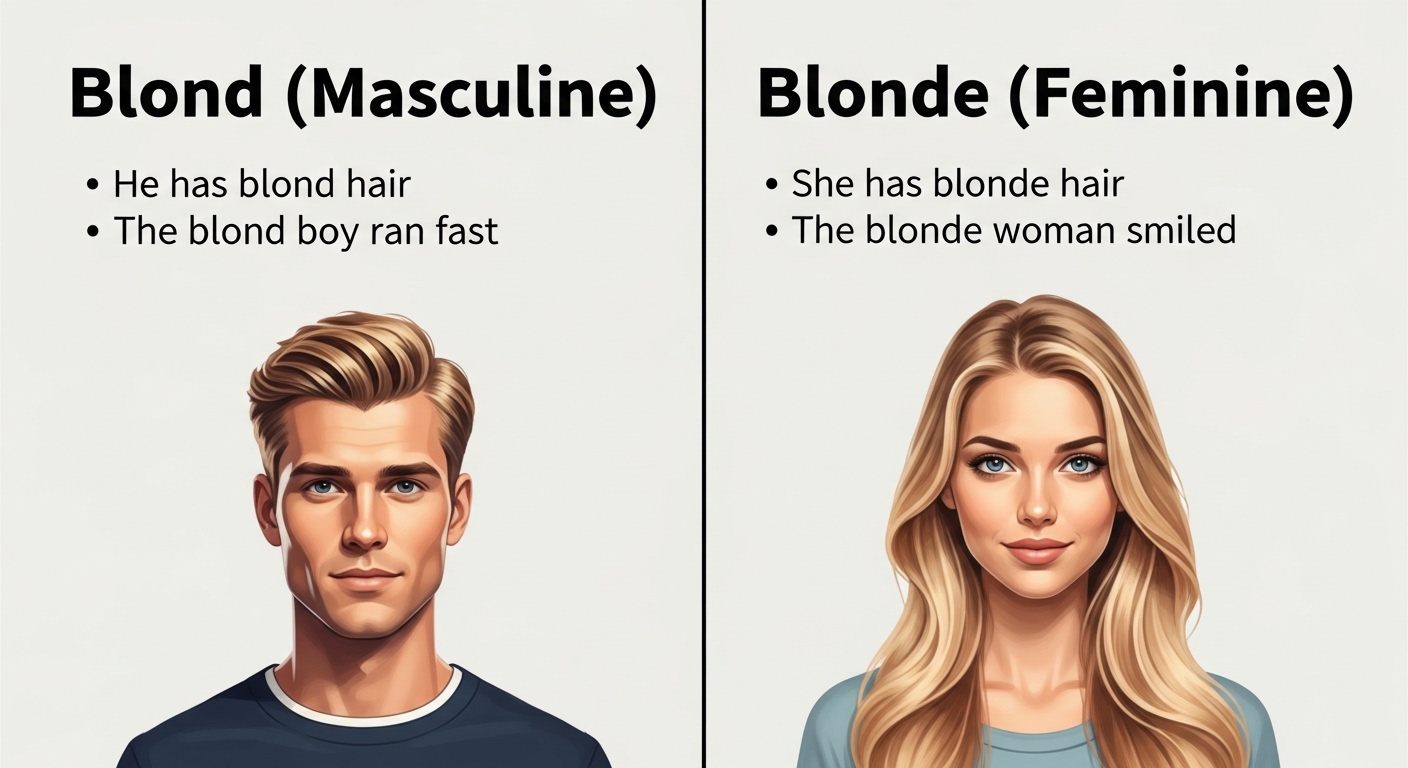
There are moments in English language usage when a tiny thing, like just an “e” hanging at the end of a word, suddenly becomes a whole personality debate. Blond vs Blonde is exactly that kind of linguistic drama, quiet but also kinda loud if you stare at it long enough.
One letter, yet it shifts tone, gender perception, and even stylistic mood in writing. Strange, right? Like how language sometimes behaves like it has moods of its own.
I remember once reading a magazine where someone described a character as “a blonde” and then in the next line called the same person “blond hair” and my brain just paused for a second, like it tripped over its own shoelaces.
That’s the messy beauty of blonde / blond spelling variation, it feels simple but carries hidden rules underneath. Not always obvious ones either.
Writers, editors, and even casual texters sometimes stumble here because English language usage doesn’t always stay consistent across regions or style guides. And when you throw in gendered language usage, things get even more twisty.
But don’t worry, we’ll walk through it in a way that feels more like a conversation than a grammar lecture from school that nobody asked for.
Some people even say tools like QuillBot AI writing tools or citation generator tool help them stay consistent, but honestly, even without tech help, once you “feel” the rule, it kinda sticks weirdly well. Let’s explore it all step by step, slightly imperfectly, like real writing in the wild.
| Aspect | Blond | Blonde |
|---|---|---|
| Basic meaning | Light yellow/light brown hair | Light yellow/light brown hair |
| Grammar role | Mostly adjective | Adjective + noun |
| Gender usage | Gender-neutral (modern usage) | Traditionally feminine |
| Example (adjective) | He has blond hair | She has blonde hair |
| Example (noun) | Rare as a noun | “She is a blonde” |
| Modern usage | Preferred in many style guides for all genders | Still common in informal writing |
| Style guides | Often simplified to “blond” for consistency | Used when keeping gender distinction |
| Tone implication | Neutral, technical | Slightly traditional or descriptive |
Blond vs Blonde: The Spelling Variation Story in English Language Usage
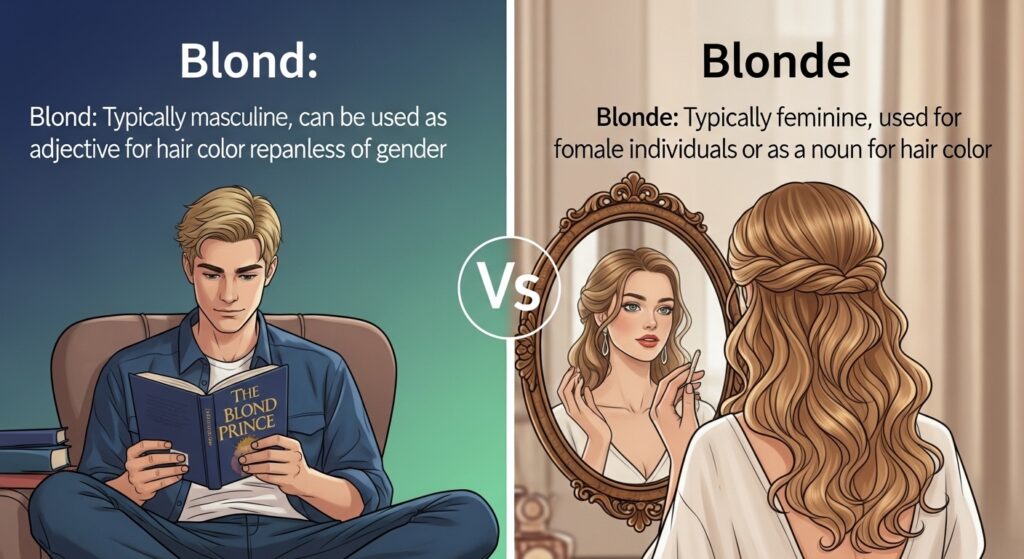
At the heart of it, Blond vs Blonde is a classic case of orthographic variation (blond vs blonde spelling differences). English borrowed the word from French, where gendered endings matter.
So we ended up with “blond” and “blonde,” both referring to light yellow hair or sometimes even light brown hair shade, depending on context and perception.
In modern English usage rules, especially in American writing, things are slowly becoming more flexible, but traditions still linger like old furniture in a room nobody wants to throw away.
Here’s how the variation behaves in real linguistic life:
- Blond is often used as a gender-neutral spelling adjective, especially in modern editorial writing
- Blonde traditionally refers to feminine usage, especially when describing a woman
- Some style guides prefer “blond” for adjective forms and “blonde” as a noun
- British writing sometimes keeps the French-style distinction more alive than American writing
- In casual writing, people mix both without even noticing, which breaks writing consistency guidelines a bit
- In strict editorial guidelines, consistency matters more than preference
- The word shifts meaning slightly depending on whether it’s acting as an adjective or noun
- Some publications now avoid gender marking entirely, reflecting evolving modern English usage rules
A linguist once noted (I might be paraphrasing slightly messy here), “Language doesn’t decide once and stay still; it keeps renegotiating itself with society.” That’s exactly what happens with blond vs blonde usage examples, they keep shifting depending on tone and audience.
Blond vs Blonde Usage Examples and Sentence Examples (blond/blonde usage)
Now let’s make it more practical, because theory alone feels like eating dry toast without tea. The real understanding of hair color description comes from seeing it inside sentences that breathe a little.
Below are real-style sentence examples (blond/blonde usage) showing how writers might naturally use both forms:
- She had blonde hair meaning soft golden waves that caught light like morning dust in air
- He was a blond teenager with messy curls and always slightly tired eyes
- The movie character was described as “a mysterious blonde”, which added to her aura
- His light blonde hair description made him stand out in the crowd like a pale spark
- The stylist recommended a platinum-blond / platinum-blonde look for a sharper aesthetic vibe
- I saw a boy with blond hair spelling rules ignored completely in the signboard, just “blonde boy” written casually
- She wasn’t just “a blonde,” she was a whole story walking through the room, honestly
- The fashion magazine used gender-neutral spelling blond throughout the article for consistency
- That character’s blonde vs blond usage examples shifted depending on whether she was being described or identified
- He joked that even his shampoo ad got confused about whether he was blond or blonde, lol awkward but funny
Notice how context changes everything. The same human, same hair, but language flips depending on role, tone, and sometimes just editorial mood swings.
Gendered Language Usage in Blond vs Blonde (adjective “blonde”, noun “a blonde”)
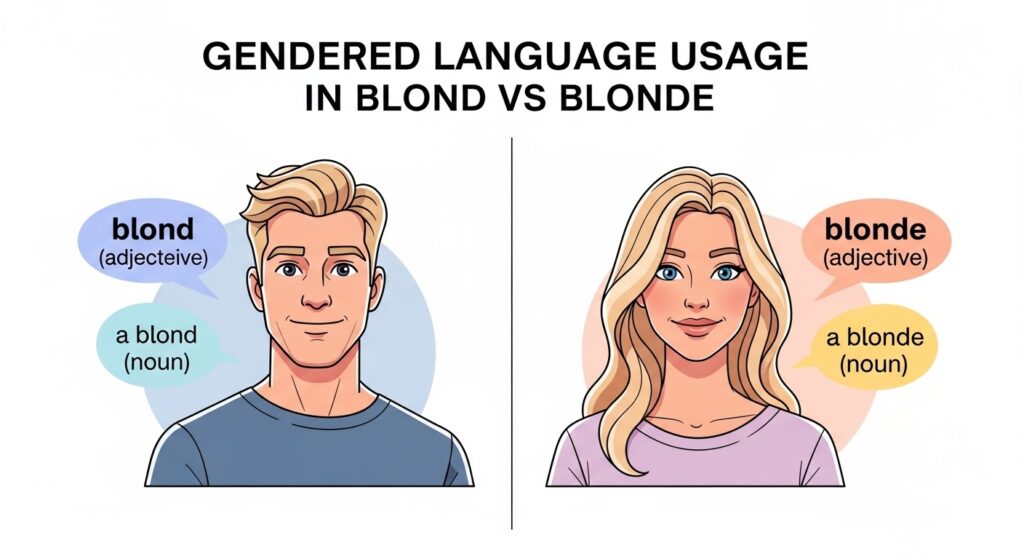
Now this is where things get slightly more sensitive and interesting. The idea of gendered language usage in Blond vs Blonde carries both linguistic and cultural weight. In traditional grammar, “blonde” as a noun often refers to a woman, while “blond” as an adjective can describe hair regardless of gender.
But language is not just grammar rules, it also carries social framing. Calling someone “a blonde” can sometimes unintentionally reduce a person to just a physical trait, which ties into objectifying language usage blonde noun discussions in modern linguistics.
Let’s break down usage patterns:
- The adjective “blonde” describes hair color without necessarily labeling identity
- The noun form “a blonde” can feel reductive depending on context
- Some writers avoid noun usage to maintain stylistic sensitivity in writing
- Modern publications prefer copywriting consistency over gendered labeling
- The shift reflects broader evolution of language norms
- Academic discussions often highlight gender marking in language as socially constructed
- In casual speech, people still use “a blonde” without thinking twice
- Editorial teams may revise such usage under professional writing guidelines
There’s a small but important cultural shift happening here. As one writing coach once said (in a workshop I half-attended and half-daydreamed through), “Words don’t just describe people, they also frame how people are seen.” That hits harder than expected sometimes.
Commonly Confused Words & Style Guides: Writing Consistency Rules
Now, Blond vs Blonde sits comfortably in the club of commonly confused words English writers struggle with. Not because it’s hard, but because it’s inconsistent across systems. That’s where style guide spelling rules come in, trying to bring order into the chaos.
Different organizations handle it differently:
- AP Style in journalism often prefers blond for both adjective and noun (simplified consistency)
- Some literary editorial standards English writing preserve gender distinction
- Academic writing sometimes leans toward traditional French-based differentiation
- Digital platforms often follow internal writing consistency rules
- Brands care more about copywriting best practices than linguistic purity
- Inconsistent usage can affect product description writing tips in marketing
- Even automated tools like QuillBot writing tools sometimes flag inconsistency
The interesting thing is that consistency often matters more than correctness. If you pick one system and stick to it, readers rarely complain.
Blond vs Blonde in Product Descriptions, Marketing Text Conventions & Everyday Objects
Now here’s a slightly unexpected twist: language like blond vs blonde spelling variation even shows up outside human description. It appears in product descriptions and branding contexts more than you’d think.
For example:
- Blonde ale (beer style) refers to a light, smooth, golden beer, not a person at all
- Blonde roast coffee describes a lighter roast profile, mild and slightly acidic
- Blonde wood furniture and flooring materials refer to pale, natural wood tones used in interiors
- Marketing teams often use marketing text conventions to keep “blond” as neutral adjective usage
- A furniture catalog might say “blond oak finish” instead of darker descriptive tones
- Beauty brands carefully maintain copywriting consistency when describing hair products
- Even lighting design sometimes uses “blonde tones” metaphorically in branding
- In product naming, clarity matters more than grammatical purity sometimes
It’s funny how a word tied to hair ends up describing coffee, beer, and wood. Language is kinda chaotic like that, always borrowing colors and meanings across domains.
Modern English Usage Rules and Linguistic Variation Spelling
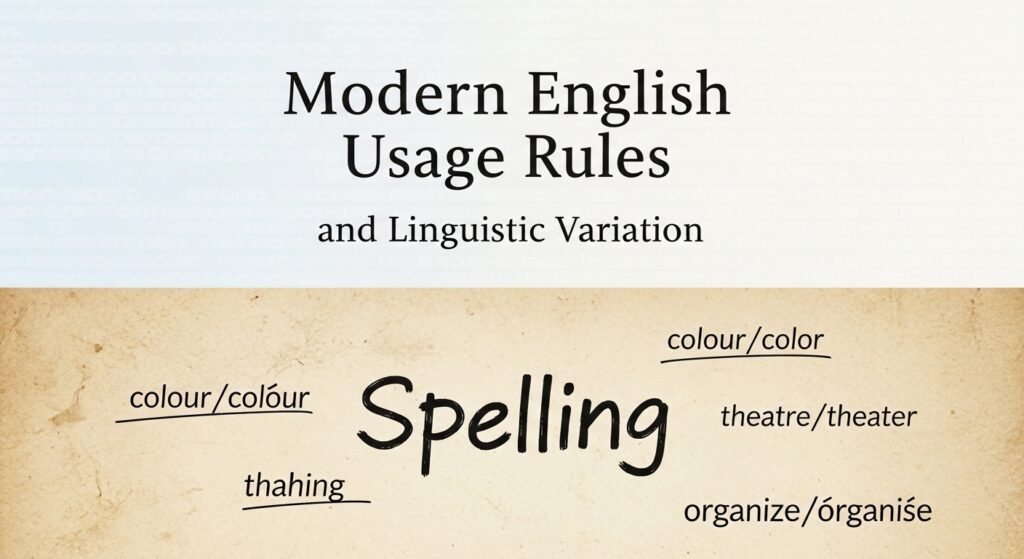
In the broader world of modern English usage rules, Blond vs Blonde is a perfect example of how language refuses to stay frozen. The standardization of spelling in writing tries to keep things neat, but real usage is always slightly messy.
We see shifts driven by:
- Global English mixing different regional preferences
- Digital communication reducing strict grammar enforcement
- Increased focus on audience-aware language usage
- Growth of tools like QuillBot AI writing tools influencing editing habits
- Simplification trends in informal writing
- Stronger emphasis on language consistency principle in professional writing
- Awareness of gender-neutral communication
This creates a living tension between tradition and practicality. Some writers love preserving nuance, others prefer streamlined clarity.
A small personal observation: the more I read different writers, the more I notice nobody fully agrees on anything anyway. And maybe that’s the point.
Frequently Asked Questions
blonde or blond
“Blond” is generally used for males or as a general adjective, while “blonde” is often used for females (especially in American English).
blond or blonde
Both are correct spellings; “blond” (masculine/general) and “blonde” (feminine) refer to light-colored hair.
blonde vs blond
The difference is mostly grammatical gender in English usage, though modern English often uses “blond” for all cases.
is it blond or blonde
Both are acceptable, but “blond” is increasingly used as the neutral form, while “blonde” is still common for women.
blond meaning”
“Blond” means a light yellow or golden hair color, and it can also describe a person with that hair color.
Read this Blog: https://marketbellione.com/invisible-character/
Conclusion: Why One Letter Still Matters More Than It Should
So after all this wandering through spelling, identity, and even coffee branding, Blond vs Blonde ends up being more than just a grammar choice. It becomes a reflection of how English language usage keeps shifting between history and modern expression.
Whether you prefer blond vs blonde usage examples in a strict grammatical sense or a flexible modern style, what really matters is awareness. Knowing why you choose a form gives your writing intention, even if it looks casual on the surface.
If you’re writing something today, try experimenting a bit. Rewrite a sentence both ways, feel the difference, notice the tone shift. Language learns best when it’s played with, not just memorized.
And if you’ve ever mixed the two and wondered if it was “wrong,” well… it’s less about wrong and more about context, consistency, and audience.
Feel free to share your own funny encounters with commonly confused words or times when a tiny spelling choice changed the vibe of your writing completely. Those little moments are where language feels most alive, honestly.