
Ever sat down with a sentence and felt like it’s whispering secrets you just can’t quite catch? Like words are dancing around each other, and you’re missing the rhythm? That’s kinda what learning about Complete Predicate feels like the first time.
You know the Subject the star of the sentence, the one doing the thing but what about everything else, all the juicy details that tell us what’s happening, how, when, or why? That’s where the magic of the Complete Predicate comes in.
Think about it. Sentences are like tiny universes. The Subject is the sun, shining brightly, but the Complete Predicate is the orbiting planets, moons, and cosmic dust, giving context, flavor, and meaning to the action. Without it, your sentence is kinda flat, one-dimensional. And let’s be real, Clear Writing and Effective Communication hinge on getting this right.
In this article, we’re diving deep like, Mariana Trench deep into Complete Predicates, exploring their definition, dissecting examples, contrasting them with Simple Predicate, and sprinkling in Core NLP / Semantic Entities and Grammatical Concepts to really anchor your understanding. Buckle up.
| Term | Definition / Explanation | Example |
|---|---|---|
| Complete Predicate | Everything in the sentence that tells what the subject does, including the verb, objects, complements, and modifiers. | “is running quickly across the yard” |
| Simple Predicate | Only the main verb (and auxiliary verb, if present) showing the action of the subject. | “is running” |
| Main Verb / Auxiliary Verb | The core action word(s) in the predicate. | “is writing”, “have eaten” |
| Object | The receiver of the action. | “a homework assignment” |
| Complement | Completes the meaning of the verb. | “a doctor” |
| Modifier | Describes or gives extra info about the action. | “quickly”, “on the rooftop” |
| Prepositional Phrase | Provides where, when, or how the action happens. | “across the yard”, “before leaving for school” |
What is a Complete Predicate? Definition and Core Idea
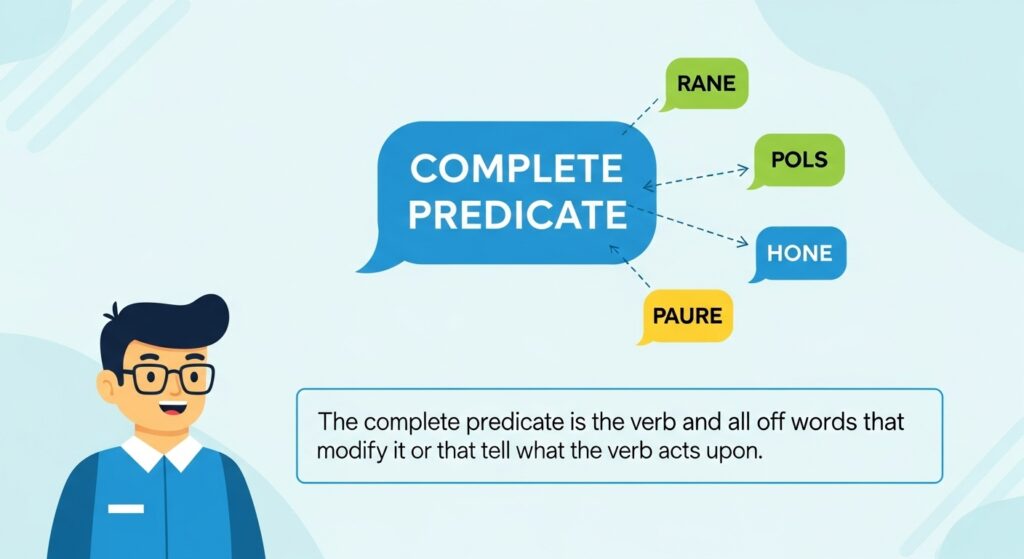
At its core, a Complete Predicate is everything in a sentence that tells about the action of the subject. It starts with the Main Verb (sometimes paired with an Auxiliary Verb) and extends to all the Objects, Complements, and Modifiers that describe or complete the action.
So if your Subject is “The dog,” the Complete Predicate is the part that answers: “What is the dog doing?” or “What’s happening to the dog?”
Example:
- Sentence: “The dog is running quickly across the yard.”
- Subject: The dog
- Complete Predicate: is running quickly across the yard
- Simple Predicate: is running
Notice how the Complete Predicate isn’t just the verb. It includes everything that modifies the action, like “quickly” and “across the yard.” These details are crucial for Descriptive Writing and Sentence Structure because they bring clarity and life to your sentence.
Simple Predicate vs Complete Predicate: Understanding the Difference
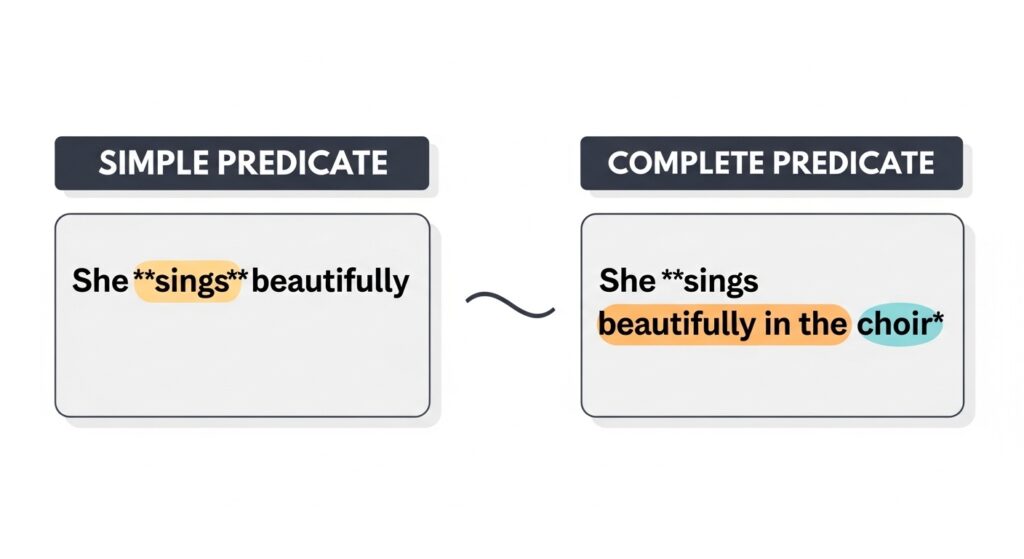
Confusion often arises between Simple Predicate and Complete Predicate, but once you see the difference, it’s like switching on a light.
- Simple Predicate: Only the Main Verb (and sometimes Auxiliary Verb) that tells what the Subject does.
- Complete Predicate: The verb + all modifiers, objects, and complements that describe or complete the action.
Examples / Illustrations:
- She is singing.
- Simple Predicate: is singing
- Complete Predicate: is singing beautifully on the rooftop
- They have eaten breakfast.
- Simple Predicate: have eaten
- Complete Predicate: have eaten breakfast at the cafe
Notice how the Complete Predicate expands the action, adds detail, and enhances Sentence Analysis. It’s like the difference between saying someone walked versus saying they walked briskly through a rain-soaked street at dawn suddenly the sentence has mood, scene, and texture.
Components of a Complete Predicate
A Complete Predicate is rarely just a verb. It’s a constellation of elements, each playing a role:
- Main Verb / Auxiliary Verb: The heartbeat of the sentence. Examples: is writing, have eaten, will sing.
- Object: Receives the action. “The teacher gave the students a homework assignment.”
- Complement: Completes the meaning. “She is a doctor.” The word “doctor” completes the idea of “is.”
- Modifier: Adds description or context. “The dog is running quickly.”
- Prepositional Phrase: Often gives where, when, or how. “He is writing a letter on the old oak desk.”
Think of Complete Predicate like a multi-layered cake. The Main Verb is the sponge layer, the Objects and Complements are the frosting and filling, and the Modifiers and Phrases are sprinkles, caramel drizzle, and that cherry on top. Together, they create Clarity in Writing and Communicative Effectiveness.
Examples of Complete Predicates in Everyday Writing
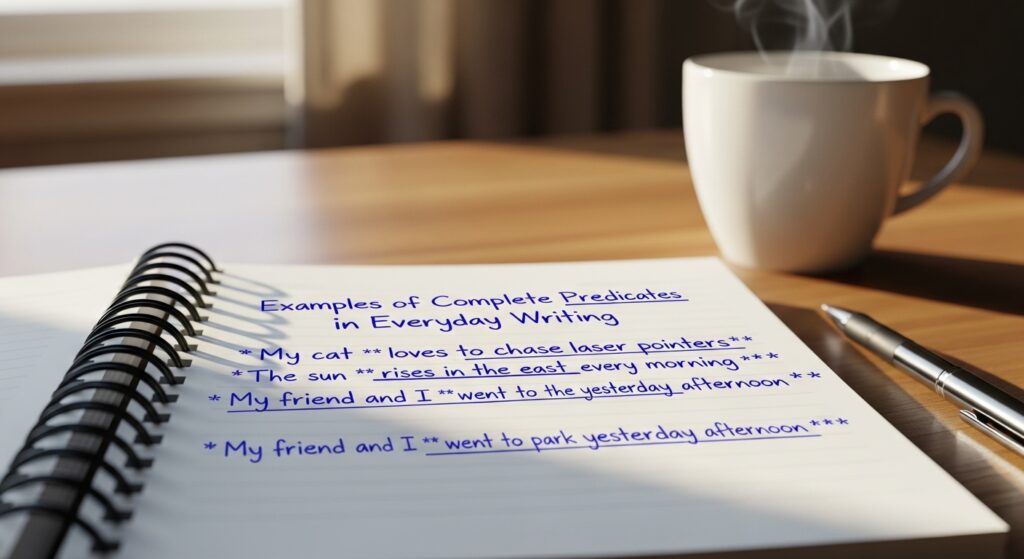
Seeing examples in isolation is good, but real learning comes when we spot them in the wild stories, conversations, and casual Writing. Here are some examples:
- She is writing a novel during the quiet hours of the night.
Complete Predicate: is writing a novel during the quiet hours of the night - The children are singing loudly in the school auditorium.
Complete Predicate: are singing loudly in the school auditorium - He is giving his best effort to complete the marathon on time.
Complete Predicate: is giving his best effort to complete the marathon on time - They have eaten breakfast before leaving for their early morning hike.
Complete Predicate: have eaten breakfast before leaving for their early morning hike
Each example demonstrates how the Complete Predicate captures the action, objects, complements, and modifiers in a cohesive package. Notice the verbs and Verb Phrases; they’re the core around which the sentence builds meaning.
Why Complete Predicates Matter: The Role in Clear Writing
Now you might wonder, why bother dissecting this? Honestly, Sentence Construction isn’t just an academic exercise. Knowing how to identify and use Complete Predicates improves:
- Clarity in Writing: Your readers instantly understand who is doing what, and how.
- Grammar: Ensures verb agreement and proper sentence flow.
- Descriptive Writing: Adds layers of detail through Modifiers, Prepositional Phrases, and Complements.
- Effective Communication: Critical for teaching, storytelling, or even casual texting “I ran” versus “I ran through the park, dodging puddles and laughing at the rain” paints vastly different pictures.
Even in English Language Arts (ELA) classrooms, mastering Complete Predicates helps students break down sentences and improve comprehension, critical thinking, and Sentence Analysis.
Types of Complete Predicates
Complete Predicates come in different flavors depending on the complexity of the sentence:
1. Simple Action Complete Predicate
The verb is active, and the sentence is straightforward.
- Example: “She is singing.”
Everything after the Subject is the Complete Predicate.
2. Complete Predicate with Object
The verb acts on something.
- Example: “The teacher gave the students a homework assignment.”
3. Complete Predicate with Complement
The verb links to a Complement that completes its meaning.
- Example: “She is a doctor.”
4. Complete Predicate with Modifier or Phrase
Adds descriptive flair.
- Example: “The dog is running quickly across the yard.”
Here, “quickly across the yard” acts as a Modifier and Prepositional Phrase.
5. Complex Complete Predicate
Includes multiple Objects, Complements, Modifiers, and Phrases.
- Example: “He is writing a letter to his grandmother, explaining the adventures of his new puppy and how excited he is to visit next week.”
Understanding these types makes it easier to identify Complete Predicate in any sentence, whether you’re reading a novel, drafting an email, or analyzing Grammar Rules.
How to Identify a Complete Predicate: Step-by-Step Guide
Identifying a Complete Predicate can feel tricky, but here’s a foolproof way:
- Locate the Subject: Ask “Who or what is this sentence about?”
- Ask What the Subject is Doing: The answer usually starts with the Main Verb.
- Include Everything that Adds Meaning: Objects, Complements, Modifiers, Prepositional Phrases all go into the Complete Predicate.
- Double-Check Verb Agreement: Ensure your Verb matches your Subject in tense and number.
- Review with Example Sentences: Try out sentences like “She is writing a novel” or “The dog is running quickly” to see how it works in practice.
Common Mistakes When Using Complete Predicates
Even seasoned writers slip up. Here’s what to watch for:
- Confusing Simple Predicate with Complete Predicate
- Leaving out Modifiers that are essential for clarity
- Misidentifying Objects or Complements
- Overstuffing a predicate, making it confusing or awkward
- Ignoring Auxiliary Verbs in tense formation
Remember, the Complete Predicate is about balance: enough detail to convey meaning, but not so much it trips the reader.
Practical Tips for Using Complete Predicates in Writing
- Mix Simple and Complex Predicates: Keep your writing lively.
- Use Modifiers Sparingly: Only where they improve clarity or imagery.
- Highlight Action: Readers connect more with Actions / Functions like Running, Singing, Writing, Giving, Eating.
- Leverage Phrases: Verb Phrases and Prepositional Phrases enrich your sentences.
- Read Aloud: You’ll feel if the Complete Predicate captures the full meaning.
Read this Blog: https://marketbellione.com/complete-subject/
Frequently Asked Questions
what is a complete predicate
A complete predicate is the part of a sentence that tells what the subject does or what happens to it, including the main verb, auxiliary verbs, and any objects, complements, or modifiers.
what’s a complete predicate
A complete predicate provides all information about the action of the subject, covering the main verb, any helpers, and additional words that describe the action.
whats a complete predicate
It is the portion of a sentence that includes the verb and all words that complete its meaning, showing what the subject is doing or experiencing.
complete predicate examples
Examples of complete predicates include: “is writing a novel,” “gave the students a homework assignment,” and “are singing loudly.”
what is a complete predicate in a sentence
In a sentence, the complete predicate shows the action of the subject and includes all words that describe or complete that action, like “is running quickly” or “is a doctor.”
Conclusion: Why Complete Predicates Make Your Writing Sing
Understanding Complete Predicate is like discovering a secret key to Effective Communication and Clear Writing. It’s not just grammar for grammar’s sake it’s about giving your sentences life, context, and action. From Main Verb to Modifier, Object, Complement, and Phrase, each part plays a role in telling your story fully.
So next time you’re writing or analyzing sentences, pause and appreciate the Complete Predicate. It’s the heartbeat of your sentence, the energy that turns simple words into vivid, communicative art. As one English teacher I know likes to say: “Without the Complete Predicate, your sentence is like a song without melody technically correct, but kinda dull.”
Whether you’re teaching, learning, or simply enjoying the beauty of language, embracing Complete Predicate and its components Subject → Action (verb), Object → Receives action, Complement → Completes meaning of verb, Modifier → Describes verb will elevate your Writing, Descriptive Writing, and overall Sentence Construction.
Start small. Pick a sentence today. Identify the Subject, then hunt for the Complete Predicate. Notice how much more alive your sentence feels. Then share your favorite examples or mini-discoveries with others language is best celebrated when shared.
Your sentences can do more than communicate. With Complete Predicates, they can sing, run, give, eat, and write themselves into unforgettable stories.