
Have you ever been reading a sentence, just casually scrolling through your favorite book or typing away an essay, and felt like something was… missing? Like, you kinda know what’s happening, but the sentence doesn’t quite land? That’s probably because the complete subject wasn’t clear enough.
I remember the first time my niece tried to explain this to me over a cup of hot cocoa she said, “It’s like the part of the sentence that dresses up the main idea all fancy-like.” And, honestly, she wasn’t wrong.
Grammar can be fun, weird, and super relatable, especially when you look closely at the complete subject in sentences. Today, we’re gonna dive deep, and i promise, by the end, you’ll see subjects not just as words, but as little story heroes that perform action, provide context, and make sentences come alive.
Complete Subject: Definition and Examples table
| Term | Definition | Examples | Notes / Keywords Highlighted |
|---|---|---|---|
| Complete Subject | All words in a sentence that tell who or what the sentence is about, including modifiers, articles, adjectives, phrases, or clauses. | – The big red car raced down the street. – The students who are struggling in math need help. | Includes noun, pronoun, modifiers, noun phrases, clauses, prepositional phrases |
| Simple Subject | The main noun or pronoun that performs the action, without modifiers. | – Car raced down the street. – Students need help. | Core of the complete subject; does not include adjectives or phrases |
| Compound Subject | Two or more simple subjects joined by conjunctions. | – John and Mary went to the park. – The dog and the cat slept on the couch. | Plural or singular verbs depend on structure; can be noun phrases |
| Complex Subject | A subject that includes a subordinate clause or modifying phrase. | – The student who is struggling in math asked a question. – The book that is on the table belongs to Sarah. | Includes adjective clauses, noun clauses, prepositional phrases |
| Collective Subject | A singular noun representing a group or collection. | – The team wins every Friday. – The family gathers on Sunday. | Verb agreement can vary depending on whether the group acts collectively or individually |
Understanding the Complete Subject

Alright, so first thing’s first: what exactly is a complete subject? It’s basically everything in a sentence that tells us who or what is doing something. That’s not just the simple subject (like “dog” in “The dog runs”), but all the little words that modify or describe it. Think adjectives, articles like “the” or “a,” maybe even prepositional phrases that give extra flavor.
For example, in the sentence:
“The big red car raced down the street.”
Here, “The big red car” is the complete subject, while “car” alone is the simple subject. The words “the big red” aren’t just decoration they modify and describe the main noun, giving context and clarity. And honestly, without them, the sentence feels kinda… flat.
Why it Matters
Some folks shrug when you start talking grammar, but the complete subject is basically the backbone of clear communication. It tells readers exactly who or what your sentence is about, which helps avoid confusion.
Think about writing emails, essays, or even texting getting this right makes your sentence structure stronger, your verbs agree properly, and your ideas land exactly where you want them to.
Simple Subject vs Complete Subject
You’ll often hear teachers or grammar guides talking about simple subjects and complete subjects. The difference? Easy, but worth really sinking your teeth into.
- Simple subject: The core noun or pronoun that performs action. Example: She in “She laughs loudly.”
- Complete subject: The noun plus all its modifiers, phrases, or clauses that describe it. Example: The tired teacher who stayed up all night grading papers in “The tired teacher who stayed up all night grading papers yelled at the students.”
See the difference? One’s barebones, one’s dressed up for the party.
Types of Complete Subjects
Not all complete subjects are created equal. Depending on your sentence, you might run into a compound subject, a complex subject, or even a collective subject. Let’s break these down with examples so they stick in your brain:
1. Compound Subject
A compound subject happens when two or more simple subjects are joined by a conjunction like “and” or “or.” They act as one giant noun phrase.
Examples:
- John and Mary went to the park.
- The dog and the cat slept on the couch.
- He and she are studying for the math exam.
Notice how each noun could be a subject alone, but together, they form a more complex complete subject. You gotta make your verbs agree with plural or singular depending on the structure.
2. Complex Subject
A complex subject includes a subordinate clause or a modifying phrase that adds depth. These can be tricky because the extra words sometimes hide the main noun.
Examples:
- The students who are struggling in math need extra help.
- The book that is on the table belongs to me.
- The teacher, tired from grading papers, went home early.
Here, the added clauses like “who are struggling in math” and “that is on the table” clarify, describe, or modify the main noun, giving your sentence structure more detail.
3. Collective Subject
Sometimes, one word represents a group, which is called a collective subject.
Examples:
- The team wins every Friday.
- The family gathers for dinner every Sunday.
- The audience applauds loudly.
Even though it’s singular, the verb can sometimes act like it’s plural depending on whether you’re talking about the group as a whole or the individuals inside it. Pretty wild, huh?
Components That Make a Complete Subject
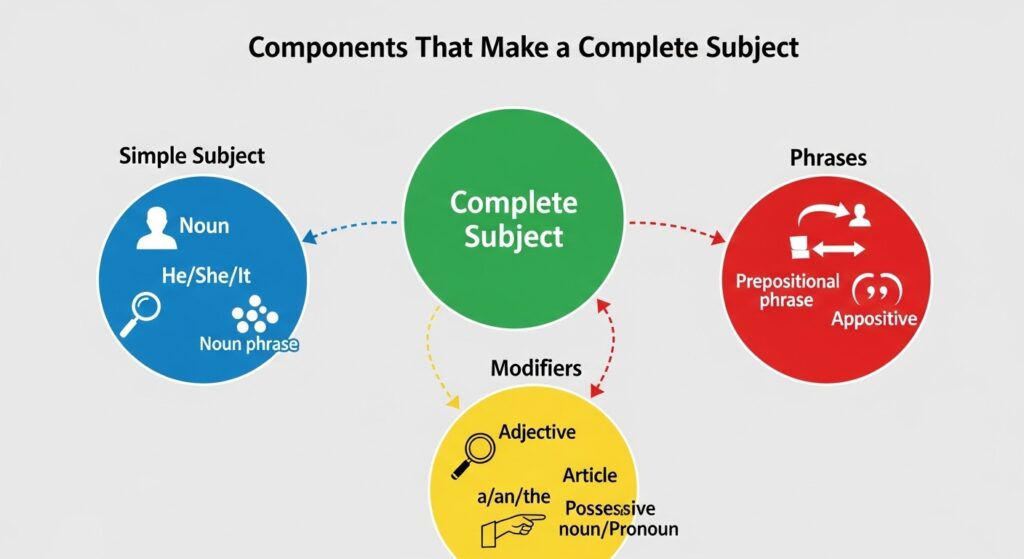
To really understand the complete subject, you gotta look at the parts that make it up. It’s not just nouns and pronouns. There are modifiers, phrases, clauses, and more.
Nouns and Pronouns
These are the heart of your complete subject. Without them, your sentence doesn’t know who or what it’s talking about. Examples include John, she, the dog, the book, or even the students who are struggling in math.
Modifiers
Modifiers are words that describe or clarify the noun. Adjectives, articles, and even prepositional phrases can modify the subject.
Examples:
- Adjectives: The tired teacher
- Articles: The book vs A book
- Prepositional phrase: The book on the table
Clauses
Sometimes, you gotta level up with a subordinate clause, like:
- The student who is struggling in math
- The team that won last year
Clauses add context and make your subject richer, helping your communication be more precise.
Phrases
A phrase can be a group of words that add info but don’t have a verb on their own. Commonly, prepositional phrases show up in complete subjects:
- The students in the library
- The cat under the bed
All these pieces together help your sentence clarity, which is super useful for writing essays, emails, or even storytelling.
How to Identify a Complete Subject
Honestly, the easiest way to spot the complete subject is to ask: Who or what is this sentence about? Then, take all the words that describe it along for the ride.
Step-by-step:
- Find the verb first it tells what action is happening.
- Ask: Who or what performs this action? That’s your simple subject.
- Look for modifiers, articles, adjectives, phrases, or clauses that give more info. Add them. Boom you’ve got your complete subject.
Example:
- Sentence: “The bright, cheerful students in the science lab are experimenting with magnets.”
- Verb: are experimenting
- Simple subject: students
- Complete subject: The bright, cheerful students in the science lab
See how all those extra words give color and clarity? Without them, it’s just… “students are experimenting.” Kinda boring, right?
Examples in Everyday Context
Sometimes grammar feels dry if we only look at textbooks, so let’s throw in some real-life vibes:
- Big red dog barked at the mailman.
- The teacher who loves chocolate smiled at her students.
- John and Mary planned a surprise party for their friend.
- The family packed their bags for a beach vacation.
Notice how even in casual or storytelling contexts, identifying the complete subject makes your writing way more vivid.
Tips to Improve Your Understanding of Complete Subjects
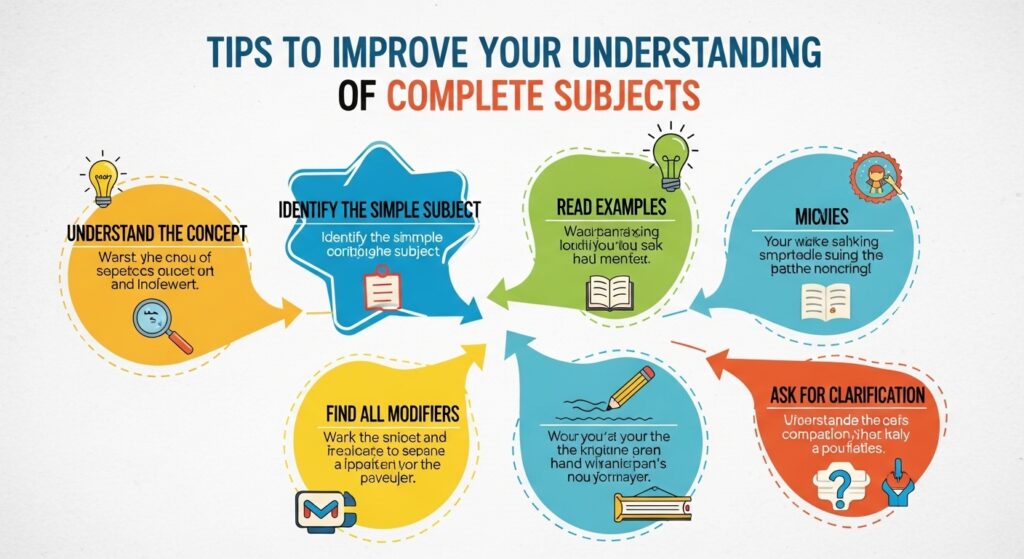
- Read sentences aloud. Hearing them helps you feel where the subject begins and ends.
- Highlight the noun or pronoun first, then look for modifiers.
- Practice with noun phrases and clauses: the more you see them in action, the easier it becomes.
- Try turning a simple subject into a complex subject by adding descriptive words or prepositional phrases.
For example, “The dog ran” can become “The big brown dog with a red collar ran.” See the magic of complete subjects?
Frequently Asked Questions
Can a complete subject be more than one word?
A: Absolutely! Often, it’s several words, especially if you include adjectives, articles, phrases, or clauses.
What’s the difference between a simple and a complete subject?
A: Simple subject = main noun or pronoun. Complete subject = simple subject + all modifying words.
Can a pronoun be a complete subject?
A: Yes, but usually only if it’s a standalone pronoun like he, she, or they. If you add modifiers, it becomes more complex.
How do I teach this to kids?
A: Use fun examples like the big red car, the tired teacher, or the dog under the table. Visual examples make the abstract concepts concrete.
complete subject
A complete subject is the main noun or pronoun in a sentence along with all the words that modify or describe it. It tells who or what the sentence is about.
what is a complete subject
A complete subject is the entire noun phrase that includes the main noun or pronoun and all its modifiers. It functions as the “who” or “what” performing the action in the sentence.
complete subject examples
Examples of complete subjects include “The big red dog,” “The students who are struggling in math,” and “The book on the table.” Each includes the main noun and its modifiers or phrases.
what’s a complete subject
A complete subject is the full part of a sentence that names the person, place, thing, or idea doing the action, including all descriptive words or phrases.
whats a complete subject
A complete subject consists of a main noun or pronoun plus any words, phrases, or clauses that modify it, giving the sentence clarity and context.
Conclusion
Understanding the complete subject isn’t just a grammar exercise it’s a key to better writing, clearer communication, and smarter sentence structure.
Whether you’re writing essays, emails, or just crafting stories, knowing how to spot the subject, dress it up with modifiers, and use clauses or phrases will make your sentences sing.
So next time you see a sentence, pause and think: Who’s the hero here? Then look at all the words that give them life. Because a sentence without a complete subject is like a story without its main character just kinda floating around, hoping to be understood. And nobody wants that.
Once you get comfy with complete subjects, start experimenting: turn simple subjects into compound subjects, try complex subjects, sprinkle in prepositional phrases, and watch your writing clarity soar.
Remember, grammar isn’t just rules it’s a tool for effective communication, creativity, and storytelling. Embrace the complete subject, and suddenly, your sentences don’t just speak they dance.