
There was a moment, years ago, when I tried spelling “Worcestershire” in a grocery store aisle while texting a friend. I typed it wrong three times. Then four.
Eventually I just wrote “that brown sauce thing.” The English language, you see, sometimes feels like a mischievous little puzzle box beautiful, expressive, and… slightly unfair. And honestly, thats part of its charm.
When people begin exploring an English spelling challenge, they quickly realize something strange: English spelling rarely behaves the way beginners expect. Words don’t always sound the way they look. Letters show up quietly and refuse to make a sound. Pronunciation dances in odd ways.
This delightful confusion is the result of centuries of linguistic borrowing. The English language was shaped by the French language influence, the Latin language influence, the German language influence, and even the Greek language influence.
Because of these mixed roots, English contains countless borrowed words in English that follow different spelling rules and pronunciation rules.
What this means for learners is simple: English language complexity is real, and sometimes a bit cheeky. But mastering it also builds incredible communication skills, stronger linguistic abilities, and deep language proficiency.
So today we’re exploring a fun English spelling challenge featuring 20 famously tricky words. Each one tells a tiny story about silent letters in English, strange letter-to-sound mapping, and the fascinating dance between spelling and speech.
Let’s wander through these words slowly, like explorers in a slightly confusing dictionary forest.
| Hard Word | Correct Pronunciation | Why It’s Difficult |
|---|---|---|
| Mischievous | MIS-chuh-vus | Often mispronounced with an extra syllable |
| Colonel | KER-nul | Spelling vs pronunciation mismatch |
| Epitome | eh-PIT-uh-mee | Ending looks like “tome” but isn’t |
| Cymotrichous | sigh-MOT-ri-kus | Rare word with unusual spelling |
| Draught | draft | Contains silent letters |
| Worcestershire | WOOS-ter-sheer | Complex letter-to-sound mapping |
| Pococurante | poh-koh-koo-RAN-tay | Borrowed word with foreign pronunciation |
| Nauseous | NAW-zee-us | Often confused meaning and pronunciation |
| Bouquet | boo-KAY | Silent “t” from French influence |
| Cacciatore | kah-cha-TOR-ay | Italian origin spelling |
| Diaphragm | DYE-uh-fram | Silent “g” and tricky consonant cluster |
| Entrepreneur | on-truh-pruh-NER | Difficult spelling and French origin |
| Massachusetts | mas-uh-CHOO-sits | Long word with repeated letters |
| Onomatopoeia | on-uh-mat-uh-PEE-uh | Many vowels in sequence |
| Pauciloquy | paw-si-LOK-wee | Rare academic vocabulary |
| Phlegm | flem | Silent letters make spelling confusing |
| Appoggiatura | uh-poj-uh-TOOR-uh | Musical term with Italian spelling |
| Liaison | lee-AY-zon | French spelling with silent letters |
| Quiche | keesh | Pronunciation very different from spelling |
| Supercalifragilisticexpialidocious | soo-per-kal-uh-fra-jil-is-tik-ex-pee-al-ih-DOH-shus | Extremely long playful word |
Why the English Spelling Challenge Exists at All
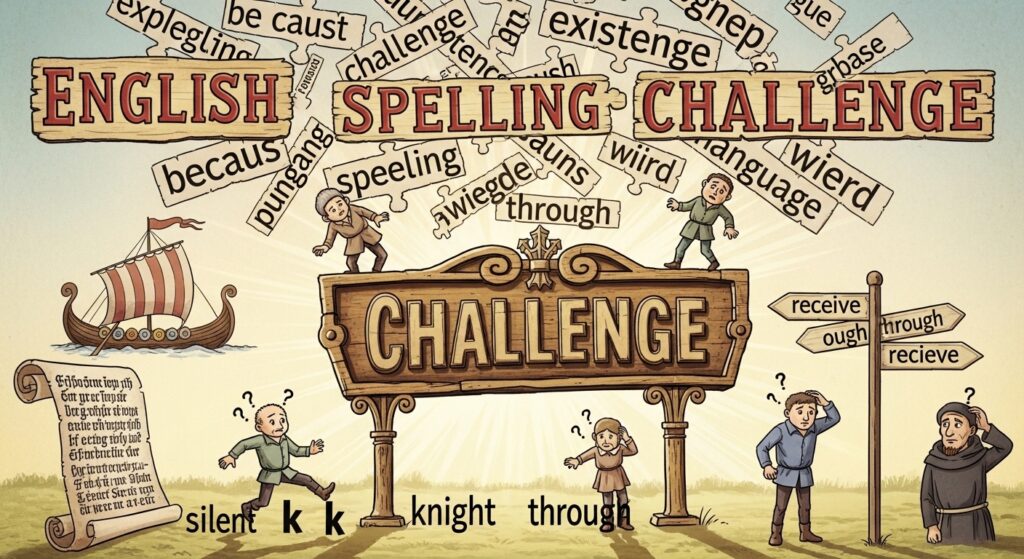
Before jumping into the list, it helps to understand why English has so many difficult English words.
Unlike many languages with tidy spelling systems, English evolved through waves of cultural influence. The English language influenced by French after the Norman conquest added elegant but confusing spellings. Meanwhile Latin language influence and Greek language influence introduced academic vocabulary with unusual letter patterns.
Because of this, English now contains:
- Irregular spelling
- Silent letters
- Pronunciation challenges
- Complex word pronunciation patterns
All of this leads to what linguists often call the great spelling vs pronunciation mismatch. It’s also the reason learners search for things like hardest English words to pronounce, difficult English words to spell, or mispronounced English words.
But here’s the upside: practicing these words dramatically improves language fluency, spoken English improvement, and overall vocabulary acquisition.
And yes… sometimes it even makes you laugh a little.
The Ultimate English Spelling Challenge: 20 Hard Words
Here begins our official English spelling challenge. These twenty words are famous examples of hard English words to spell, tricky pronunciation puzzles, and little linguistic adventures.
Mischievous
People often pronounce Mischievous as “mis-CHEE-vee-us.” But the correct English pronunciation is closer to MIS-chuh-vus.
This word illustrates a common word pronunciation pattern problem: extra syllables sneaking into speech.
It’s also a wonderful example of how improving pronunciation accuracy can prevent misunderstandings in effective communication.
Colonel
Perhaps one of the most confusing entries in any difficult vocabulary words list.
Colonel is pronounced KER-nul. Not even remotely similar to its spelling.
This oddity comes from historical spelling shifts influenced by both French and Italian. A perfect illustration of English pronunciation vs spelling differences.
Epitome
Many learners pronounce Epitome as “epi-tome.”
But the correct form is eh-PIT-uh-mee.
This word frequently appears in advanced writing, making it important for advanced English vocabulary and language comprehension.
Cymotrichous
Now here’s a word that makes even native speakers pause.
Cymotrichous refers to wavy hair. It’s pronounced sigh-MOT-ri-kus.
This is the kind of word you might only encounter during an extreme English spelling challenge, but it’s fascinating for understanding phonetic understanding.
Draught
Another classic example of silent letters in English.
Draught is pronounced simply as draft.
This comes from British spelling traditions and shows how borrowed words in English evolved through historical spelling.
Worcestershire
Ah yes. The legendary spelling monster.
Worcestershire is pronounced roughly WOOS-ter-sheer.
This word perfectly demonstrates tricky pronunciation examples and the chaos of letter-to-sound mapping.
Pococurante
A word borrowed from Italian meaning someone who is indifferent or unconcerned.
Pococurante appears mostly in literary discussions, representing the rich English vocabulary complexity created by linguistic borrowing.
Read this Blog: https://marketbellione.com/conversion-guide-3-liters-to-oz/
Nauseous
Interestingly, many people use Nauseous incorrectly.
Traditionally it meant “causing nausea,” though modern usage also accepts “feeling sick.” Language evolves… sometimes confusingly.
Bouquet
Thanks to French language influence, Bouquet has a silent “t” at the end.
Pronounced boo-KAY, it’s a gentle example of how silent letters cause pronunciation differences.
Cacciatore
Borrowed from Italian cuisine, Cacciatore appears often in cooking contexts.
Pronounced ka-cha-TOR-ay, it shows how global culture shapes English vocabulary learning.
Diaphragm
One of the classic difficult English words with silent letters.
Diaphragm ends with a silent “g.” This makes it tricky for learners improving pronunciation practice.
Entrepreneur
A word that terrifies spelling-bee contestants everywhere.
Entrepreneur reflects heavy French language influence and challenges both spelling memory and accent improvement.
Massachusetts
Even native speakers sometimes hesitate before spelling Massachusetts.
This state name highlights how place names often become legendary spelling practice words.
Onomatopoeia
This beautiful word describes sounds that imitate real noises.
Despite its length, Onomatopoeia becomes easier with good mnemonic devices.
Many teachers encourage breaking it into chunks during English spelling exercises.
Pauciloquy
Meaning “briefness of speech,” Pauciloquy is rare but delightful.
Ironically, the word itself is long for something describing few words.
Phlegm
A nightmare for beginners.
Phlegm contains the strange “phl” cluster, which complicates pronunciation practice and spelling rules.
Appoggiatura
A musical term borrowed from Italian.
Appoggiatura demonstrates how artistic vocabulary contributes to English language complexity.
Liaison
Often mispronounced, Liaison reflects classic French language influence.
Pronounced lee-AY-zon, it appears frequently in business and diplomacy.
Quiche
Another French culinary import.
Quiche is pronounced keesh, making it one of the classic mispronounced English words.
Supercalifragilisticexpialidocious
Yes, the famous playful word from popular culture.
While whimsical, Supercalifragilisticexpialidocious is often used as a humorous English spelling challenge.
It proves that sometimes language learning should just be fun.
How Hard English Words Improve Language Mastery
Learning hard English words to spell might seem like a strange hobby, but it offers powerful benefits.
First, it strengthens vocabulary acquisition. Exposure to unusual words expands your understanding of advanced English vocabulary.
Second, practicing pronunciation improves spoken language accuracy. This leads to clearer linguistic clarity and stronger communication skills.
Third, it builds language mastery. When learners tackle difficult words regularly, their confidence grows.
And honestly… there’s a small joy in finally spelling Massachusetts correctly without checking.
Tips for Conquering Difficult English Words
If these words made your brain feel slightly tangled, don’t worry. Even native speakers struggle sometimes.
Here are practical strategies for mastering tricky English vocabulary.
Use Mnemonic Devices
Memory tricks make long words easier.
For example, learners often remember Massachusetts as:
Mass – a – chu – setts.
These small mental patterns strengthen English vocabulary improvement.
Practice with Pronunciation Guides
Listening to audio dictionaries helps develop correct pronunciation.
This builds native-like fluency over time.
Study Silent Letters
Understanding silent letters in English dramatically reduces spelling mistakes.
Examples include:
- Phlegm
- Bouquet
- Draught
Use Dictionaries Regularly
Good dictionary usage reveals pronunciation guides, word origins, and example sentences.
That small habit accelerates language proficiency faster than most people realize.
A Tiny Cultural Story About Spelling
A British teacher once told her class a funny story about spelling bees.
A student was asked to spell “Worcestershire.”
He paused, took a deep breath, and said:
“Can I just spell ketchup instead?”
Everyone laughed. But the teacher made a good point afterward: struggling with language is normal. Every learner passes through the same stage.
Even native speakers experience moments of pauciloquy when a word refuses to cooperate.
Turning the English Spelling Challenge Into a Game

If you want to improve faster, turn spelling practice into a playful routine.
Try these ideas:
- Create weekly English spelling exercises
- Practice tricky pronunciation examples aloud
- Challenge friends with difficult vocabulary words
- Track your progress in a vocabulary notebook
Consistency, more than anything, improves spelling skills.
Frequently Asked Questions
Hard Spelling Words
Hard spelling words are English words that many learners find difficult to spell because of silent letters, unusual letter combinations, or irregular spelling patterns. Practicing these words regularly can help improve spelling accuracy and vocabulary skills.
Hard Spelling
Hard spelling refers to words that do not follow common English spelling rules, making them challenging for both learners and native speakers. Understanding pronunciation patterns and word origins can make these spellings easier to remember.
Hard Words
Hard words are vocabulary terms that may be difficult to spell, pronounce, or understand due to their complexity or unfamiliar structure. Learning these words helps expand vocabulary and improves overall language proficiency.
20 Hard Words in English
There are many hard words in English that challenge learners, such as “mischievous,” “colonel,” “entrepreneur,” and “onomatopoeia.” Practicing these difficult words can strengthen spelling skills and improve pronunciation.
Hard Spellings
Hard spellings are words that contain silent letters, irregular patterns, or uncommon combinations of letters. Regular practice, reading, and using mnemonic techniques can help learners remember these tricky spellings more easily. ✍️📚
Final Thoughts: The Beauty of an Imperfect Language
The English language is messy. It bends rules. It borrows shamelessly from other languages. Sometimes it feels like a museum of linguistic history where every exhibit speaks a slightly different dialect.
Yet that very language irregularity is what makes English vibrant and expressive.
Every time you tackle an English spelling challenge, you strengthen your linguistic abilities, sharpen your communication skills, and move a step closer to real language fluency.
So the next time a word like Entrepreneur, Onomatopoeia, or Phlegm appears in your path, don’t panic. Smile a little. Spell it slowly. Maybe laugh when you get it wrong the first time.