
Ah, geometry… the magical world where shapes live and lines tell stories. I remember sittin’ at my old wooden desk, trying to wrap my head around 2-D shapes while my pencil wobbled over the paper, and it felt like a secret code just for grown-ups.
Now, as a teacher and someone who’s obsessed with making learning fun, I can tell ya, introducing Grade 3 kiddos to geometry is a mix of “aha!” moments and the occasional “wait, what?” giggle.
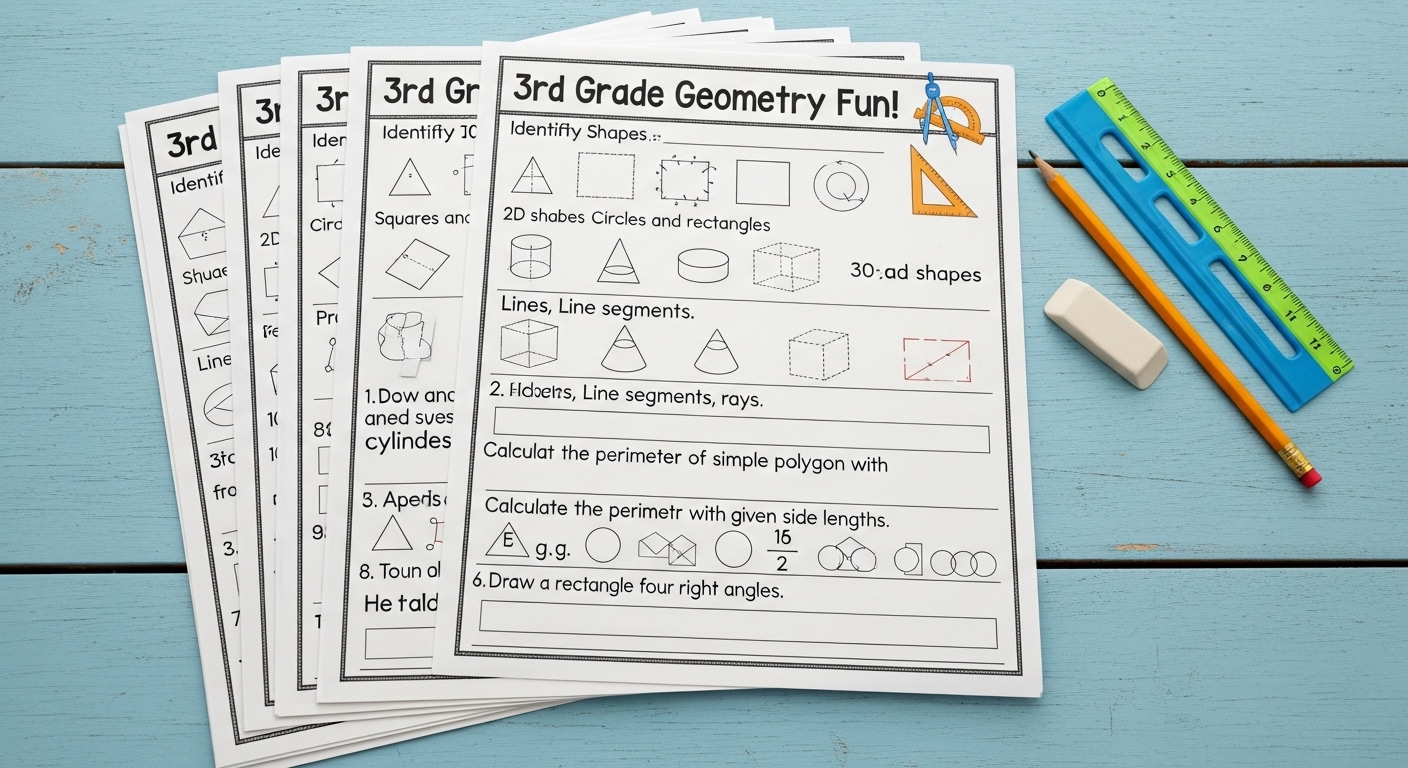
That’s where 3rd Grade Math Worksheets step in they’re not just boring papers with angles and circles, they’re tiny adventures where children identify, draw, classify, and measure shapes like little explorers with crayons as compasses.
When I talk about 3rd Grade Geometry, I imagine a place where triangles and quadrilaterals dance together, where parallel lines whisper secrets to perpendicular ones, and where a circle isn’t just round it’s a playground of parts of a circle ready to be discovered.
Worksheets make this journey hands-on, letting students see, touch, and even color their way through concepts that can otherwise feel… well, invisible.
| Topic | Key Concepts | Worksheet Activities |
|---|---|---|
| 2-D Shapes | Circles, Triangles, Quadrilaterals, Polygons, Regular & Irregular polygons | Identify shapes, classify triangles by sides/angles, draw and label polygons |
| Lines and Angles | Lines, Segments, Rays, Right/Acute/Obtuse/Straight angles, Parallel & Perpendicular lines | Draw lines & rays, measure angles with protractors, classify angles, find parallel/perpendicular lines |
| Area and Perimeter | Area of rectangles, Perimeter of rectangles & irregular shapes, Rectangular grids | Calculate area & perimeter, compare shapes, solve grid-based problems |
| Symmetry and Congruency | Congruent shapes, Symmetrical shapes, Lines of symmetry | Draw symmetrical shapes, identify lines of symmetry, explore congruent shapes |
| Educational Tools | Worksheets, Flashcards, Workbooks, Sample worksheets, Basic shapes & geometry exercises | Practice drawing, labeling, measuring, and calculating shapes and angles |
| Skills Developed | Identify, Classify, Draw, Label, Measure, Calculate, Compare, Describe | Applied exercises combining creativity and math reasoning |
Why Geometry is Exciting for Grade 3
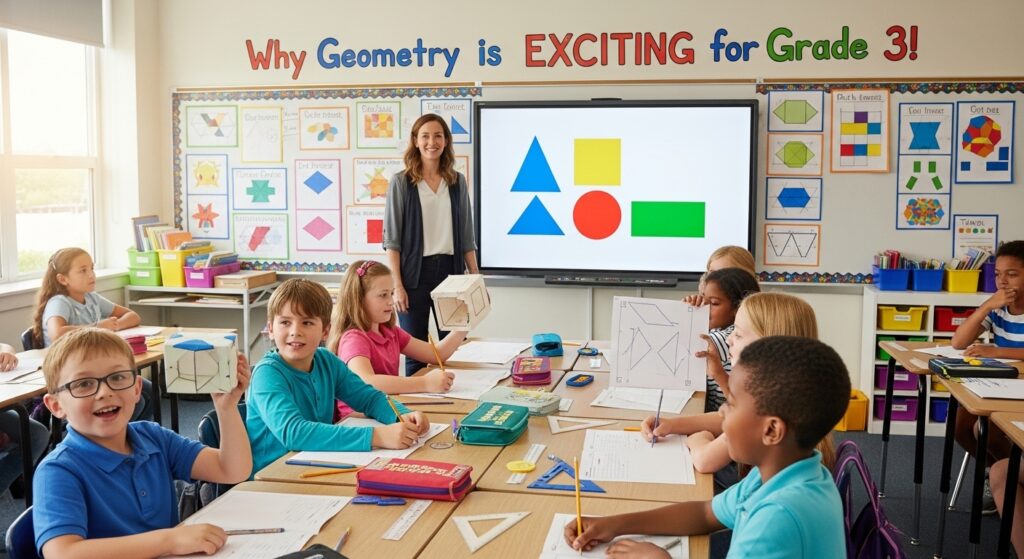
Geometry in Kindergarten to Grade 5 isn’t just about memorizing shapes it’s about seeing the world differently. Imagine pointing out rectangles in the classroom windows, triangles on rooftops, or counting lines of symmetry in a butterfly’s wings.
3rd Grade Geometry worksheets allow kids to classify triangles by sides or angles, explore quadrilaterals like squares, rectangles, trapezoids, parallelograms, and even the tricky rhombuses.
Kids start thinking, “Oh hey, that stop sign is a regular polygon!” or “This kite is like two congruent shapes stuck together!” It’s like giving them magical glasses to see the hidden math in their everyday world.
And lemme tell ya, worksheets aren’t just about writing. They encourage kids to draw symmetrical shapes, measure angles with protractors, and calculate area of rectangles or perimeter of irregular shapes on rectangular grids.
Each exercise is a tiny puzzle that strengthens their brain muscles, improves math practice for Grade 3, and builds confidence that they can tackle bigger challenges later.
Two-Dimensional Shapes (2-D Shapes): Fun and Discovery
Let’s start with the most basic and yet endlessly fascinating area: 2-D shapes. Here’s where students can identify circles, squares, rectangles, triangles, and even polygons. Worksheets often mix regular polygons (all sides and angles equal) and irregular polygons (nope, not equal more personality!).
In my classroom, one fun exercise I do is to ask the kids to hunt the room for triangles and quadrilaterals. Some bring pencils, some bring sticky notes, and some just use their fingers anyway works.
Worksheets then let them classify triangles by sides (equilateral, isosceles, scalene) or by angles (right, acute, obtuse). It’s amazing how quickly a kid who couldn’t tell a trapezoid from a rectangle becomes a mini geometry detective.
Creative Worksheet Ideas for 2-D Shapes
- Draw your favorite polygon and label all its sides and angles.
- Identify shapes in a classroom photo and color code them.
- Compare a square and a rectangle, and write down how they’re similar and different.
- Make your own irregular polygon and calculate its perimeter.
- Cut out paper shapes to create a new 2-D collage.
- Circle all right angles in a picture of a house.
Worksheets that mix drawing, labeling, and comparing help kids develop spatial awareness, while keeping it playful. And here’s a tip: let the students tell mini stories about their shapes they’ll describe angles like characters in a comic, “Mr. Right Angle is very serious, but Ms. Acute is tiny and sneaky.”
Lines and Angles: The Backbone of Geometry
When we move to lines and angles, it’s like giving children keys to unlock geometry’s hidden secrets. Worksheets in this section encourage students to draw, measure, and classify.
You got segments, rays, parallel lines, perpendicular lines, right angles, acute angles, obtuse angles, and straight angles all living together in one worksheet. Sounds messy? Nah, it’s perfect chaos for the curious mind.
One of my favorite activities: using protractors to measure angles on a drawing. Little hands wobble a bit at first, but when they see “Wow! My triangle has a 90° angle!” that’s the magic moment.
Worksheets can also mix exercises like lines and angles activities, where kids compare angles or identify parallel vs. perpendicular lines in everyday objects, like ladders or book spines.
Engaging Worksheets for Lines and Angles
- Draw three rays that start from one point and measure the angles they form.
- Identify all right angles in a classroom layout picture.
- Make a mini scavenger hunt for acute and obtuse angles around the room.
- Draw parallel lines and add a perpendicular line crossing them.
- Using a protractor, measure angles in simple geometric figures and label them.
These worksheets turn abstract concepts into tangible experiences. Kids learn not only to calculate or measure, but also to compare and describe, which deepens their understanding.
Area and Perimeter Concepts: Hands-On Math
Now let’s talk about something that makes kids say, “I can really use this!” area of rectangles and perimeter of irregular shapes. In 3rd Grade Math, worksheets often involve rectangular grids, letting students calculate and label areas and perimeters, sometimes even mixing exercises that challenge them to perimeter of irregular shapes.
I remember one student, Lily, who drew a house on a rectangular grid. She calculated the perimeter by walking her pencil along the sides. She giggled and said, “It’s like I’m walking around my house!” That’s exactly the kind of engagement worksheets aim for they make math physical, playful, and memorable.
Worksheet Examples for Area and Perimeter
- Color in a rectangle on a grid and calculate its area.
- Draw your own shape and calculate the perimeter.
- Compare two shapes’ areas and see which one fits more triangles inside.
- Solve real-life problems like “If a garden is 5×4 squares, what’s its perimeter?”
These activities help kids measure, calculate, and even describe their results in words, not just numbers a critical thinking boost that goes beyond memorization.
Symmetry and Congruency: Artistic Geometry
Who says geometry isn’t artistic? Symmetrical shapes, lines of symmetry, and congruent shapes are perfect for worksheets that mix math with creativity. Kids get to draw symmetrical shapes, fold papers, cut, and see the magic of mirrored worlds.
Worksheets can ask students to identify symmetrical shapes in nature, like leaves or butterflies, and then draw symmetrical patterns themselves.
“Math and art in one go!” as one parent told me while helping her child with a symmetry drawing activity. It’s hands-on, visually stimulating, and reinforces concepts like congruent shapes and lines of symmetry.
Creative Symmetry Worksheets
- Draw a butterfly with perfect symmetry.
- Identify shapes that are symmetrical in a collage.
- Cut out shapes and fold to see congruency in action.
- Design a tile pattern with symmetrical shapes.
- Find all lines of symmetry in different polygons.
These exercises are not only educational but also calming for many kids they combine focus, creativity, and fun, all in one worksheet.
Educational Resources to Make Geometry Stick
Worksheets aren’t the only tools in the geometry toolkit. Flashcards, workbooks, sample worksheets, and basic shapes exercises supplement learning in K5 Learning programs.
There’s even a place for angles exercises and 3D shapes in broader collections, giving kids multiple touchpoints to identify, classify, measure, and compare shapes.
A few resource tips I swear by:
- Flashcards for types of polygons.
- Mini workbooks with lines and angles activities.
- Digital geometry exercises for kids with interactive elements.
- Sample worksheets to try at home with crayons or chalk.
Using multiple resources alongside worksheets ensures kids don’t just memorize they understand. And the more they draw, label, and describe, the stronger their geometry intuition becomes.
Making the Most of 3rd Grade Geometry Worksheets
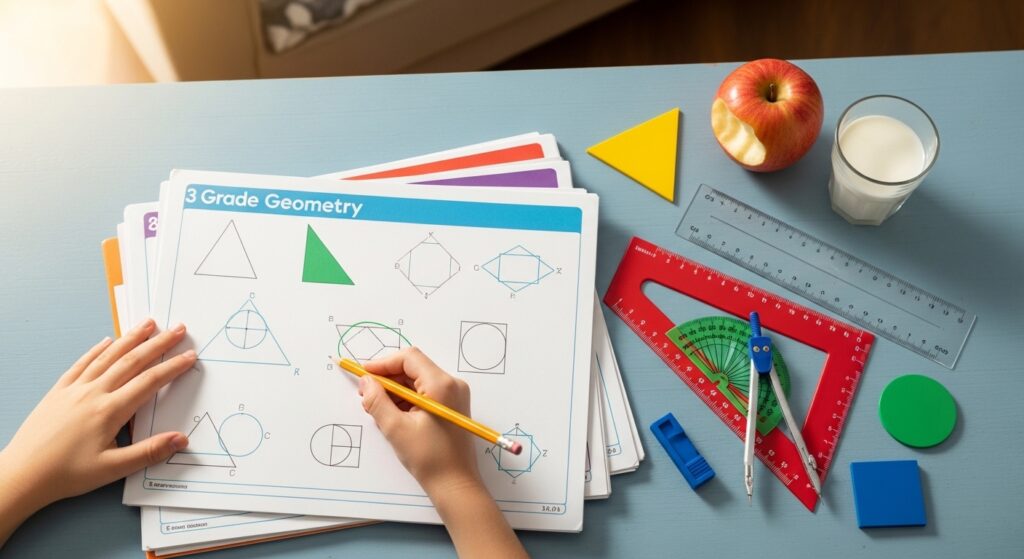
It’s easy to just hand over a worksheet and call it a day, but the magic happens when you make it interactive:
- Let kids color code shapes and angles.
- Turn perimeter exercises into a “walk-around” activity on the floor.
- Encourage storytelling with shapes triangles as “mountains” or circles as “planets.”
- Share worksheets in pairs for collaborative problem-solving.
- Celebrate small wins: “Wow, you identified all the obtuse angles correctly!”
Worksheets become more than homework they become tiny adventures in spatial thinking, creativity, and discovery.
Frequetnly Asked Questions
3rd grade area worksheets
These worksheets help students calculate the area of various 2-D shapes like rectangles, squares, and irregular shapes using grids and formulas.
3rd grade geometry worksheets
These worksheets cover identifying, classifying, and drawing 2-D shapes, lines, angles, polygons, and exploring symmetry and congruency.
volume of composite figures worksheet
This worksheet guides students to find the volume of composite 3-D shapes by breaking them into simpler shapes like cubes, rectangular prisms, and cylinders.
3rd grade geometry
Grade 3 geometry introduces basic concepts of shapes, lines, angles, polygons, symmetry, and spatial reasoning skills.
area worksheets grade 3
These worksheets focus on calculating the area of rectangles, squares, and other shapes using formulas, grids, and practical examples.
Read this Blog: https://marketbellione.com/algebra/
Conclusion: Geometry is Everywhere
Geometry isn’t just a chapter in a 3rd Grade Math workbook; it’s a lens to see the world. From 2-D shapes to lines and angles, area and perimeter to symmetry, worksheets guide kids to identify, classify, measure, calculate, and describe the hidden math around them. They learn to appreciate shapes not just as lines on a page but as friends, puzzles, and even art.
So next time you open a 3rd Grade Geometry worksheet, remember: it’s more than exercises it’s a chance to spark curiosity, creativity, and confidence in a child who might one day design bridges, draw comics, or simply see the beauty in a polygon on a park bench.
Make the learning playful, interactive, and full of “aha!” moments, and watch as kids fall in love with the shapes that quietly shape their world.