
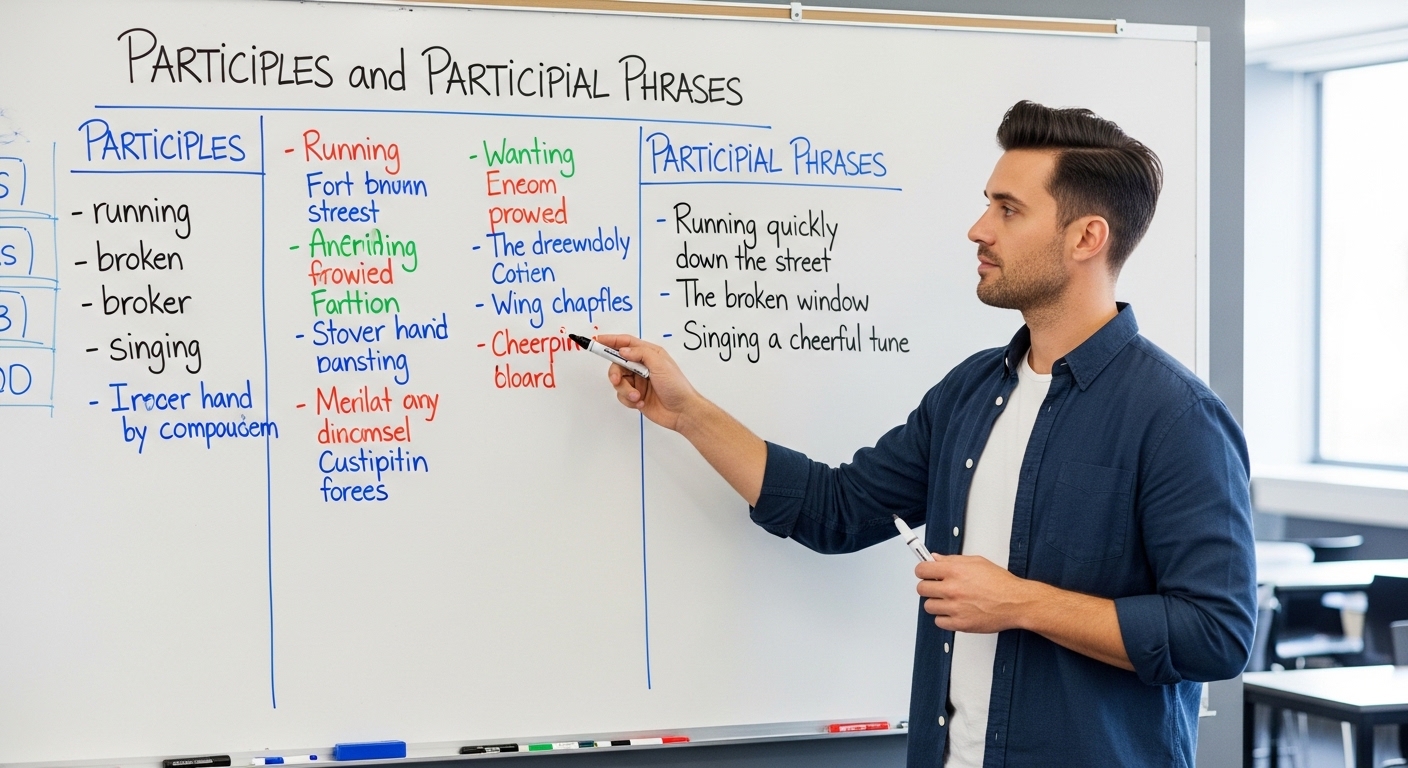
There’s something kinda magical about the way words can dance around each other, don’t you think? I was sittin’ in a sunlit cafe once, watchin’ a toddler a tiny baby girl, actually reaching out with her chubby fingers for a crumpled napkin, and I realized…
language does the same kinda thing. Every verb and adjective in a sentence can stretch, bend, and pirouette to tell a story, kinda like that tiny hand grabbing at the world. That’s where participles and participial phrases step in the unsung heroes of sentence structure, the subtle sculptors of writing flow.
If you’ve ever wondered why some sentences sing while others stumble, or why your description in writing sometimes feels flat, well, participles are like that sprinkle of sugar on a warm strudel they elevate, embellish, and bring action to life.
Today, we’re diving deep, sprinkling in visual aids, quirky anecdotes, and practical educational content types like definition cards, worksheets, and even ideas for short-form instructional video to make these grammar gems stick in your memory.
| Concept | Definition / Function | Example | Notes / Tips |
|---|---|---|---|
| Participle | A verbal that acts like an adjective, describing a noun | Crying baby, Sunburned Alan | Can be present (-ing) or past (-ed, -en) |
| Present Participle | Shows ongoing action | Running student, Laughing teacher | Ends in -ing; describes current/continuous action |
| Past Participle | Shows completed action | Beaten path, Frosted cake | Often ends in -ed, -en, -t; can describe states |
| Perfect Participle | Indicates completed action relative to another | Having finished her homework, the student went out to play | Combines “having + past participle” |
| Participial Phrase | A group of words led by a participle adding action and detail | Beaming with pride, the new graduates flipped their tassels | Adds description/emotion; enhances sentence flow |
| Dangling Participle | Misplaced participle causing confusion | Running quickly, the finish line was crossed by the graduate | Always place participle next to the noun it describes |
| Tips for Writing | Use small phrases, mix participle types, avoid dangling participles | Crying, the baby refused her bottle | Adds sentence detail and action incorporation in writing |
What is a Participle Anyway?
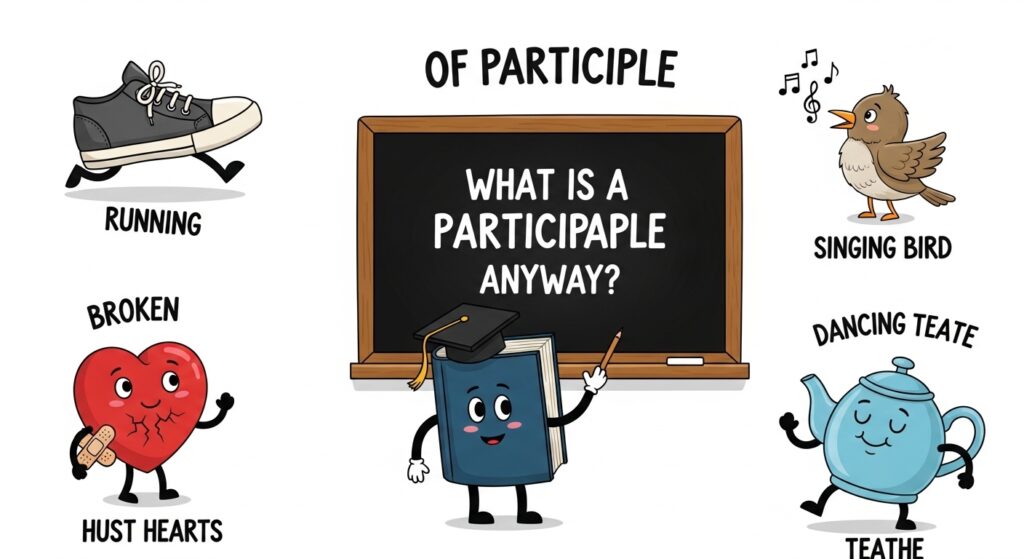
Let’s start super simple, but in a kinda messy, real-life way because language is messy, isn’t it? A participle is basically a verbal form, which means it comes from a verb but acts like an adjective. So it can describe a noun while still carrying some of that action punch from the verb.
- Example: The crying baby was inconsolable until she saw her mother.
Here, “crying” is a present participle it’s verb-y, but it’s describing the baby. Not just saying what she is doing, but painting a little motion picture in your head.
There’s also the past participle, which often ends in -ed (but watch out, English is sneaky) and can show completed action:
- Example: Sunburned Alan struggled to find a comfortable sleeping position.
See? You get a sense of what’s happening and who’s involved, all in two words. That’s participles at work making sentences more alive than a plain “Alan was uncomfortable.”
Diving Into Participial Phrases
If a participle is a single actor, a participial phrase is a whole mini-drama. It’s a group of words led by a participle that gives extra description or action incorporation in writing.
- Example: Beaming with pride, the new graduates flipped their tassels and cheered.
Here, “beaming with pride” is a participial phrase it sets the scene, paints the emotion, and lets you feel the moment without adding another sentence. Participial phrases are like the jazz hands of English grammar flamboyant, optional, but oh-so-effective.
Dangling Participles The Grammar Traps
Ah, beware the dangling participle. It’s like putting the baby in the stroller but forgetting to attach the straps. The sentence might sound funny, or worse, confusing:
- Wrong: Running quickly, the finish line was crossed by the beaming graduate.
- Better: Running quickly, the graduate crossed the finish line, beaming with pride.
See? Misplaced participles can flip meanings in a blink. They’re sneaky little grammar traps, especially for students learning English grammar.
Why Teachers Love Participles

Some teachers swear by participles. They’re gold for student engagement, because you can incorporate action in writing without overloading your sentences.
You can make even the driest sentence sing with a tiny modifier or participle. And trust me, no frustrated student ever forgets the one time they wrote:
- Crying, the baby refused her bottle.
Instant clarity, instant mental image, instant “aha!” moment. That’s why GrammarFlip and other platforms push instructional resources like quick review exercises and educational videos for participles.
Types of Participles and Their Uses
Let’s break ‘em down, in a kinda quirky, real-life, imperfect way that sticks.
Present Participles (-ing)
Used to show ongoing action, emotion, or state:
- Crying baby
- Running student
- Laughing teacher
They’re your go-to for sentence detail that feels alive.
Past Participles (-ed, -en, etc.)
Used to show completed actions or states:
- Beaten path
- Sunburned Alan
- Frosted cake
You can also use them in participial phrases for extra flourish:
- Exhausted from the long hike, the student fell asleep immediately.
Perfect Participles
Mixes action with time nuance. Usually having + past participle:
- Having finished her homework, the student went out to play.
It’s sophisticated, elegant, and oh-so-satisfying in long-form instructional video examples.
Participles in Real-Life Sentences
You might think, “okay, but when would I ever use this?” Well, participles sneak in everywhere. Check out these quirky examples from real life:
- The pastry chef topped the strudel with a large dollop of whipped cream, humming a tune.
- Frustrated student slammed his textbook shut, tossing it onto the floor.
- Beaming graduates waved at the crowd, their caps wobbling slightly.
Notice how the participles and participial phrases add action, emotion, and visual cues. They turn a static sentence into a mini-story.
Tips for Writing with Participial Phrases
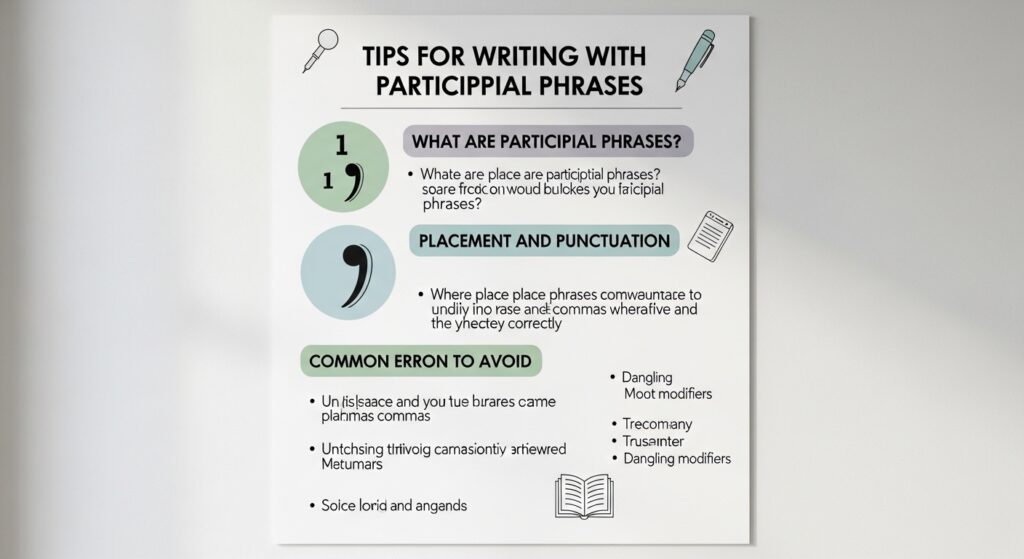
- Start small a single participle at the beginning of a sentence can already add drama.
- Mix it up alternate present participles, past participles, and perfect participles to vary sentence structure.
- Watch for dangling participles make sure the participle clearly refers to the noun next to it.
- Add emotion participial phrases can carry feelings: tired, happy, frustrated, excited… like little story nuggets.
- Experiment with placement beginning, middle, or end of a sentence, each spot gives a different rhythm.
Incorporating Participles in Educational Materials
Teachers and students alike can get super creative with participial phrases. You can use:
- Worksheets with fill-in-the-blank sentences for practice.
- Definition cards with examples like crying baby or sunburned Alan.
- Memorable images showing the sentence visually.
- Short-form instructional video for 60-second demos of adding action to sentences.
- Long-form instructional video for step-by-step mastery.
The idea is to reinforce learning with multi-modal content that sticks, not just dry text.
Participles Across Languages and Cultures
Here’s a fun fact: many languages use similar grammar concepts, but English loves to be tricky. In French, for example, you might see participe présent, which functions similarly but with a more rigid placement.
In Hindi, participles often carry tense markers that subtly shift meaning. Even in everyday celebrations, like welcoming a baby girl, descriptions like “crying baby” or “beaming with pride” appear in cards, social media posts, and cultural narratives showing how universal participial storytelling really is.
Practical Examples for Writers
Imagine you’re crafting a short story, or even educational content types like definition cards for students:
- Crying baby woke the whole house, demanding attention.
- Excited students spilled into the hallway after the exam results.
- Sunburned Alan, squinting at the sunset, vowed never to skip sunscreen again.
- Having finished her strudel, the pastry chef wiped the counter and smiled.
Notice how each participle or participial phrase layers action and emotion, often replacing what could’ve been an entire sentence.
How to Write Your Own Participial Phrases
Writing your own? Easy, if you think like a painter instead of a robot:
- Pick the action (in sentences). What’s happening?
- Turn it into a participle: -ing for ongoing, -ed for completed, or having + past participle for nuance.
- Decide who or what it describes. Stick it next to that noun.
- Optionally, extend into a participial phrase for extra flair.
- Example: Running toward the bakery, the pastry chef tripped but caught the tray just in time.
Voila. You’ve got drama, action, and description all in one.
Frequently Asked Questions
what is a participial phrase
A participial phrase is a group of words that starts with a participle and describes a noun or pronoun, adding more detail or action.
participle or participial phrase.
A participle is a single word used as an adjective, while a participial phrase includes the participle plus its modifiers or objects.
participle or participial phrase
A participle modifies a noun by itself, whereas a participial phrase gives extra information by combining the participle with related words.
participle phrases examples
Examples: “Running down the street, she tripped and fell” or “Covered in chocolate, the cake looked delicious.”
participial phrase worksheet
A participial phrase worksheet provides exercises for identifying and using participles and participial phrases in sentences.
Read this Blog: https://marketbellione.com/participles-and-participial-phrases/
Conclusion: Why Participles Matter
Participles and participial phrases aren’t just fancy grammar rules for frustrated students. They’re storytelling tools, emotional amplifiers, and clarity boosters.
Whether you’re teaching writing skills, creating visual aids for student engagement, or simply writing a card for a crying baby or beaming graduate, participles give life to sentences.
So next time you scribble a note, pen a story, or craft a long-form instructional video, sprinkle in a few participles. Let your words dance. Let your sentences breathe.
And remember, whether you’re welcoming a baby girl or describing sunburned Alan, a participle might just be the heartbeat of your story.