
Sometimes, when i’m scribbling down thoughts in the quiet of the night, i feel like words themselves are little dancers twirling, leaping, and settling into places you never thought they’d fit.
And then comes the participle, showing up unannounced, a graceful word that’s part verb but acting like an adjective, painting life into the bland walls of sentences.
Imagine opening a letter and seeing: “Beaming with pride, the new graduates flipped their tassels and cheered.” Just a few words, yet suddenly you’re there, under the confetti, feeling the warmth of accomplishment.
That’s the magic of participial phrases. They don’t just tell they show, describe, and add a kind of cinematic flow to writing that dry grammar rules rarely capture on their own.
Yet, despite their elegance, participles are tricky little beasts. A misplaced one, and suddenly your reader sees “dangling participles” doing acrobatics across the page, making you wish someone handed you GrammarFlip GrammarFlip on a silver platter for rescue. But once you get them, oh, the possibilities are endless action, description, emotion, all rolled into compact, punchy bursts.
So buckle up. We’re diving headfirst into the world where verbs wear costumes of adjectives, and sentences come alive in ways that ordinary verbs and adjectives alone can’t accomplish.
| Concept | Definition / Use | Example |
|---|---|---|
| Participle | A verb acting as an adjective. Can be present (-ing) or past (-ed/-en). | The crying baby was inconsolable. |
| Participial Phrase | A participle plus modifiers, objects, or complements that adds action or description. | Beaming with pride, the new graduates flipped their tassels. |
| Present Participle | -ing form, shows ongoing action. | Running quickly, she reached the finish line. |
| Past Participle | -ed/-en form, often shows completed action. | Sunburned from the beach, Alan struggled to sleep. |
| Dangling Participle | A misplaced participle that does not clearly modify the correct subject. | Walking down the street, the trees whispered. → Wrong |
| Gerund | A verb acting as a noun. | Swimming is fun. |
| Infinitive | to + verb, expresses purpose or action. | To swim in the lake is exciting. |
What is a Participle? A Quick Peek
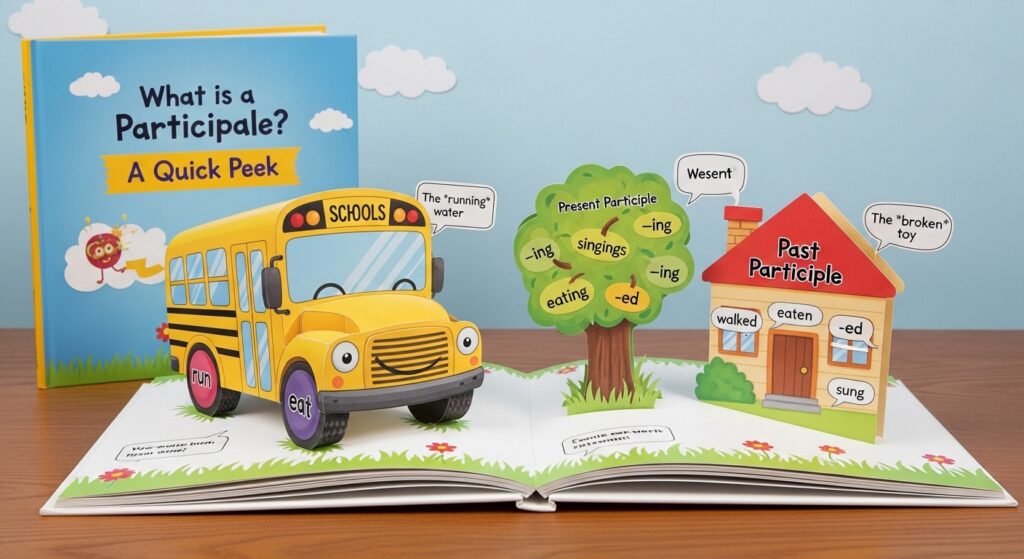
At first glance, a participle looks like a verb. You’ll see endings like -ing or -ed, but don’t be fooled it’s moonlighting as an adjective. Think of it like Alan’s neighbor’s cat: always doing something, yet somehow becoming part of the furniture of the sentence.
- Present participle: The crying baby was inconsolable until she saw her mother.
- Past participle: Sunburned from his day at the beach, Alan struggled to find a comfortable sleeping position.
Notice how these words aren’t just doing they’re describing, adding mood, action, and context simultaneously. And when you bundle them with participial phrases, the sky’s the limit.
Participial Phrases: Sentences That Sing
A participial phrase is basically a participle and all the words around it, working together like a tiny orchestra. It’s like giving your sentence a little soundtrack: sometimes dramatic, sometimes whimsical. Consider:
- “The pastry chef topped the strudel with a large dollop of whipped cream.”
Simple? Sure. But turn it into a participial phrase explosion:
- “Topping the strudel with a large dollop of whipped cream, the pastry chef smiled at the delighted customers.”
Suddenly, the sentence moves, breathes, describes, and even winks at the reader. Participial phrases are essential for writers who don’t want their prose to feel like dry textbook material, even if you’ve been staring at definition cards and visual cues all week.
The Dangling Participles That Haunt Us
Ever written: “Walking down the street, the trees whispered secrets to me.” and thought it was fine, until your friend laughed and said, “The trees were walking??” That’s a dangling participle, folks. The participle is great, but it’s not connected to the right subject, and now your sentence is performing acrobatics that confuse readers.
Fixing it can be fun:
- Corrected: “Walking down the street, I heard the trees whisper secrets to me.”
See? Now it’s grounded, yet still full of life. Quick review, anyone? This is why teaching tools like free worksheets or long-form instructional videos often spend extra time on dangling participles because they’re deceptively tricky, but once understood, make your writing flow feel effortless.
Using Participial Phrases for Emotional Depth

The beauty of a participial phrase isn’t just grammar it’s the power to evoke emotion. Imagine welcoming a newborn into your life: “Holding her tiny fingers, tears of joy filled my eyes.” The participial phrase doesn’t just tell; it transports the reader into that intimate moment.
Here’s more ways you can layer emotion and action:
- “Trembling with excitement, she unwrapped the letter she had waited weeks to receive.”
- “Laughing under the summer rain, the children forgot their worries.”
- “Covered in flour, Alan realized he might have overbaked the cookies.”
Notice the mix of action, description, and subtle humor? That’s the sweet spot where participles shine. In fact, research on student engagement / learning / understanding suggests visualizing sentences with participial phrases boosts better retention they’re mini-snapshots that stick.
Participle vs. Gerund vs. Infinitive: Sorting the Trio
If participles are actors, gerunds are stagehands, and infinitives are choreographers. Sounds chaotic? A bit. Let’s untangle:
- Gerund a verb acting as a noun: “Swimming is my favorite hobby.”
- Infinitive to + verb, often expresses purpose: “To swim in the ocean is thrilling.”
- Participle a verb acting as an adjective, often part of a participial phrase: “Swimming quickly, she reached the shore first.”
The distinction matters, especially if you’re crafting sentences that flow naturally while still solidifying understanding. And if you toss a little humor in your examples, it’s unforgettable: “Alan, fearing the splash, ran like a confused penguin.”
Creative Uses in Storytelling
Wanna know a secret? Writers often abuse participial phrases in a good way. They pack info into memorable images without breaking the rhythm of the story.
- Suspense: “Hearing footsteps behind her, she ducked into the shadowed alley.”
- Comedy: “Tripping over the garden hose, Alan managed to knock over three gnomes and a flamingo statue.”
- Reflection: “Sitting alone by the lake, the old man watched the sunset melt into the horizon.”
Notice how in all these, the phrase comes at the beginning, middle, or end, giving writers flexibility. Instructional videos often highlight this variety because seeing visual cues alongside sentences helps students grasp the subtle shifts in sentence detail / sentence description.
Tips for Writing Your Own Participial Phrases

Ok, you’re ready to dive in, but a few tips to make it smooth:
- Always match your participle with the correct subject to avoid dangling mishaps.
- Experiment with placement: beginning, middle, end it changes the tone and pace.
- Use them for emotion: whether humor, suspense, or tenderness, participial phrases are mini emotional engines.
- Combine with adjectives and verbs for richer description.
Here’s a quick exercise: take a bland sentence like “Alan read the book.” and try:
- “Sipping his coffee, Alan read the book, laughing quietly at the irony.”
Feels alive, doesn’t it? That’s participial magic.
Teaching Participles and Participial Phrases
For those in classrooms or homeschooling situations, these pedagogical tools & media are lifesavers:
- Long-form instructional videos great for deep dives.
- Short-form instructional videos perfect for quick memory hacks.
- Definition cards flashcards with examples like “The frustrated student shut his textbook and gave up on studying.”
- Memorable images link visuals to phrases; the more absurd, the better.
- Free worksheets practice makes perfect.
Anecdote: I once had a student named Alan who struggled with dangling participles. We turned it into a mini comic striphe laughed so hard, he remembered every rule for weeks. That’s why mixing humor, visuals, and action (as incorporated in participial phrases) works wonders.
Common Mistakes and How to Fix Them
- Dangling participles already covered, but always double-check who is doing what.
- Overuse too many participial phrases in a row, and your prose sounds like a toddler’s spaghetti art.
- Verb tense confusion make sure your participle matches the timing of your sentence.
Quick fix: read your sentences aloud. If it trips your tongue, it’s probably confusing your reader too.
Participle Phrases in Everyday Writing
Surprise! You encounter them all the time: news articles, blogs, texts, even greeting cards. They sneak in to provide action and description efficiently. For instance, in a baby card:
- “Giggling and wiggling in her tiny socks, the newborn brought joy to everyone in the room.”
See how participial phrases can make something ordinary feel cinematic? That’s their superpower.
Frequently Asked Questions
Participle or Participial Phrase
A participle is a verb form used as an adjective, while a participial phrase includes the participle and any related words, functioning together as an adjective.
Participle or Participial Phrase
This highlights the distinction: a single participle modifies a noun or pronoun, whereas a participial phrase provides more detail or context in a sentence.
Participle Phrases Examples
Examples include: “Beaming with pride, she accepted her award” or “The frustrated student gave up studying,” showing how participial phrases describe nouns.
Participial Phrase Worksheet
A participial phrase worksheet provides exercises to identify and use participial phrases correctly, reinforcing grammar skills through practice.
Participle and Participial Phrases
These elements add action, detail, and description to writing, enhancing sentence clarity and flow without needing separate clauses.
Read this Blog: https://marketbellione.com/simple-predicates-and-complete-predicates/
Conclusion: Embrace the Dance
Participles and participial phrases aren’t just grammar they’re tools for storytelling, emotion, humor, and life itself on paper. Whether you’re teaching students with visual cues, crafting memorable images, or just trying to write that perfect note to your friend, participial phrases add depth, action, and sentence description like nothing else.
So next time you write, think like Alan, sunburned but curious: move your words around, let them dance, mix action and description, and above all, don’t fear a dangling participle it’s just a chance for creativity.
Use GrammarFlip GrammarFlip if you need, peek at definition cards, watch a few instructional videos, and watch your writing flow become smoother, richer, and unforgettable.
Remember, writing is alive, and participial phrases are the heartbeat. Let your sentences breathe, laugh, and sing. And maybe, just maybe, your reader will feel it too.