
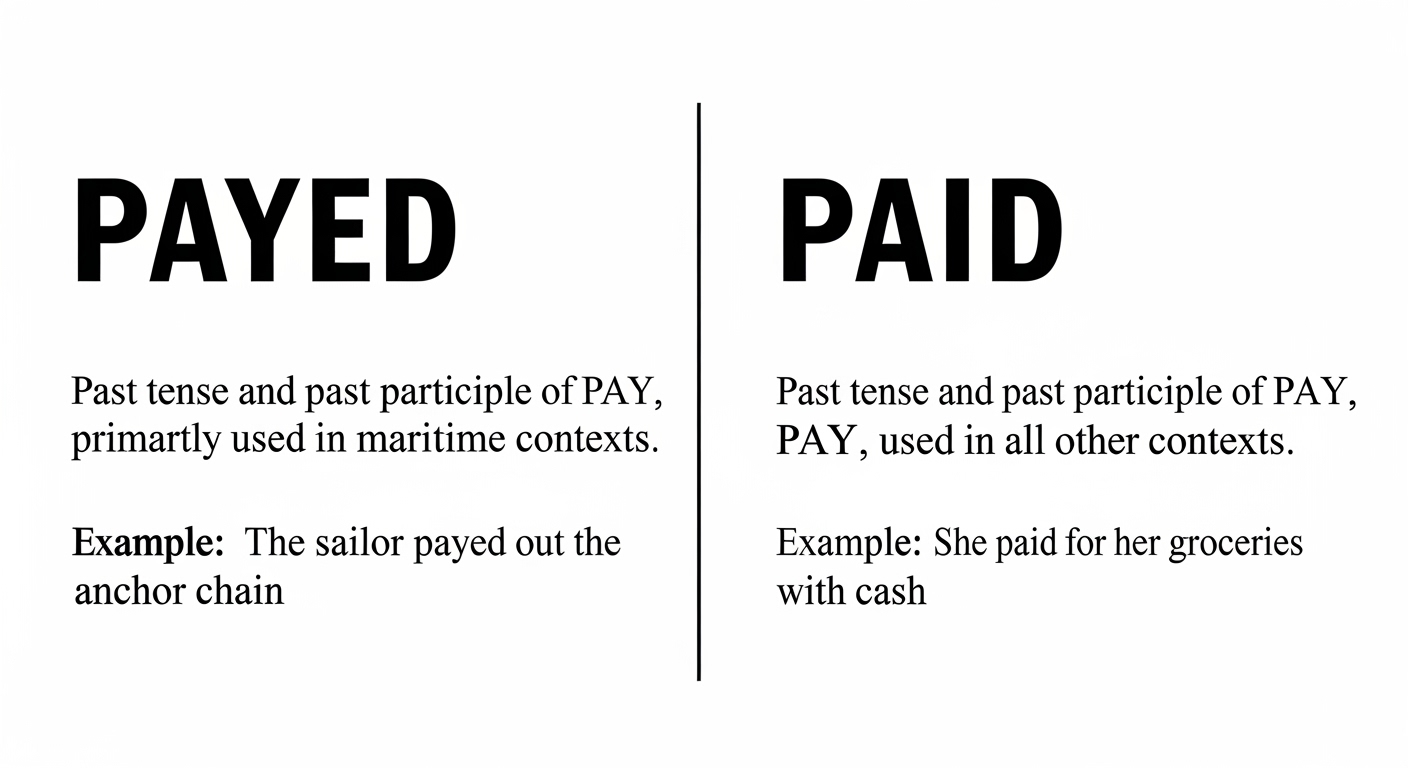
Language, they say, is a living thing it breathes, evolves, and sometimes trips us up in ways that make us go, “Wait… did I really write that?” If you’ve ever stared at a text, email, or even an old diary and hesitated over “payed” vs. “paid”, you’re not alone.
English loves its quirks, throwing curveballs from the 1800s to modern-day CNN headlines. But here’s the thing this little past participle puzzle actually has stories, history, and even some nautical adventures tucked in it. Let’s dive in, like a sailor pitching waterproof coating on a boat deck, into the murky waters of payed vs. paid.
Here’s a concise, easy-to-read table summarizing payed vs. paid:
| Feature | Paid | Payed |
|---|---|---|
| Part of Speech | Past tense & past participle of pay | Simple past (nautical context) |
| Meaning | Money given, attention given, debts settled | Coated a ship’s seams with pitch; waterproofing |
| Context | Financial, idiomatic, figurative, everyday English | Nautical, historical, maritime |
| Example 1 | I paid my taxes yesterday. | The sailors payed the boat deck before the storm. |
| Example 2 | She paid close attention to the lecture. | He payed the seams of the ship carefully. |
| Origin | Latin | Old English / nautical tradition |
| Frequency | Common, standard | Rare, specialized |
| Tip to Remember | Money, attention, dues → paid | Ships, decks, pitch → payed |
A Personal Dive Into Words
I remember the first time someone corrected me for writing “I payed the bill.” I was horrified, feeling like I’d just hit a hidden iceberg in the calm sea of grammar.
Turns out, paid is the regular past tense of pay, rooted in Latin origins, used in finance, debts, and everyday transactions money given, taxes settled, mortgages concluded.
Payed, on the other hand, is a quirky, irregular cousin: rare, almost theatrical, and mostly lives in nautical contexts, where sailors payed the seams of a ship to keep her waterproof. I felt both embarrassed and fascinated English had a tiny secret language within its language.
Language lovers, rejoice: this isn’t just a spelling correction. Understanding when to use paid versus payed gives your writing credibility, helps you pay attention to subtle distinctions, and even keeps you from suffering little miscommunications.
Understanding “Paid”: The Everyday Workhorse
Paid is everywhere. Bills, wages, tips, taxes if money changed hands or attention was given in the past, “paid” is your go-to.
- I paid my mortgage in full last week; felt like a huge weight lifted.
- She paid close attention to the CNN coverage of the Biden administration’s policy.
- After I paid my dues, I finally felt respected in the club.
Notice how versatile it is? Paid works in financial transactions, in giving attention or respect, and even in idiomatic expressions like “rob Peter to pay Paul”. Its origins trace back centuries, with historical usage in the 1800s showing just how stubbornly regular it is in English grammar.
Think of paid as your reliable yacht always seaworthy, smooth sailing, and fully dependable.
Exploring “Payed”: The Rare Nautical Gem
Payed is rarer, but boy, it’s fancy when it appears. Its life is mainly on boats, ships, and yachts, where sailors payed (coated with pitch) seams to ensure no water seeps through.
Imagine the deck of a ship glistening under the sun after being payed a practical, historical necessity that echoes back to mariners who sang songs about stormy nights and creaking masts.
Some examples:
- The crew payed the boat deck to make her fully waterproof before setting sail.
- Every autumn, sailors payed the seams to prevent leaks during winter storms.
- He payed no attention to superstition, but the hull stayed dry, thanks to the meticulous coating.
In modern English, payed rarely pops up outside of this nautical context, which makes it a linguistic trophy for curious readers.
Common Mistakes and How to Avoid Them
You’d be surprised how often even seasoned writers mix these two up. Often, paid is replaced by payed in emails, casual writing, or even social media posts like on Twitter, giving a slightly quirky flavor to an otherwise normal sentence.
Mistakes to watch for:
- Incorrect: I payed the bill yesterday.
- Correct: I paid the bill yesterday.
- Incorrect: She payed attention to the lecture.
- Correct: She paid attention to the lecture.
- Correct use of payed (nautical): The sailors payed the seams before the storm hit.
Think of it like this: if it involves money, attention, dues, or debts, default to paid. If it’s a historical, nautical, or specialized context, then payed may actually be the right choice.
Examples From Real Life and History
Language nerds, this part’s for you. Let’s sprinkle some juicy historical and contemporary context.
- In the 1800s, you’d often see paid in newspapers covering financial transactions, loans, and debts the backbone of city economies.
- In 2022, BBC reported on the Biden administration’s stimulus packages, using paid in coverage of citizens receiving benefits.
- easyJet flight attendants were once noted jokingly on Twitter for claiming passengers had “payed” attention to safety announcements proof that colloquial humor sometimes bends the rules.
Even when subtle, these examples show how paid dominates everyday communication, while payed preserves a niche charm.
Grammar Rules, Pronunciation, and Idiomatic Usage
Okay, here’s the nitty-gritty:
- Paid: past tense and past participle of pay. Pronounced /peɪd/. Irregular but widely accepted. Works in both financial and figurative contexts: pay your taxes, pay respect, pay attention, pay dues.
- Payed: simple past of pay in the nautical sense. Pronounced the same, but used sparingly. Applies to coating a boat deck, pitching seams, or making a ship seaworthy.
Idiom alert: “paid off” means a successful result, not a ship’s deck. “Pay respect” is about acknowledgment, not pitching seams. Context is king, folks.
Fun Anecdotes From Nautical Life
Imagine Captain Hargrove in 1820, explaining to the crew, “Make sure every plank is payed, lads, or we suffer loss when we hit rough waters.” It wasn’t just a job it was survival.
The paying of a ship involved heated pitch, careful spreading, and teamwork. A misstep could mean water flooding the hold, ruining cargo, or worse, sinking a ship entirely.
Compare that with modern life: paying your mortgage in full isn’t life-threatening, but the relief feels just as intense. Language carries these tiny, metaphorical echoes of history.
Why People Still Confuse Them
Part of the confusion is because payed looks like it should be the standard past tense English loves its traps. Add in casual social media posts, texting, and global English variations, and suddenly, what’s “correct” is context-dependent.
Some linguistic scholars even argue that as English continues evolving, words like payed could see resurgence in specialized or figurative contexts much like old-fashioned spelling comebacks.
Practical Tips to Never Mess Up Paid vs. Payed
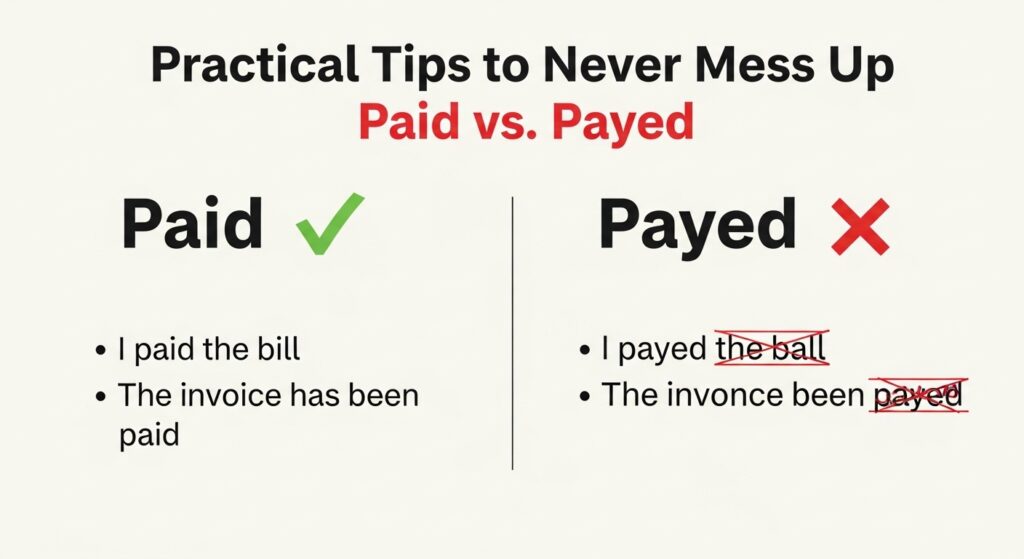
Here’s your action plan:
- If it’s financial, educational, or attention-related, use paid. Think taxes, dues, attention, debts, money, and compensation.
- If it’s nautical, historical, or involves coating a ship, use payed.
- When in doubt, run a quick check: “Did someone literally coat a deck or pitch seams?” Yes payed. Otherwise paid.
- Reading contemporary sources like The Guardian or BBC helps you see modern usage in context.
- Keep a mini mnemonic: “Money is paid, ships are payed.” Works surprisingly well.
Creative Writing Examples
Sometimes, seeing examples in playful or metaphorical sentences helps them stick.
- I paid attention to her story, hoping to learn from her mistakes.
- The sailors payed the boat deck, sealing the creases against the sea’s assault.
- After he paid off his mortgage, he felt like he had just set sail on calm waters, without debt dragging the anchor.
- She paid her respects at the ceremony, placing flowers and whispering memories.
- The old ship, payed with care, floated elegantly into the harbor, a testament to craftsmanship.
Mix financial and nautical imagery to remember the difference your brain loves stories, and stories stick.
Frequently Asked Questions
payed vs paid
“Paid” is used for financial transactions or general past tense of “pay,” while “payed” is rare and mostly nautical, meaning to coat parts of a boat with waterproof material.
payed
“Payed” refers specifically to applying pitch or a waterproof coating to a boat, not to making a payment.
payed or paid
Use paid for money or general past tense; use payed only in a nautical context related to boats.
is payed a word
Yes, “payed” is a word, but it is rare and mainly used in marine contexts.
difference between paid and payed
“Paid” relates to money, work, or attention, while “payed” relates to coating a boat with waterproof material; both are past forms of “pay” but in different contexts.
Read this Blog: https://marketbellione.com/able-and-ible/
Conclusion: Paying Attention to Words
Language is like a boat: if you don’t maintain it, leaks happen. Words have history, culture, and life. Paid dominates daily transactions, idioms, and figurative usage. Payed survives as a rare, historical, nautical delight a reminder of English’s seafaring past.
Next time you write, notice the tiny histories in your words. Pay attention. Pay respect to their lineage. And maybe, just maybe, find joy in knowing that a single letter change can tell a story spanning centuries, oceans, and human endeavor.
So go on, pay forward your newfound knowledge comment below with your own examples, confusions, or little nautical tales. Let’s make the world a slightly more grammatically joyful place, one paid or payed at a time.