
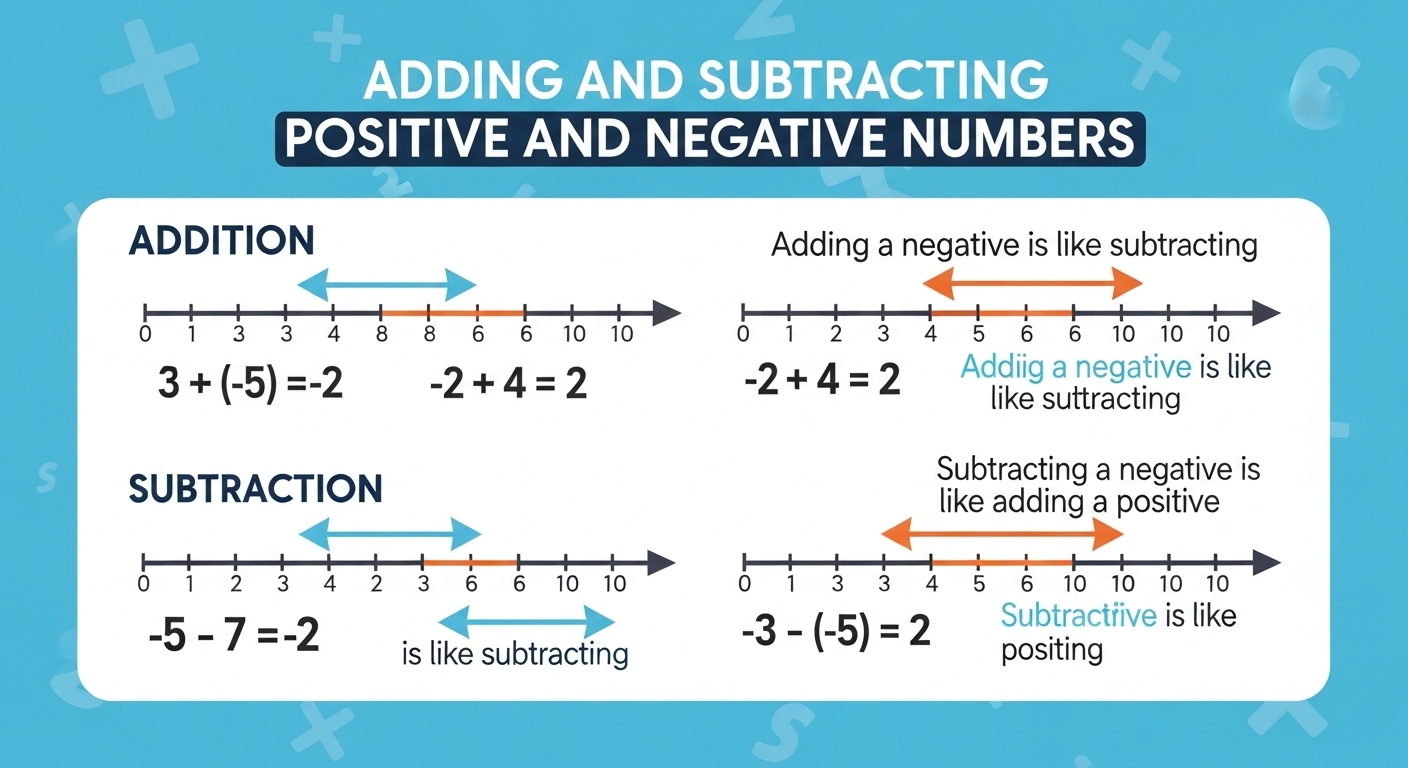
You ever sit down with a cup of coffee, look at your bank balance, and think… why does math always gotta feel like a tiny puzzle hiding in plain sight? Yeah, i know, numbers can be kinda sneaky.
But here’s the thing adding and subtracting positive and negative numbers isn’t just a classroom exercise. It’s a peek into life itself. I remember one rainy afternoon, staring at a number line my teacher drew, thinkin’ about how the world has its ups and downs, much like positive numbers and negative numbers.
You go up 500 meters on a hill, then slide down 240 meters into a valley, and boom math reflects life. And honestly, when you start thinking like that, all those seemingly dry mathematical operations suddenly get kinda poetic.
| Operation | Rule | Example | Result |
|---|---|---|---|
| + Positive + Positive | Add absolute values, keep positive | 5 + 12 | 17 |
| + Negative + Negative | Add absolute values, keep negative | −7 + −5 | −12 |
| + Positive + Negative | Subtract smaller absolute value from larger, take sign of larger | 12 + (−7) | 5 |
| + Negative + Positive | Subtract smaller absolute value from larger, take sign of larger | −12 + 7 | −5 |
| Positive Positive | Subtract absolute values, keep sign of larger | 12 − 5 | 7 |
| Negative Negative | Subtract absolute values, take sign of larger absolute value | −12 − (−5) | −7 |
| Positive − Negative | Add absolute value of negative to positive | 7 − (−5) | 12 |
| Negative − Positive | Add absolute value of positive to negative | −7 − 5 | −12 |
Understanding Core Mathematical Entities
Before we jump into examples that’ll make you go “ohhh, now i get it!”, let’s get cozy with some core mathematical entities. These are like the characters in our number story.
- Integers the backbone, the whole warriors of the number world. They include positive numbers, negative numbers, and zero (0). Think of them as soldiers lined up along a number line, ready for addition and subtraction battles.
- Absolute value the ego of a number. Doesn’t care if you’re a −7°C chill or a 12°C warm hug, it only sees magnitude.
- Whole numbers basically the posh cousins of integers who avoid negative drama.
So whenever you’re tackling fundamental mathematics, these entities are your friends, not foes. Like, imagine telling a kid: “hey, −5 and 7 are gonna be buddies today.” Sounds silly, but it works in the math world.
Adding Two Positive Numbers: The Happy Path

Alright, we start simple because even the tallest mountain is climbed step by step. When you’re adding two positive numbers, it’s like piling blocks on top of each other straightforward joy.
- Example: 5 + 12 → easy, just add absolute values, you get 17.
- Imagine you’re walking up 500 meters and then another 240 meters. How high are you? 740 meters. That’s real-life applications folks!
Notice, nothing scary here. Integer rules say: keep the sign positive, trust the process. And honestly, this is the math that makes you wanna high-five your inner number nerd.
Adding Two Negative Numbers: When Life Feels Downward
Ok, now let’s talk gloom – adding two negative numbers. You think: “ugh, why bother?” but it’s actually predictable.
- Take 7 + 5 add the absolute values (7 + 5 = 12), then slap a negative sign in front 12.
- In real life? Imagine your bank account had an overdraft of 170, and another overdraft of 30 comes in (fees, sigh). Now you’re at 200. See? financial management is just math wearing fancy clothes.
It teaches a lesson too: sometimes negativity compounds, but math tells you exactly what’s happenin.
Adding a Positive and a Negative Number: Life’s Tug-of-War
Here’s where it gets fun. This is like a seesaw. Positive says “I got this!” Negative whispers “not so fast.” The rule: subtract the smaller absolute value from the bigger, keep the sign of the bigger.
- Example: 12 + (−7) → 12 − 7 = 5. Positive wins!
- Flip it: −12 + 7 → 12 − 7 = 5, but now negative rules → −5.
It’s literally life: gains and losses, ups and downs, temperatures like −7°C turning to 5°C, small victories and setbacks. And honestly, it makes mathematical reasoning way more relatable.
Subtracting Numbers: The Reverse Adventure
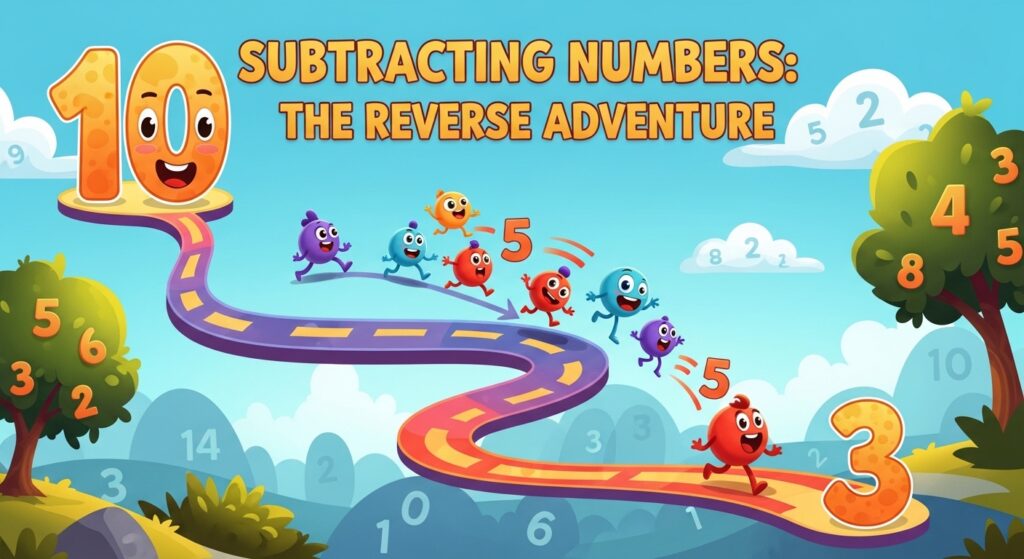
Subtraction’s kinda like retracing your steps on that number line. Rules differ depending on whether you’re dealing with positive numbers or negative numbers.
- Subtracting two positive numbers: 12 − 5 → just subtract absolute values = 7. Easy-peasy.
- Subtracting two negative numbers: −12 − (−5) → subtract absolute values (12 − 5 = 7), then take the sign of larger absolute value → −7.
- Subtracting positive from negative: −7 − 5 → add absolute value of positive to negative → −12.
- Subtracting negative from positive: 7 − (−5) → add absolute value of negative to positive → 12.
See? It’s all about following integer rules and respecting magnitude. It’s like life: sometimes you gain, sometimes you lose, sometimes you just have to do the math to know where you stand.
Real-Life Applications of Positive and Negative Numbers
Let’s make this really human, not just chalkboard math.
- Financial management / bank balances: You deposit 500, withdraw 200, overdraft −300? That’s subtraction and addition at work, helping you track investment gains and losses.
- Temperature changes: From7°C to 12°C and then down to 5°C, math helps track swings so you don’t freeze your socks off.
- Elevation / depth tracking: Climb 640 meters, descend 240 meters → you’re at 400 meters. Math doesn’t lie.
- Stock value changes: Bought at 100, lost 20, gained 57, lost 63 → integer rules again, keeping track of gains and losses.
The point: everyday life math is just arithmetic operations disguised in ordinary life. Once you spot it, suddenly math feels… alive.
Examples to Practice: Numbers in the Wild
Here’s a smattering of scenarios where you can flex your new problem-solving strategies:
- 7 + (−2) = ?
- −5 − 12 = ?
- 100 − 57 = ?
- −30 + 170 = ?
- 500 − 200 − 300 = ?
Notice how all these tiny puzzles sneak into practical math examples. It’s like spotting life lessons in grocery receipts.
Strategies for Confident Integer Handling
Sometimes rules are boring, but strategies can make math a bit like a game:
- Always check the absolute value first. Big picture first, small details later.
- Use a number line visually it’s easier to see magnitude comparison than guess.
- Think in terms of real life: “losing 5 meters in depth, gaining 12 meters height” – suddenly subtraction feels like hiking.
- Practice mathematical operations in small doses; mix positives and negatives for brain gymnastics.
Even seasoned adults forget these steps. That’s why a teacher once told me: “Math isn’t scary, it’s sneaky.” And honestly, they were right.
Fun with Integer Rules in Stories
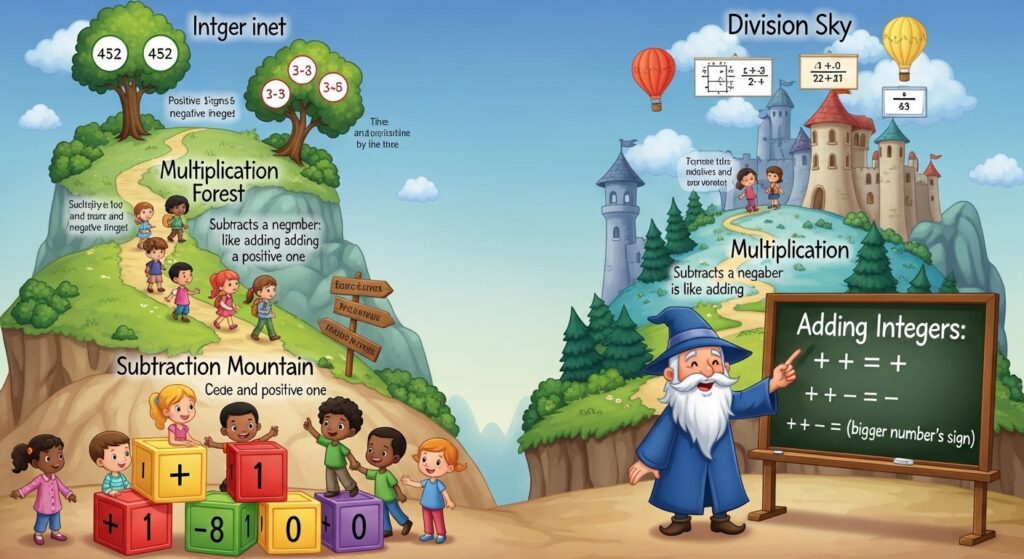
Let’s sprinkle some charm:
- Imagine you’re a pirate tracking treasures. +500 gold coins, −200 coins stolen. Math helps you survive mutiny.
- Or a grandma measuring flour: 12 cups, takes out 5, spills 2 → back to integer rules in the kitchen.
- Even daily moods follow this: happy + joy = more joy, sad + sad = deeper gloom, happy + sad = depends on magnitude.
See? mathematical concepts understanding isn’t confined to classrooms. It’s living, breathing, and often hilarious.
Read this blog: https://marketbellione.com/english-spelling/
Frequently Asked Questions
negative and positive rules
Positive numbers are greater than zero and represent gain, while negative numbers are less than zero and represent loss; their signs determine how they combine in addition and subtraction.
rules for adding and subtracting negative numbers
When adding negatives, combine absolute values and keep the negative sign; when subtracting, convert to addition and apply the rules of signs.
adding positive and negative numbers
Subtract the smaller absolute value from the larger and assign the sign of the number with the larger absolute value.
negative and positive number rules
The sign of a number indicates whether it is above (positive) or below (negative) zero, which affects all arithmetic operations with integers.
how to add and subtract negative numbers
For addition, combine absolute values based on signs; for subtraction, rewrite as addition and follow sign rules to find the result.
Conclusion: Making It Personal
So after all these numbers, rules, problem-solving steps, and quirky examples, here’s the takeaway: adding and subtracting positive and negative numbers is more than numbers. It’s life in integers. And you can make it personal:
- Track your finances in real-world units.
- Measure steps, hikes, and depths.
- Even track emotions if you’re daring.
And just like welcoming a baby girl brings joy and change into a home, mastering these numbers brings clarity and confidence. Play with numbers, write them in a journal, and don’t be afraid to mess up – mistakes are part of the learning story.
Next time someone says, “ugh, I hate negative numbers,” smile and say: “Negative numbers just make positive wins sweeter.” Life, math, and adventure – all in a number line.