
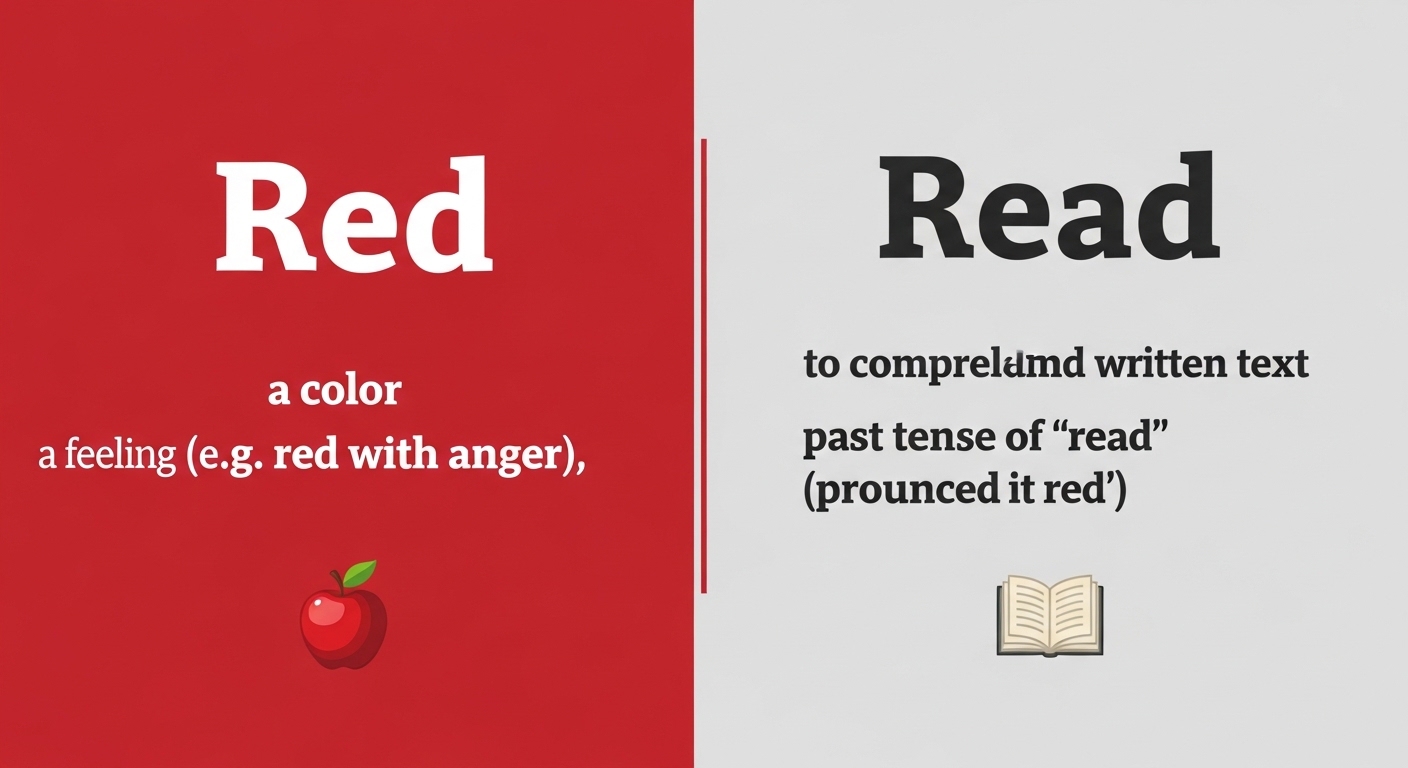
English is one of those languages that likes to play tricks on us. I still remember the first time I saw the words red and read side by side in a sentence and my brain just… froze.
I thought, “Wait, are they the same word? Did someone misspell this?” Turns out, no English just loves making us sweat a little. But beneath that confusion lies a fascinating world of pronunciation, spelling, emotion, and even culture.
Today, we’re gonna dive deep into red vs read, uncover their meanings, differences, and sprinkle in some quirky facts about how these words show up in our daily lives.
| Word | Part of Speech | Meaning | Pronunciation | Example |
|---|---|---|---|---|
| Red | Adjective | Color, emotion (love, danger, passion) | /rɛd/ | The apple is red. |
| Read | Verb | To look at and understand text | Present: /riːd/ ; Past: /rɛd/ | I read a book yesterday. |
Understanding the Basics: Red and Read
Let’s start simple, though simple here is relative. Red is a color, an adjective, and a symbol. It’s the color of fire engines, ripe strawberries, and sometimes anger or passion.
The word red is pronounced /rɛd/, rhymes with “bed,” and is a primary color on the visible light spectrum. In terms of grammar, it’s mostly used as an adjective, but can also appear in compound nouns like red flag, red wine, or even metaphorically as in seeing red (anger).
Read, on the other hand, is a verb. And here’s where English flexes its muscles. Depending on tense, its pronunciation changes. Present tense: “I read every morning” is pronounced /riːd/.
Past tense: “Yesterday, I read a book” is pronounced /rɛd/ exactly like the color. Mind blown? Yeah, me too. That’s why homophones and heteronyms are such a headache and delight at the same time.
Quick Tip: Don’t Panic Over Spelling
Even native speakers stumble over read and red. The trick is remembering context: if it’s describing color or feeling, it’s red. If it’s talking about the action of interpreting text, it’s read, and pronunciation depends on tense.
Red – More Than Just a Color
Red isn’t just something you slap on a stop sign. In literature, culture, and emotion, red is packed with symbolism. It screams love, danger, power, and courage all at once.
Think about Valentine’s Day hearts, or red carpets at glamorous events humans have been drawn to this color for millennia. And in language, using red as an adjective can invoke emotions instantly:
- Her cheeks turned red from the cold, but also from embarrassment.
- The sunset painted the sky red, a warning that storms were coming.
- He felt red with rage, a fire that no apology could cool.
- The red ink on the page made him realize the mistake he overlooked.
- Their love burned red, unstoppable, passionate, and wild.
- Even a tiny red ribbon can symbolize courage and remembrance.
- When the traffic light turned red, she paused literally and figuratively.
Notice how some sentences are literal, some emotional, some metaphorical? That’s the magic of adjectives they carry shades of meaning beyond the dictionary.
Read – The Action Word That Confuses Everyone

Now, read. This little verb might look innocent, but it’s got layers. Its irregular verb nature means students often trip up: read, read, read same spelling, different sound. Irregular verbs like read remind us that English is living, historical, and sometimes… just mean.
Here are some ways read appears in real-life sentences:
- I read your message last night, but didn’t reply immediately.
- Have you read the latest article on grammarist.com?
- She likes to read before going to sleep; it’s her ritual.
- He read aloud to the children, bringing stories to life.
- We read the instructions carefully to avoid mistakes.
- My grandma always says, “You should read to understand, not just skim.”
- They read the contract twice before signing wisdom indeed.
See how context and tense guide pronunciation? Native speakers get it naturally, but English learners often need to slow down and practice.
Red vs Read: Homophones, Heteronyms, and Confusion
Here’s where things get funky. Red and the past tense read are homophones they sound the same but differ in meaning. Meanwhile, read as present vs past tense is a heteronym same spelling, different pronunciation. For linguists, this is phonology gold. For students? Slight panic.
- Homophones confuse because they sound identical but spelling matters: “I like red apples” vs “I read the book yesterday.”
- Heteronyms confuse because spelling is identical, but pronunciation flips: “I read a book” (present) vs “I read a book yesterday” (past).
Pronunciation, context, and a little memory trick go a long way. Here’s one tip: if you can swap in “looked at” instead of “read” and it makes sense, you’re probably dealing with past tense read.
The Grammar Angle: Irregular Verbs & Conjugation
Read is an irregular verb. That means it doesn’t follow the classic “-ed” ending for past tense. Like:
- Present: I read, you read, he/she/it reads
- Past: I read, you read, he/she/it read (but pronounced /rɛd/)
Students often confuse this when writing essays or emails, especially if they rely on phonetic spelling. Compare to regular verbs: “walk” “walked,” “talk” “talked.” Easy. But read? Gotta keep it in your mental toolbox.
And let’s not forget sentence examples these are golden for teaching:
- Incorrect: Yesterday I red a book.
- Correct: Yesterday I read a book.
Little changes in spelling and pronunciation can avoid ambiguity in written communication.
Red in Culture, Emotion, and Symbolism
Across cultures, red carries deep symbolism:
- In China, red is luck, happiness, and celebration.
- In Western cultures, it can symbolize love or warning (like “seeing red”).
- In fashion, a red dress often signals power, determination, or passion.
Even emotional states link to colors. Psychologists often note that people feel energized around red hues a mix of danger, courage, love, and strength. So the next time you choose words for writing, notice the subtle emotional undertones colors can provide.
Real-Life Anecdotes: Red & Read Confusion

My friend Sarah once told me about a hilarious mix-up: she wrote to her cousin, “I red your letter last night” her cousin stared for a minute before realizing she meant she read it. These tiny moments remind us that language is lived, not just learned.
Similarly, in classrooms, teachers often illustrate red vs read with real-life examples: marking homework in red, and then asking students to read aloud the corrections. It’s practical, visual, and sticks in memory.
Tips for Students: Avoiding the Red vs Read Trap
- Context check: Ask yourself, “Is it color/emotion or action?”
- Tense check: Present tense = /riːd/, past tense = /rɛd/.
- Memory aid: Associate red with visible light spectrum; associate past tense read with a book you’ve finished.
- Practice aloud: Pronounce sentences so your ear catches heteronyms.
- Write mini-stories: Like “I read a red book yesterday” see both worlds collide!
Grammarist.com is a great reference for deeper examples on irregular verbs and homophones.
Creative Ways to Remember Red and Read
- Draw a Red Card: every time you make a spelling mistake with read, put a tiny red dot on your notebook. Visual memory = strong memory.
- Mini Roleplay: act out sentences one person says “I read the letter,” another waves a red scarf. Kinesthetic memory helps.
- Songs & Rhymes: “I read a book that’s red, I read a book that’s red…” repeat it, weird but effective.
- Color & Action Journals: separate your notes with red headers for color adjectives and blue for verbs like read.
Fun Linguistic Factoids
- Did you know read is one of the oldest irregular verbs in English, appearing in Old English as rǣdan?
- Red comes from Old English rēad, connected to the Proto-Indo-European reudh- meaning red or ruddy.
- These tiny etymologies explain why English spelling and pronunciation are quirky it’s history lingering on the page.
Practical Advice: How to Use Red and Read Correctly
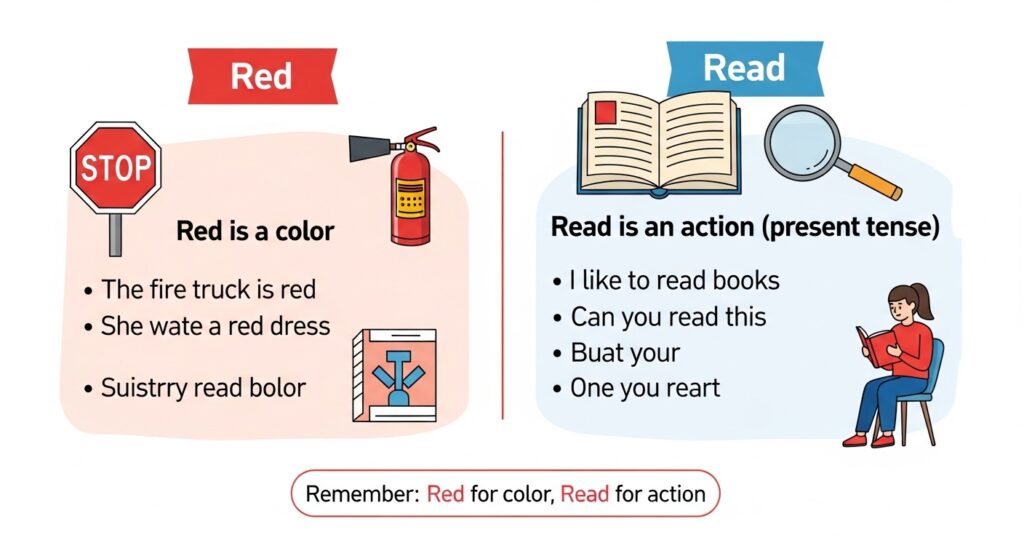
- Proofread: especially in emails, essays, or public posts.
- Contextual Examples: when teaching or learning, create sentences with both words.
- Synonyms: sometimes replace read with “peruse,” “study,” or “examine” to avoid confusion.
- Color Codes: in study guides, write red in red ink your brain loves consistency.
Frequently Asked Questions
read red
“Read” is a verb meaning to look at and understand written words, while “red” is a color; they sound similar in certain contexts but have very different meanings.
red vs read
“Red” refers to the color, and “read” is a verb; the key difference is one is an adjective describing a hue, and the other is an action.
read and red
These two words can sound the same in the past tense of “read,” but “red” is never a verb, so context determines their meaning.
how to spell read
The spelling is always “read,” but the pronunciation changes depending on tense: present tense “reed,” past tense “red.”
i red that book
This is incorrect; the correct sentence is “I read that book,” with “read” pronounced as “red” to indicate past tense.
Read this Blog: https://marketbellione.com/multitask/
Conclusion: Embracing the Beauty of Language
At the end of the day, red vs read isn’t just a grammar puzzle; it’s a window into the emotional, cultural, and historical richness of English. The color red connects us to feelings, warnings, and passion.
The verb read connects us to knowledge, imagination, and reflection. Together, they remind us that language is alive a canvas of vocabulary, pronunciation, irregular verbs, homophones, and heteronyms that paints our thoughts into the world.
Next time you pause over a sentence like “I read the red book,” take a moment to smile. You’re not just choosing words; you’re navigating centuries of history, culture, and emotion.
And hey, if you have your own quirky anecdotes about mixing up red and read, drop them in the comments let’s all celebrate the messy, beautiful, human side of English.