Ever noticed how some words just… hug you? Like, they wrap around your thoughts and linger, not letting go, kinda like the first time you hold a newborn baby girl and feel this tiny, warm heartbeat against your chest.
Words are magical that way. They’re bridges between what we feel and what we try to share. And among the myriad tools writers use to do this, figure of speech reigns supreme.
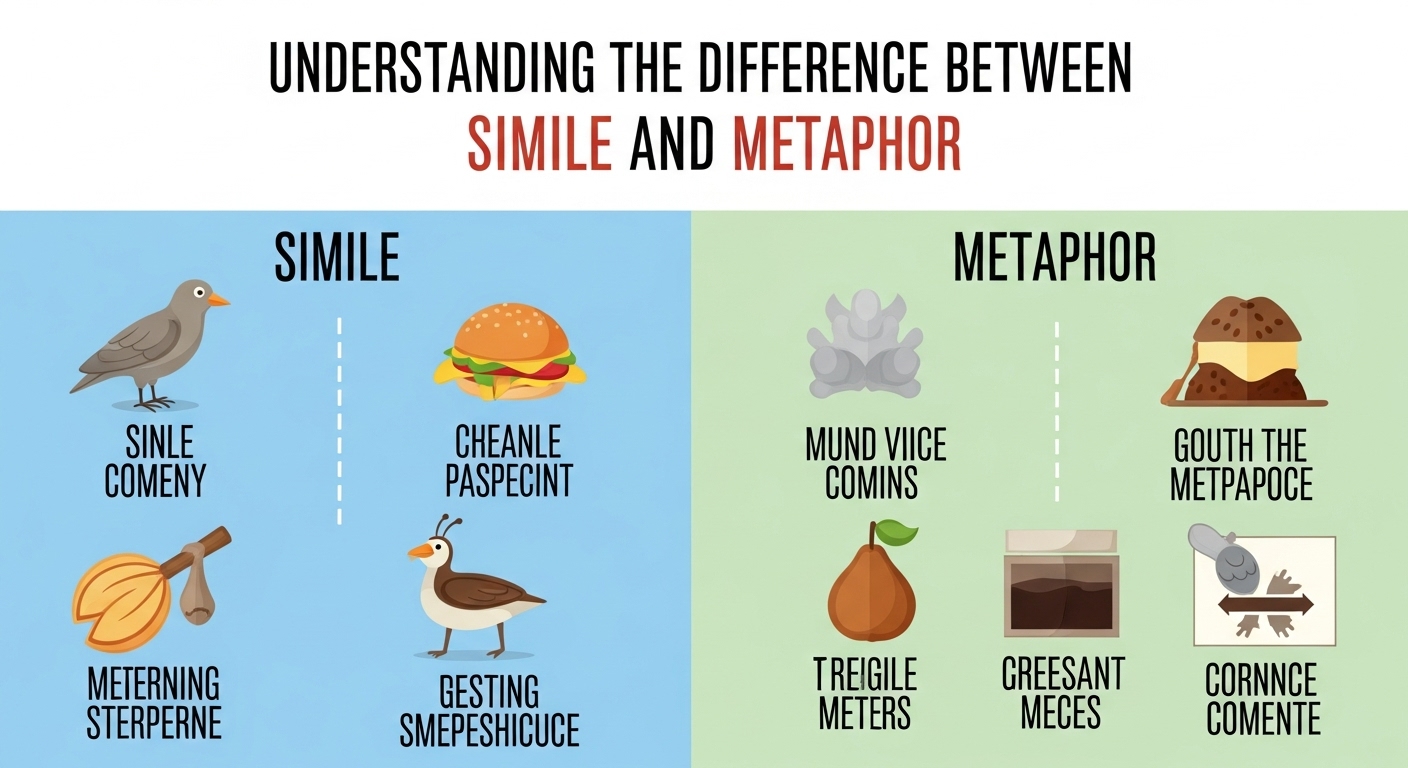
Today, we’re diving into two of its most enchanting forms: the simile and the metaphor. They’re cousins, they look alike sometimes, but oh boy, they dance differently.
Just as a parent might compare their daughter’s eyes to stars twinkling in a dark sky, writers compare, connect, and contrast experiences. But why bother knowing the difference?
Because knowing whether your expression is a simile or metaphor is like knowing if you’re holding a feather of lightness or a lion of bravery in your hands each carries its own force, its own emotional weight.
| Feature | Simile | Metaphor |
|---|---|---|
| Definition | A figure of speech that compares two things using “like” or “as” | A figure of speech that compares two things by saying one thing is another |
| Comparison Type | Explicit / Direct | Implicit / Implied |
| Example | Her eyes sparkled like stars. | Her eyes were stars. |
| Clarity | Clear and easy to understand | Requires interpretation; more poetic |
| Emotional Impact | Gentle, descriptive | Strong, immersive, often symbolic |
| Usage | Everyday speech, poetry, prose | Poetry, literature, expressive writing |
| Effect | Guides reader to imagine | Transforms reader’s perception |
| Tone | Playful, reflective | Bold, profound |
What is a Simile? The Art of Saying “Like” or “As”
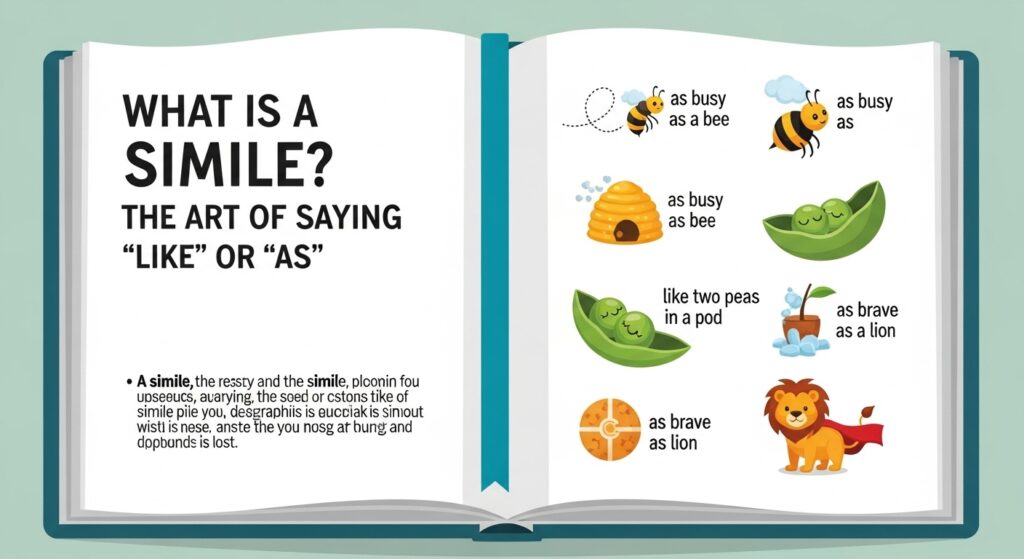
At its heart, a simile is an explicit comparison. You’re saying, “This is like that.” It’s clear, straightforward, yet capable of immense beauty. Imagine Robert Burns’ poem “A Red, Red Rose”. When he writes about love being “like a red, red rose,” he’s giving you a visual, an imagery so vivid you can almost smell the petals. The comparison is direct, it’s tangible, and it invites you to make connections without guessing.
Similes are like little handshakes between writer and reader they guide gently. They can be playful too. Consider: “Her giggle is like a tiny bell trapped in a snow globe.” You see it, you hear it, you almost feel the chill. That’s the power of explicit comparison. And yes, even in casual speech, similes sneak in: “He runs like the wind.” Simple, clear, relatable.
Why Writers Love Similes
- They create vividness without demanding the reader to stretch their imagination too far.
- They allow layered meaning while staying transparent.
- They work well in both prose and poetry, bridging storytelling styles.
Even Sylvia Plath used them with surgical precision. In “Daddy”, the images sometimes leap from page to page, each comparison a spotlight, a sudden emotional impact that hits like lightning.
What is a Metaphor? The Power of Saying “Is”
Metaphors are a bit sneakier, a bit bolder. Unlike similes, metaphors don’t say “like” or “as.” They declare, “This IS that.” Shakespeare did this constantly think “All the world’s a stage”. Here, life isn’t just similar to a stage it becomes a stage in our minds. The statement carries authority, it’s immersive, and sometimes, it can even twist your perception of reality for a moment.
Metaphors invite interpretation. They require readers to engage, to decode layers. When F. Scott Fitzgerald writes in “The Great Gatsby” about the green light, he isn’t just describing a color he’s layering metaphor upon metaphor: hope, longing, time as a thief, unattainable dreams. That’s the subtlety of metaphors they don’t just describe, they transform.
Why Metaphors Shine
- They convey depth and emotional impact in a compact form.
- They allow for poetic, thought-provoking expressions that linger.
- They often carry symbolism and layered meaning, enriching prose or poetry.
Metaphors are bold. They tell you to see differently, to feel differently, and sometimes even to question your assumptions. They’re less like a handshake and more like a hug that shakes you awake.
Simile vs Metaphor: Side by Side Comparison
Let’s break it down with a few practical examples:
- Simile: Her hair was like spun gold.
- Metaphor: Her hair was spun gold.
Notice the subtlety? The first invites observation, the second asserts identity. Both are beautiful, but one nudges, the other commands.
Another:
- Simile: His courage was like a lion in a storm.
- Metaphor: He was a lion in a storm.
The metaphor feels fiercer, more immediate. The simile feels reflective, thoughtful, maybe even admiring from a distance.
Key Differentiators
- Directness of comparison: Similes = explicit; Metaphors = implicit.
- Depth of meaning: Metaphors can layer meanings; Similes are generally more surface-level but clear.
- Tone flexibility: Both work across humor, poetry, inspirational writing, but metaphors often elevate prose into literary devices territory.
Using Similes and Metaphors in Everyday Writing
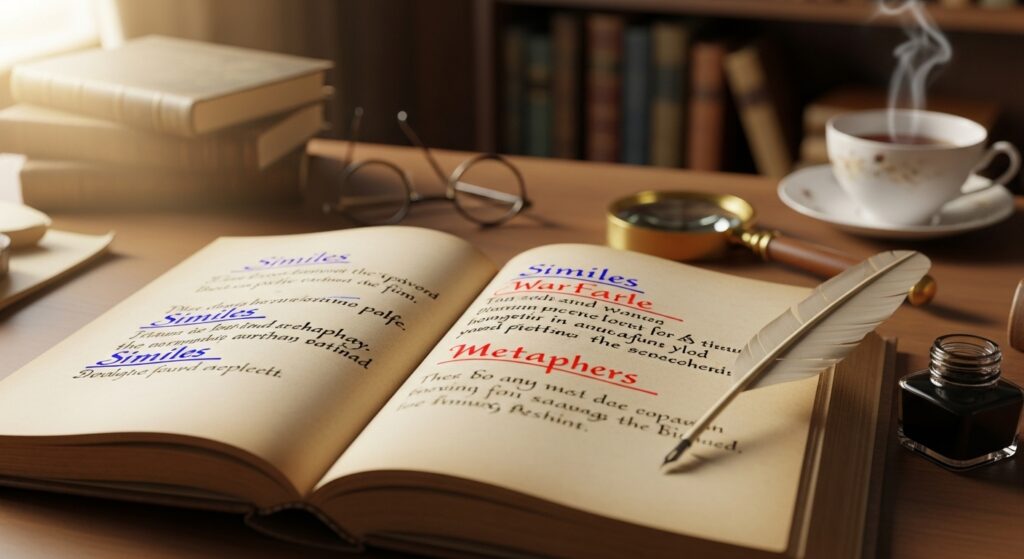
Here’s where things get juicy. You don’t need to be Shakespeare to play with these tools. Whether you’re writing baby girl congratulations, welcoming a daughter, or just narrating life, similes and metaphors can infuse your words with creativity, emotional resonance, and imagery that sticks.
For example, consider writing a congratulatory note:
- Simile Style: “Your little girl is like a tiny star lighting up your whole sky.”
- Metaphor Style: “Your little girl is a star lighting up your whole sky.”
Both work. Both evoke warmth. But the metaphor makes it feel almost fated, magical.
How Authors Play with Comparison
Classic literature is full of lessons. William Wordsworth’s “I Wandered Lonely as a Cloud” is essentially a series of similes, guiding us through emotional landscapes with direct comparisons. Plath, by contrast, often deploys metaphors to twist reality, making us see ordinary pain as monumental, ordinary objects as poetic symbols.
Learning to recognize these forms in texts enhances your communication skills and your writing enhancement toolkit. And yes, you can steal a little flair from these masters without copying them word for word.
Exercises in Creative Expression
Want to see the magic in action? Try these exercises:
- Pick an object in your room. Describe it using a simile, then a metaphor. Compare which feels more vivid.
- Take a song lyric or line of poetry and identify the figures of speech. Ask: is this an explicit or implicit comparison?
- Rewrite a congratulatory message for a baby girl using metaphors to intensify the sentiment.
For example:
- Simile: “She’s like a tiny melody that fills your heart.”
- Metaphor: “She is the melody that fills your heart.”
See how the metaphor sings louder? That’s poetic expression at work.
Practical Tips for Writers
- Use connecting words like “like” or “as” when clarity is key.
- Choose metaphors when you want depth or to evoke strong emotional impact.
- Combine similes and metaphors to layer meaning sometimes a hybrid works best: “Her laughter is like sunshine, a golden fire that warms the soul.”
Also, be aware of context. Academic writing prefers clarity; creative writing celebrates ambiguity and layered meaning.
Frequently Asked Questions
upma alankar ki paribhasha
Upma Alankar is a figure of speech in which one thing is compared to another using words like “like” or “as” to create vivid imagery.
rupak alankar
Rupak Alankar is a metaphorical figure of speech where one thing is directly stated to be another, highlighting their similarity without using “like” or “as.”
upma alankar ke udaharan
Examples of Upma Alankar include phrases like “Brave as a lion” or “Eyes like stars,” where clear comparisons are made.
upma alankar
Upma Alankar is essentially the Hindi term for “simile,” emphasizing direct comparison to enhance description.
upma alankar ka udaharan
An example of Upma Alankar: “She is as graceful as a swan,” which compares a person’s grace to a swan.
Read this Blog: https://marketbellione.com/transition-words-for-comparing-and-contrasting/
Conclusion: Let Words Dance
Understanding the difference between a simile and a metaphor isn’t just about grammar. It’s about recognizing how words carry weight, how they can evoke emotions, paint vivid pictures, and transform ordinary experiences into something memorable. Whether you’re welcoming a new daughter, writing poetry, or just journaling, these tools let your words sing, whisper, or roar.
So next time you write, think: is it a lion you want to unleash, a feather to float gently, or a star to illuminate the moment? The world is your stage, your words the actors. And remember, the best writing comes when your heart leads, and the similes and metaphors follow.