
There’s a soft thrill that comes when you see a child’s eyes light up at their first perfectly spelled word. It’s like catching sunlight in your hands, tiny sparks of wonder dancing on the page.
I still remember little Emma, barely six, tracing the letters of “butterfly” with a crayon that smudged her fingers and turned her palms into a miniature art gallery.
And as she giggled, I realized that learning words is not just about letters it’s about curiosity, joy, and a quiet sense of accomplishment. This is where spelling worksheets step in: unassuming tools that quietly turn confusion into confidence, scribbles into sentences, and mistakes into milestones.
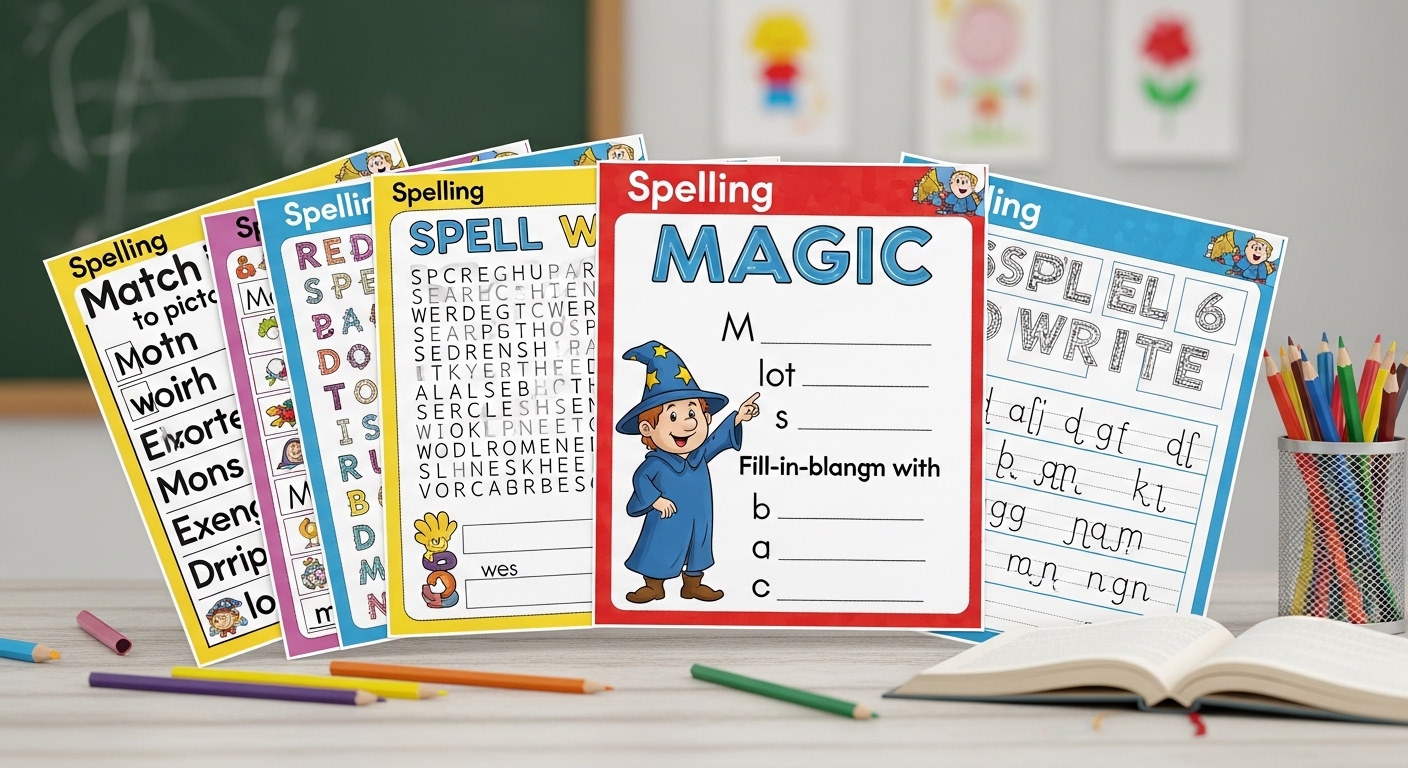
Whether you’re a parent helping at home, a teacher in Grade 2, or just someone who wants to give kids a leg-up in literacy, spelling worksheets can be magical. They don’t just teach letters; they teach patterns, sounds, and a gentle discipline that feels more like play than punishment.
In this article, we’ll explore everything from the basics of spelling skills to creative ways of using flashcards, workbooks, and spelling exercises to keep young learners engaged and thriving.
| Grade | Focus / Skills | Worksheet Types | Example Words / Activities |
|---|---|---|---|
| Kindergarten (K) | Letter recognition, phonics | Tracing letters, matching letters to pictures | cat, sun, ball; trace and match |
| Grade 1 | Sight words, basic spelling | Word lists, fill-in-the-blanks | dog, run, hat; complete the word |
| Grade 2 | Short sentences, phonics patterns | Crossword puzzles, themed worksheets | farm, tree, jump; farm animal spelling |
| Grade 3 | Contextual spelling, story building | Story weaving, visual representation of words | butterfly, garden, friend; make a short story |
| Grade 4 | Complex words, synonyms, antonyms | Word searches, spelling exercises | brilliant, adventure, mysterious; find the word in a grid |
| Grade 5 | Vocabulary expansion, sentence integration | Workbooks, flashcards, creative writing worksheets | extraordinary, courageous, recycle; create sentences using words |
Why Spelling Worksheets Matter
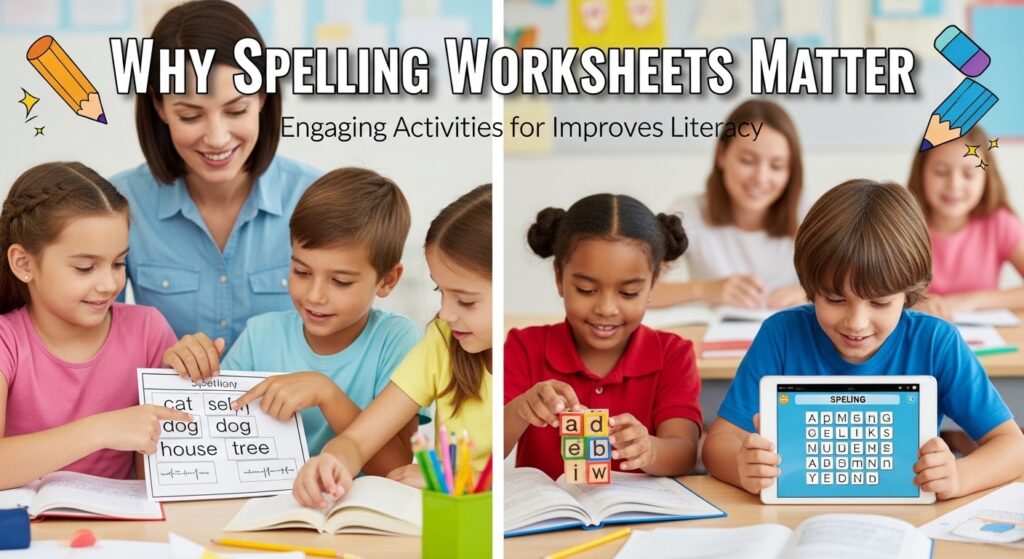
Some folks might think spelling is old-fashioned, like quills and inkpots, but the truth is, spelling forms the backbone of reading skills and writing skills.
A child who can spell is a child who can communicate clearly, who can see the bridge between thoughts and words. Even in the age of autocorrect, the muscle of spelling strengthens the brain in ways that typing alone can’t.
Spelling worksheets provide a structured yet playful environment for this growth. Take Grade 3 students, for instance. Worksheets with visual representation of words a cat next to “c-a-t,” a sun near “s-u-n” help children not just memorize letters but associate them with meaning. The learning sticks because it’s sensory, it’s visual, it’s fun.
Even across cultures, the joy of seeing a child conquer a tricky word resonates. In Japan, elementary school teachers use small flashcards called “fuda” to make kanji learning playful; in the U.S., programs like K5 Learning provide free printable worksheets for K-5 education, making literacy development accessible and enjoyable.
Different Types of Spelling Worksheets for Young Learners
There isn’t a one-size-fits-all when it comes to educational materials for kids. Different students respond to different formats, and luckily, spelling worksheets come in a dazzling variety.
1. Word Lists and Spelling Drills
This is the classic approach. You’ll see lists of words for Grade 1 or Grade 2, carefully curated for difficulty. The beauty here is simplicity:
- Kids see the word, spell it, repeat it, and cement it.
- Example: Grade 1 words: cat, dog, sun, run, hat.
- Example: Grade 4 words: brilliant, mischievous, extraordinary, pancake, adventure.
Using spelling lists alongside flashcards turns repetition into a game. For instance, you can do a “mystery word” challenge where children guess words from clues a fun twist that helps practice and improve retention.
2. Fill-in-the-Blank Worksheets
These worksheets challenge kids to recall words in context. Imagine a Grade 3 worksheet with: “The is shining bright in the sky.” Children must fill in “sun.” It’s simple but highly effective because it links spelling skills to real-world language use.
A personal anecdote: My niece, Riley, once filled “sun” as “son” by accident. We laughed, and she learned both the correct spelling and meaning in one go a small moment, but it stuck.
3. Crossword and Puzzle Worksheets
Who said learning can’t be sneaky fun? Crossword spelling exercises hide words in grids. Kids solve clues like “A yellow fruit” (answer: banana) while practicing letter recognition. Grade 5 students particularly love these because it feels like a challenge rather than homework.
Crosswords also introduce pattern recognition and problem-solving, two skills often underappreciated in elementary literacy development. Plus, seeing a completed puzzle brings a little victory dance every time.
4. Themed Spelling Worksheets
Themed worksheets cater to kids’ interests and make lessons relatable. Think: animals, holidays, seasons, or superheroes. You can turn a Grade 2 worksheet about farm animals into a mini-adventure: “Spot the animals on the farm and spell their names!”
Themed worksheets help link words to experiences, a trick parents swear by. One grandmother told me, “My granddaughter remembers ‘pig’ because she keeps feeding our neighbor’s piglets works every time.” Real-life context makes spelling exercises memorable.
5. Free Printable Worksheets and Online Resources
Digital age perks! Platforms like K5 Learning offer free printable worksheets for K-5 education. This is a godsend for busy parents or teachers who want skill-building exercises ready without reinventing the wheel.
You can mix worksheets with flashcards or workbooks to create a hybrid learning environment. Kids can write, touch, flip, and test keeping both visual representation of words and muscle memory engaged.
Spelling Worksheets as Tools for Holistic Learning
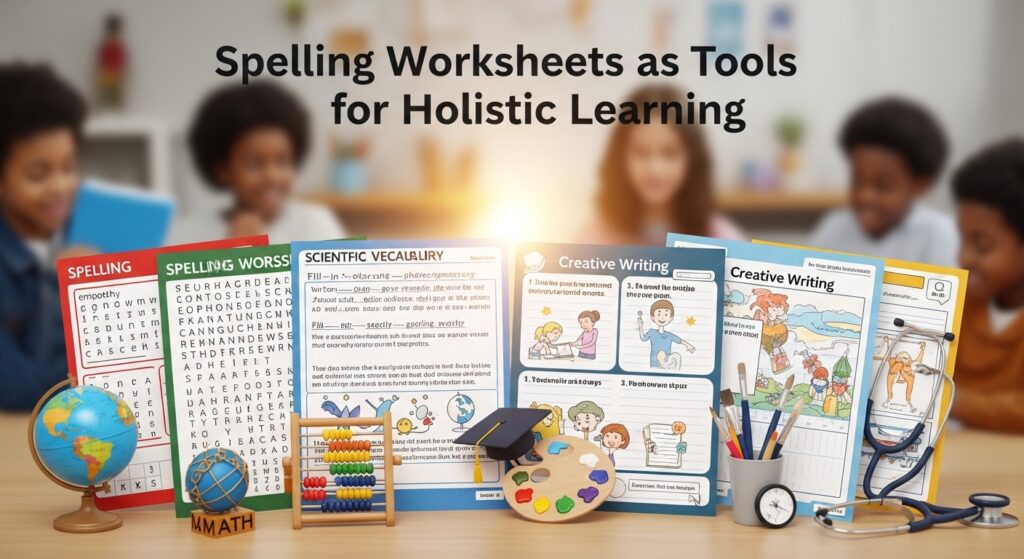
While we often focus on spelling as a singular skill, these worksheets do more. They strengthen reading skills because children encounter words repeatedly. They boost writing skills by building confidence. They even encourage self-discipline, especially when worksheets are part of grade-based activities.
A small classroom anecdote: In a Grade 1 class, Ms. Lopez made students create “word journals” from their worksheets. Within months, children were reading aloud with confidence, writing short stories, and correcting each other’s spelling gently. Worksheets were not punishment they were the scaffolding for creativity.
Creative Approaches to Using Spelling Worksheets
If you want kids to practice and improve without groans, creativity is key. Here are a few fun ideas:
- Flashcard races: Lay out spelling lists on cards. Kids run, pick a card, and spell aloud. Fast, active, memorable.
- Story weaving: Let children pick 5 words from a Grade 4 worksheet and create a short story. Spelling + imagination combo.
- Artful spelling: Draw the word while spelling it. Kids combine art with writing skills, reinforcing learning visually.
- Parent-teacher game nights: Mix worksheets with family games. Kids see spelling as celebration, not homework.
Even small tweaks like reading worksheets aloud with silly voices can turn mundane repetition into laughter, and laughter is often the glue of memory.
Integrating Spelling Worksheets Across Grades
Not all worksheets are made equal, and progression matters. Kindergarten (K) worksheets focus on letter recognition. Grade 1 introduces basic sight words.
By Grade 3, children tackle more complex spelling exercises and workbooks, and by Grade 5, they’re working with visual representation of words, synonyms, antonyms, and contextual usage.
A tip from experienced educators: Layer worksheets with printable educational worksheets for homework help, using grade-based activities to reinforce concepts gradually. Kids feel the sense of mastery rather than being overwhelmed.
Personalizing Spelling Practice
Worksheets are more impactful when tailored:
- Choose words relevant to the child’s environment. If they love gardening, include “plant,” “seed,” “water.”
- Integrate cultural stories. For example, in India, parents celebrate Saraswati Puja by teaching children traditional words using worksheets a subtle nod to heritage.
- Encourage children to add new words weekly to a personal spelling workbook. Ownership enhances learning.
One parent shared: “When my son wrote about his favorite superhero using Grade 3 spelling worksheets, he was not only spelling correctly but narrating a story I’d never heard before.” This is the real power of making worksheets personal.
Worksheets, Flashcards, and Workbooks: A Triumvirate of Learning
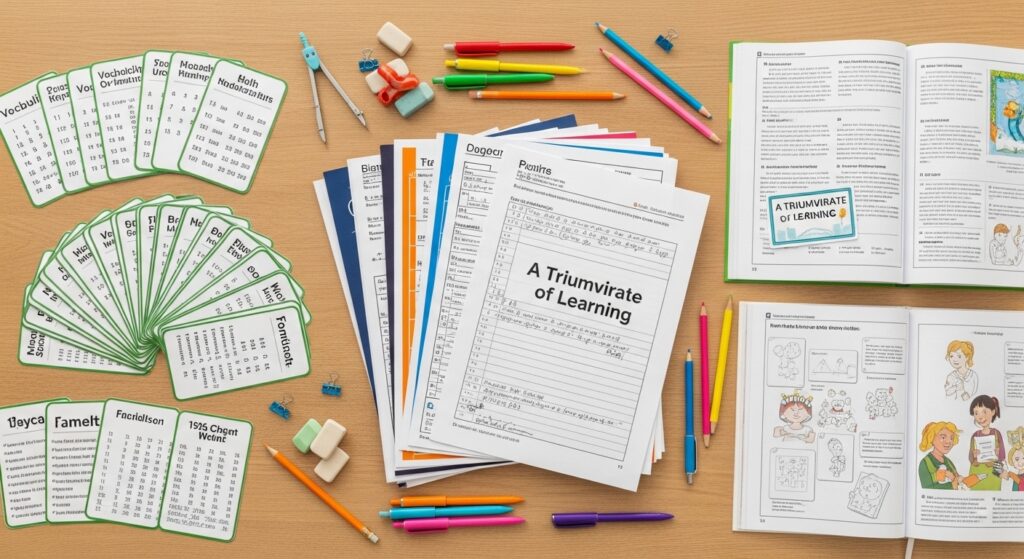
While worksheets are valuable alone, combining them with flashcards and workbooks creates a rich ecosystem:
- Flashcards reinforce recognition.
- Workbooks consolidate concepts across multiple exercises.
- Spelling worksheets provide repetition and context.
This trio addresses multiple learning styles: visual, kinesthetic, auditory. One child may thrive tracing letters, another recalling from memory, another linking words to pictures.
Creative Delivery Methods
Sometimes, the way a worksheet reaches a child is just as important as its content:
- Digital worksheets can be interactive, with drag-and-drop spelling.
- Printed worksheets allow tactile engagement and doodling.
- Homework envelopes with mini-games inside each worksheet surprise kids and motivate completion.
Even membership / access / skip ads platforms like K5 Learning allow parents to access premium spelling worksheets, ensuring children have a variety of content without distraction.
Frequently Asked Questions
spelling worksheets
Spelling worksheets help students practice correct word formation and improve their overall spelling skills. They often include exercises like fill-in-the-blanks, word searches, and matching activities.
fun spelling worksheets
Fun spelling worksheets make learning engaging by using games, puzzles, and creative exercises that motivate children to practice spelling without it feeling like a chore.
free spelling worksheets
Free spelling worksheets are accessible educational resources that allow parents and teachers to provide practice material for kids without any cost.
spelling practice worksheets pdf free
These are downloadable PDF worksheets designed for spelling practice, allowing students to print and use them anytime for offline learning.
spelling practice worksheets
Spelling practice worksheets provide structured exercises to reinforce correct spelling, improve vocabulary, and strengthen reading and writing skills.
Read this Blog: https://marketbellione.com/sixth-grade-6/
Conclusion: The Joy of Words
At the end of the day, spelling worksheets are not just teaching tools they’re doorways. Doorways to literacy, curiosity, imagination, and self-confidence. They are the quiet companions of a child’s journey from babbling to writing, from guessing letters to crafting stories.
Parents and educators can transform routine spelling exercises into moments of wonder. Whether you’re in Grade 2 helping a child sound out “rainbow,” or in Grade 5 exploring “extraordinary” in a short story, these worksheets are bridges. They turn errors into learning, repetition into mastery, and words into worlds.
So, gather your spelling lists, print those free printable worksheets, and maybe add a few crayons. Watch as children explore language, stumble, correct themselves, and emerge proud. And remember every letter learned is a little victory, a step toward confident reading and writing, and a gentle whisper that learning is beautiful.
Now, why not try creating a custom message or story from today’s spelling list? Share it, celebrate it, and watch literacy bloom in ways that worksheets alone could never predict.