
You know, sometimes numbers feel like tiny little companions that sneak into our lives without us even noticing. I remember sittin’ on my grandma’s porch as a kid, watchin’ her scribble down numbers on a torn notebook, whisperin’ something about how whole numbers and integers were like her secret friends.
She’d point to the numbers and laugh, “See this? +3, -2, 0… they’re not just numbers, they’re stories!” And honestly, she was kinda right. Integers aren’t just abstract scribbles on paper, they’re everywhere hidden in our daily allowance, sports scores, the temperature outside (+25°C, -3°C), and even in our computer games, trackin’ our health points.
Let’s take a lil’ wander through this universe of numbers and explore why integers matter, how they relate to mathematical concepts, and why they’re super cool, even if they sometimes give your brain a tiny twisty ache.
| Aspect | Description / Example |
|---|---|
| Definition | Integers are whole numbers: positive (+1, +2, +3), negative (-1, -2), and zero (0). |
| Positive Integers | Represent increase, gain, or counting. Example: +5 points in a game, +25°C temperature. |
| Negative Numbers | Represent decrease, loss, or going below zero. Example: -3°C, -15 in sports score. |
| Zero | Neutral point, balances positive and negative numbers. Example: bank balance 0, freezing point 0°C. |
| Number Line | Visual tool to show integers and opposite numbers, from negative to positive. |
| Everyday Applications | Bank account, elevators, sports scores, weather, allowance, computer games. |
| Education | Builds logical reasoning, step-by-step thinking, problem-solving skills, and prepares for algebra and geometry. |
| Mathematical Foundation | Basis for addition, subtraction, fractions, decimals, and understanding balance and equilibrium. |
| Coding & Tech | Used in loops, counters, and algorithms for games and software. |
| Historical Context | From Latin “integer” = whole, Ancient India introduced zero, shaping modern math. |
Understanding Integers: The Basics
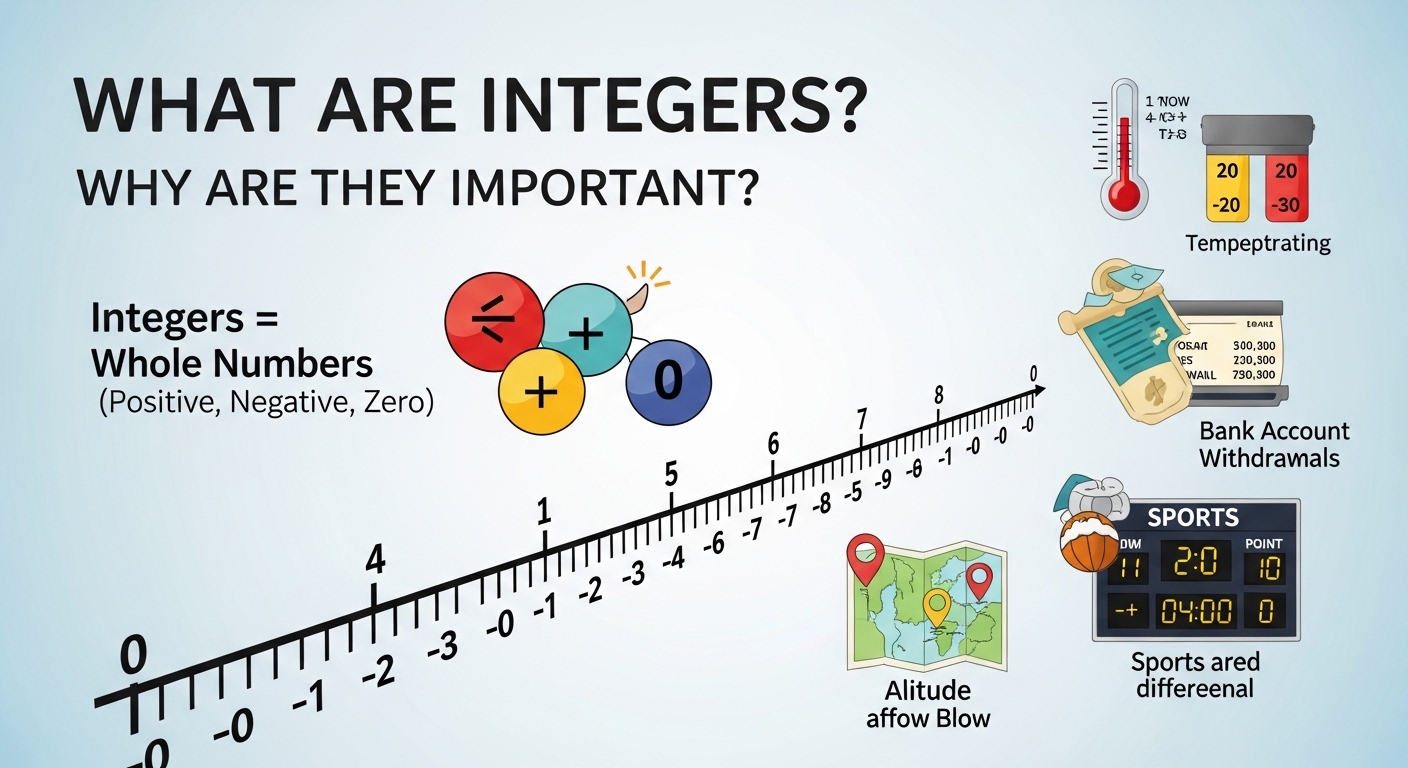
At its heart, an integer is like a whole number that can be positive, negative, or simply zero. It’s kinda like a seesaw you’ve got one side going up with +1, +2, +3, the other side going down with -1, -2, and the middle, balancing everything, is 0.
The term comes from the Latin word “integer,” meaning whole or complete, which is honestly poetic if you think about it. No fractions, no decimals, just pure, complete numbers.
The beauty of integers is that they form the foundation of so many mathematical concepts. For instance, the idea of opposite numbers +5 and -5 can feel magical when you first see it on a number line, like numbers are holding hands across a zero.
And when you move beyond, into algebra and geometry, integers are like the bricks of a building. Without them, we couldn’t solve everyday applications like balancing our bank account or figuring out elevators moving up and down.
Positive Integers: Counting the Bright Side
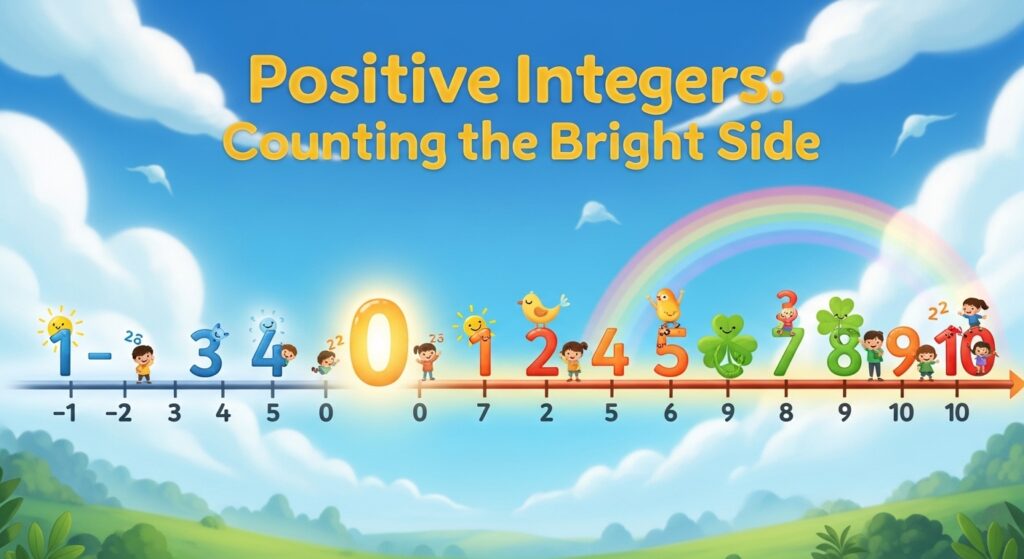
Positive integers are the crowd-pleasers of the number world. They start from 1 and climb upwards: +1, +2, +3… you get the idea. They’re the numbers you use when you’re counting your candy stash, scoring a goal in sports, or adding coins to your allowance.
- When you see +5, it might just be the extra points you gained in a video game, or the increase in temperature on a sunny afternoon.
- Teachers in math classes often tell students to use positive numbers to track what’s gained or ascend in problems.
- Fun fact: positive integers also appear in coding, like counting iterations in loops, where +1 moves you forward, step by step.
It’s not just about numbers; it’s about understanding increase and gain in everyday life. Imagine you’re tracking steps in a pedometer or time zones while planning a virtual meetup across the globe positive integers quietly guide you along.
Negative Numbers: The Other Side of the Coin
Just like there’s light, there’s shadow. Negative numbers represent decreases, losses, or even temperatures below freezing. Picture -15°C on a winter morning or -2 ½ points in a tricky math exercise suddenly, numbers aren’t just neutral, they have personality.
- Negative numbers are used when you descend floors in an elevator or lose points in computer games.
- They help us understand opposites, like gain and lose, up and down, which is crucial for logical reasoning.
- Historically, many ancient civilizations hesitated to embrace negatives. But the genius of Ancient India and later mathematicians showed that understanding zero and negatives opens up a whole new world of mathematical foundation.
Imagine trying to compute your net balance if you only had positive numbers impossible, right? The negative numbers bring equilibrium, giving balance to counting and numerical operations in everyday mathematics.
Zero: The Magical Middle
Ah, 0 it’s not just a number; it’s the fulcrum. Sitting quietly between positive integers and negative numbers, zero is the pivot point, the equilibrium that lets all numbers relate to each other. Without 0, addition and subtraction would be messy, and fractions or decimals wouldn’t have a clear starting reference.
- In educational contexts, teachers show kids 0 as the base for step-by-step thinking.
- In gaming, 0 could mean you’ve run out of health points, while in finance, it might be your account balance before you gain or lose money.
- Even in weather reports, 0°C is the magical freezing point, helping us visualize temperature changes.
Zero is kinda like the quiet hero of numbers, making everything else meaningful, connecting opposites and allowing logical reasoning to flourish.
Integers in Everyday Life: You’re Already Using Them
It’s kinda funny, but once you start noticing, integers are everywhere. You just gotta observe:
- Checking your bank account: deposits and withdrawals = positive and negative numbers.
- Walking into an elevator: going up floors = +1, +2, going down = -1, -2.
- Tracking sports scores: a basketball game could swing from +10 to -5 in a heartbeat.
- Playing computer games: your health points rise and fall with every decision.
- Cooking or baking: adjusting temperature in the oven involves +25°C or -3°C.
Even time zones use integers if you’re coordinating a meeting with a friend in Tokyo, you’re already using math to solve problems with stepwise computation. It’s incredible how these numbers silently orchestrate our day-to-day life.
Integers in Education: Building Skills for the Brain
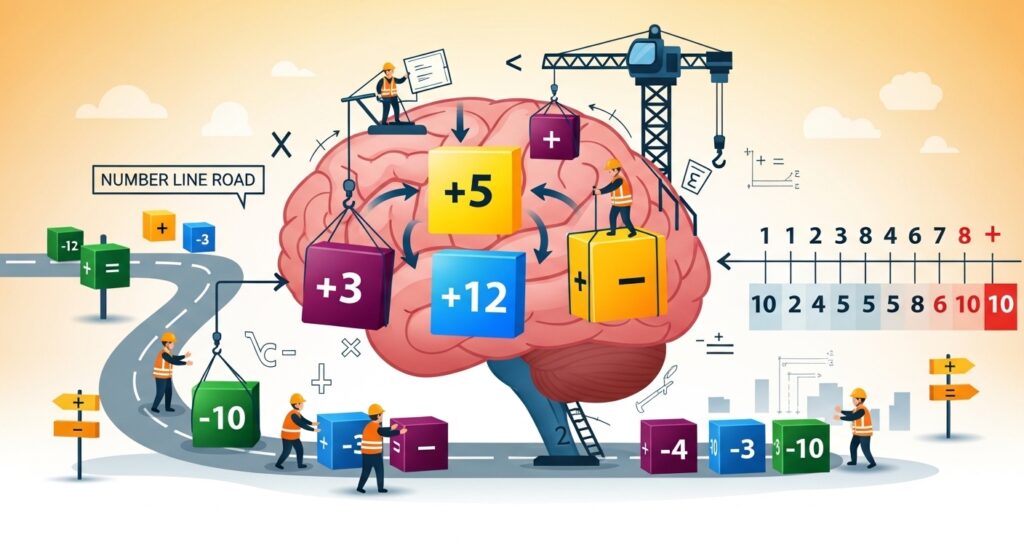
If you ever wondered why math classes focus so much on integers, it’s because they’re foundational for problem-solving skills, logical reasoning, and step-by-step thinking.
- Practice exercises with integers help students understand opposites, balance, and visualization of numbers on a number line.
- Fun math games use positive and negative numbers to teach numerical operations and logical sequencing.
- Tailored online courses now even let learners explore integers interactively, making the abstract feel real.
It’s not just about solving problems; it’s about training your brain to compute, track, and understand the rhythm of numbers in life.
Fractions, Decimals, and Their Relation to Integers
Now, you might ask, where do fractions and decimals fit into all this? Think of integers as the backbone and fractions/decimals as the fancy extensions. 0.5, 3.7, -2 ½ might seem tiny, but they all relate to whole numbers and integers. Without integers, fractions wouldn’t have a meaningful reference.
- Everyday applications like measuring temperature, allowance, or sports statistics often mix integers with fractions.
- In geometry, coordinates on a plane often rely on integers, while fractions fill in the gaps for precise points.
- Even coding uses integers for loops and counters, then decimals for precision calculations.
Understanding integers makes the leap to decimals and fractions logical, like a story unfolding one step at a time.
Historical and Cultural Perspectives
The word “integer” comes from Latin, meaning whole or complete, but numbers have a far older story. Ancient India gave us zero, which changed the world of mathematical thinking forever.
- In medieval Europe, integers were used for counting livestock, measuring land, and trade.
- Cultures celebrated milestones with numbers, often visualizing them as positive and negative for gains and losses.
- Ancient mathematicians realized that opposite numbers and balance were more than math they were a lens for seeing life.
So, integers aren’t just for classrooms they carry centuries of cultural wisdom.
Integers in Gaming, Finance, and Technology

You might not realize it, but every time you play a computer game or check your bank account, integers are doing the heavy lifting.
- Game developers track health points and scores with positive integers and negative numbers.
- Financial apps calculate deposits and withdrawals as + and – numbers, ensuring your bank account is accurate.
- Coding often relies on integers for loops, counters, and conditional logic.
It’s like integers are the silent wizards behind your screens, orchestrating balance, stepwise computation, and logical reasoning.
Creative Ways to Explore and Learn Integers
If you want to truly grasp integers, here’s some creative ways:
- Draw your own number line with + and – numbers, adding fractions for fun.
- Track weather temperatures for a week and visualize increase/decrease using integers.
- Play simple math games online where you ascend/descend points, learning opposite numbers.
- Use real-life examples like your allowance or sports scores to practice step-by-step thinking.
Learning integers can actually be fun, especially if you observe, compute, and explore their presence in daily life.
Frequently Asked Questions
integers
Integers are whole numbers that can be positive, negative, or zero, without any fractions or decimals. They are used in everyday life, from counting objects to tracking scores or temperatures.
what is a integer
An integer is a complete number with no fractional or decimal part. Examples include -3, 0, and 7.
integer number
An integer number refers to any number from the set {…, -3, -2, -1, 0, 1, 2, 3, …} that does not include fractions or decimals.
integer meaning in math
In mathematics, an integer is a number that represents a value along the number line, including positive numbers, negative numbers, and zero.
Read this Blog: https://marketbellione.com/what-is-a-participle-phrase/
Conclusion: Embracing the World of Integers
So, what’s the big deal about integers? They’re not just abstract symbols on a page they’re whole numbers that help us make sense of positive and negative numbers, zero, fractions, and decimals. They’re in our math classes, our gaming, our finance, our weather tracking, and even in how we think logically.
Next time you see +5, -3, or 0, remember they’re more than numbers. They’re stories, they’re steps, they’re tools that help us solve problems, track life, and understand the balance of the world around us. As one math teacher once said, “Integers are like the quiet heartbeat of math they’re always there, keeping everything in rhythm.”
Explore them, play with them, and maybe, just maybe, you’ll see integers not just as numbers, but as the invisible threads weaving the fabric of everyday life.