
Ever sat down with a cup of tea, just watchin’ words dance across a page, and wondered, “wait… what’s really the complete subject here?” Yeah, it sounds all fancy and grammatical-y, but lemme tell ya, it’s way more than just a boring school rule.
It’s the heartbeat of a sentence the part that tells us who or what is doing the thing, or sometimes, who or what is getting stuck in a pickle with that action. And honestly, once you start spotting these lil nuggets, your writing kinda… breathes differently. It’s like you’re seeing sentences in 3D.
So, stick around. We’re gonna dive deep, get messy with nouns, pronouns, modifiers, clauses, and phrases, and by the end, you’ll see why understanding a complete subject isn’t just grammar it’s communication magic.
| Type of Subject | Definition | Example |
|---|---|---|
| Simple Subject | The main noun or pronoun only | She ran to the store. |
| Compound Subject | Two or more nouns/pronouns joined together | John and Mary baked cookies. |
| Complex Subject | Main noun plus modifying phrases or subordinate clauses | The students who are struggling in math stayed after school. |
| Collective Subject | A single noun representing a group | The team celebrates its wins. |
| Complete Subject | All words that tell who/what the sentence is about, including modifiers | The big red dog barked at the mailman. |
Understanding the Complete Subject: The Core Idea
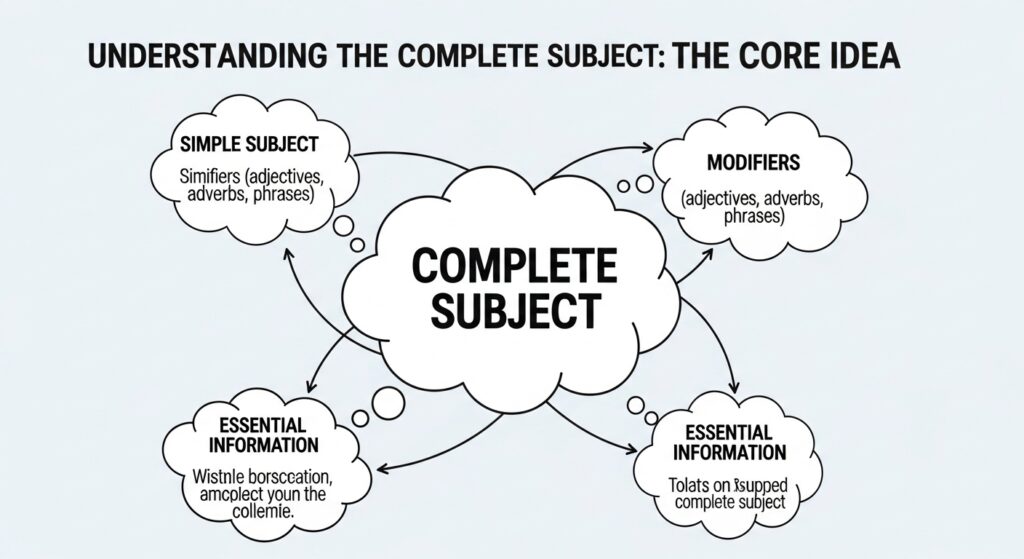
At its simplest, a complete subject is the “who or what” that the sentence is about, along with all the words that modify it. Not just the main noun or pronoun, but everything cozying up to it.
Think of it like a person wearing layers of clothes: the main noun is the body, and the modifiers—adjectives, phrases, maybe even subordinate clauses are the outfit, the accessories, the vibe.
For example, in the sentence:
The big red dog barked at the mailman.
Here, “The big red dog” is your complete subject. “Dog” is the simple subject, but all those adjectives? They’re part of the complete subject too, giving color and depth. Without ‘big’ and ‘red,’ you’d still know who’s barking, but with them? Bam! You’re seeing the dog in HD.
Understanding complete subjects isn’t just a grammar exercise. It’s about clarity. If you can’t pin down the who or what, your sentence loses meaning. And when you’re writing stories, emails, even birthday wishes… clarity is king.
Types of Complete Subjects
Just like people, not all complete subjects are the same. Let’s wander through the main types:
1. Simple Subject
The simple subject is basically the core noun or pronoun without the fluff. It’s like the skeleton of your sentence.
- John went to the store.
- She loves painting.
Notice how clean and crisp it is. No modifiers, just the main noun or pronoun doing the action.
2. Compound Subject
A compound subject has two or more nouns or pronouns joined together think teamwork in sentences.
- John and Mary baked cookies.
- The cat and the dog chased the squirrel.
Here, your plural verb agrees with a subject made of multiple entities. Simple? Kinda. But it gets trickier when you start adding modifiers.
3. Complex Subject
Now we get fancy. A complex subject includes a main noun plus one or more subordinate clauses or modifying phrases. It’s like a sandwich with layers, each adding meaning.
- The students who are struggling in math need extra help.
- The dog that barked all night kept everyone awake.
The subordinate clauses tell us extra info about the main noun. Without them, we lose context.
4. Collective Subject
Sometimes, a single word represents a whole group. That’s a collective subject.
- The team is winning the championship.
- The jury decides the verdict.
Even though “team” or “jury” is one word, it embodies multiple entities. And verbs? You gotta check if the group acts as one or individually. Grammar sneaks in surprises sometimes.
Why Complete Subjects Matter

You might think, “Ok, I get it. A subject. Big whoop.” But here’s the thing: the complete subject is the difference between a sentence that clicks and one that’s just… meh.
When you know the main noun, the accompanying words, and any modifiers, your writing:
- Gains clarity
- Improves sentence structure
- Supports better verb agreement
- Makes your message more engaging
Wanna see it in action? Compare these two:
- Kids played outside.
- The excited kids with glitter-streaked faces played outside in the autumn sunlight.
Same verb, same action, but the second sentence? It pops. Why? Because the complete subject is juicy and specific.
Breaking Down a Complete Subject
Here’s how you can spot all the layers:
- Find the verb this tells you where the subject ends.
- Ask “who or what” that’s your simple subject.
- Check for modifiers adjectives, descriptive phrases, prepositional phrases.
- Include any subordinate clauses these are part of the complex subject.
Example:
The students who are struggling in math with torn notebooks stay after school.
- Simple subject: students
- Complete subject: The students who are struggling in math with torn notebooks
Everything before the verb that’s talking about the “students” counts.
Common Modifiers in Complete Subjects
Modifiers are the unsung heroes. They dress up your nouns and pronouns, making your writing sparkle.
- Adjectives describe the noun (e.g., big, tiny, ancient)
- Adverbs occasionally sneak in (nearly everyone shouted)
- Phrases like “on the table”, “with glitter-streaked hair”
- Clauses “who ran across the field”, “that no one expected”
Modifiers turn a boring simple subject into a vivid complete subject. You want your reader to picture, not just know.
Examples of Complete Subjects in Real-Life Writing
Here’s where it gets fun. Let’s take some examples and see them in action:
- The big red dog barked at the mailman. (noun phrase example)
- She danced like nobody was watching. (pronoun example)
- John and Mary baked cookies for the school fundraiser. (compound subject example)
- The students who are struggling in math stayed after class for extra help. (complex subject example)
- The team celebrates its wins with ice cream. (collective subject example)
See how each type changes the flavor of the sentence? That’s the power of the complete subject.
Using Complete Subjects for Engaging Writing
Wanna make your essays, stories, or even emails more… alive? Treat your complete subject like a character. Give it detail, personality, context.
- Instead of “The cat slept”, try: “The tiny orange tabby with white paws slept curled up on the sunny windowsill.”
- Instead of “She ran”, try: “She, with her hair flying and shoes scuffing the pavement, ran faster than ever before.”
Suddenly, your sentence structure is cinematic. And it all starts with a clear complete subject.
Practical Tips for Identifying Complete Subjects
Here’s a checklist you can actually use:
- Find the verb first the subject is usually right before it
- Identify the main noun or pronoun
- Look for modifiers adjectives, prepositional phrases, clauses
- Include any descriptive phrases that are part of the “who or what”
- Ask: does removing this word change what the sentence is about? If yes, it’s part of the complete subject
Frequently Asked Questions
What’s a complete subject?
It’s the full “who or what” a sentence is about, including all modifiers and descriptive words.
What are the types of complete subjects?
Simple, compound, complex, and collective. Each brings different flavor and clarity to writing.
Why is it important?
Without a clear complete subject, sentences can be vague or misleading. It’s the foundation of effective communication.
Can a pronoun be a complete subject?
Absolutely! Even just She or They counts, especially when paired with modifiers.
How to determine if a phrase is part of the complete subject?
Check if it’s describing or identifying the main noun. If yes, it’s in. If not, it’s probably part of the predicate.
Read this Blog: https://marketbellione.com/poems-worth/
Conclusion: Making Your Writing Shine
Understanding the complete subject is like giving your sentences a heart, a personality, a little soul. It’s not just grammar it’s clarity, it’s specificity, it’s engaging writing.
Next time you write a story, an email, or even a newborn blessing, pay attention to the “who or what.” Add your modifiers, your descriptive phrases, your little clauses. Watch your sentences breathe, sparkle, and communicate with a clarity you didn’t know was possible.
And hey, if you’re feeling playful, try turning simple subjects into complex subjects just for fun. You might find that your emails, essays, or even birthday wishes suddenly feel way more… alive.