
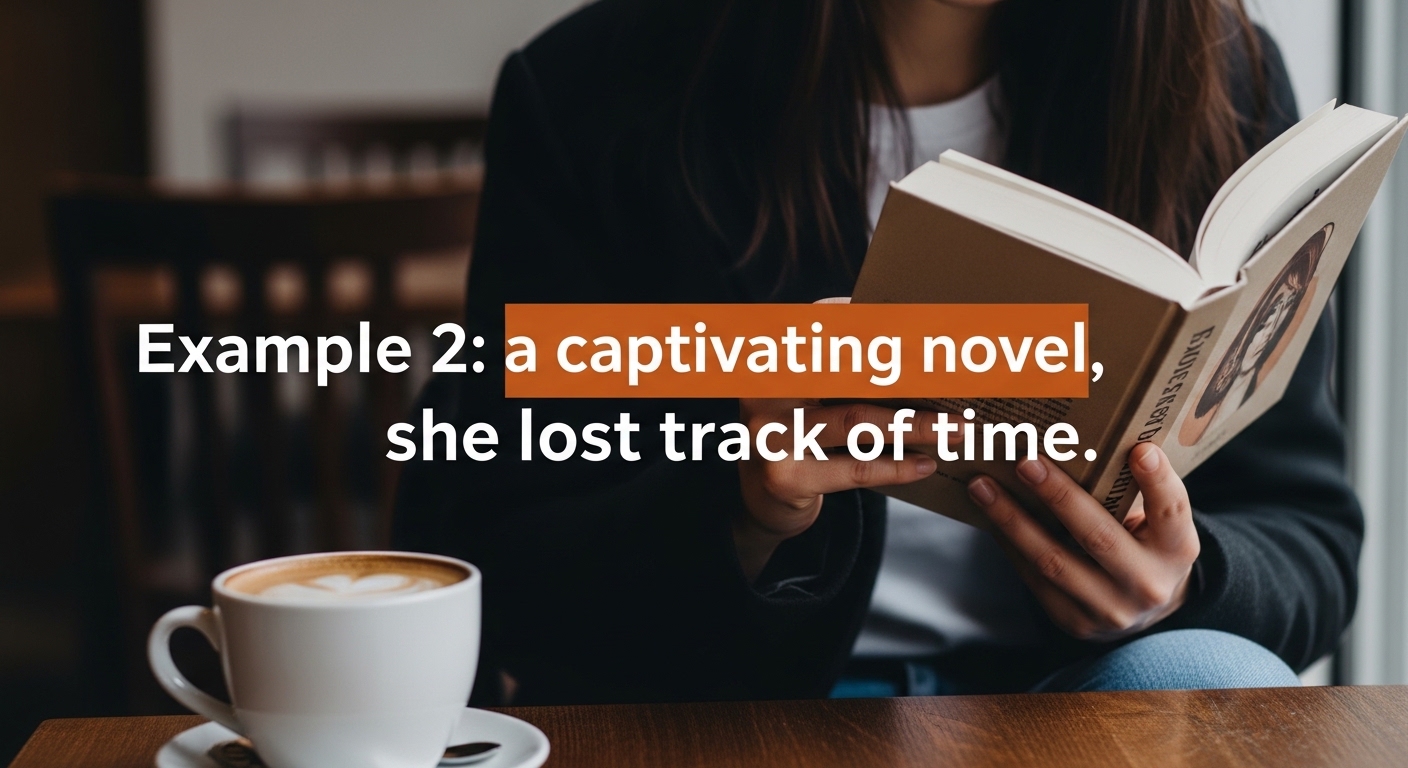
You know, sometimes in writing, the little things the tiny fluttering words carry more magic than the big bold nouns or main verbs. I was sittin’ in my favorite coffee nook, scribbling in my worn notebook, thinking about how sentences breathe life…
and it hit me: a participle phrase is like that gentle heartbeat of a story, quietly giving motion, color, and feeling without screaming for attention. It’s not just grammar, it’s storytelling in disguise.
If you’ve ever wondered why some sentences just “sing” or “flow” while others clunk like mismatched shoes, chances are, a present participle phrase or past participle phrase is at play.
So, let’s wander down this linguistic path, unpicking the mystery of these nifty little structures, and see how they can make your writing sparkle. And yes, there’ll be a sprinkle of irregularities and quirks, coz that’s how language feels alive, not rigid.
| Type | Form | Function / Use | Example |
|---|---|---|---|
| Present participle phrase | Verb + -ing | Describes ongoing action; modifies noun/pronoun | Walking down the street, she smiled. |
| Past participle phrase | Verb + -ed/-en | Describes completed action or state; modifies noun/pronoun | Destroyed by the storm, the house looked empty. |
| Perfect participle phrase | Having + past participle | Shows action completed before another action | Having finished her homework, she went outside to play. |
| Passive participle phrase | Being + past participle | Emphasizes noun as receiver of action | Being celebrated today, the policy received attention. |
The Heartbeat of Sentences: Understanding Participle Phrases
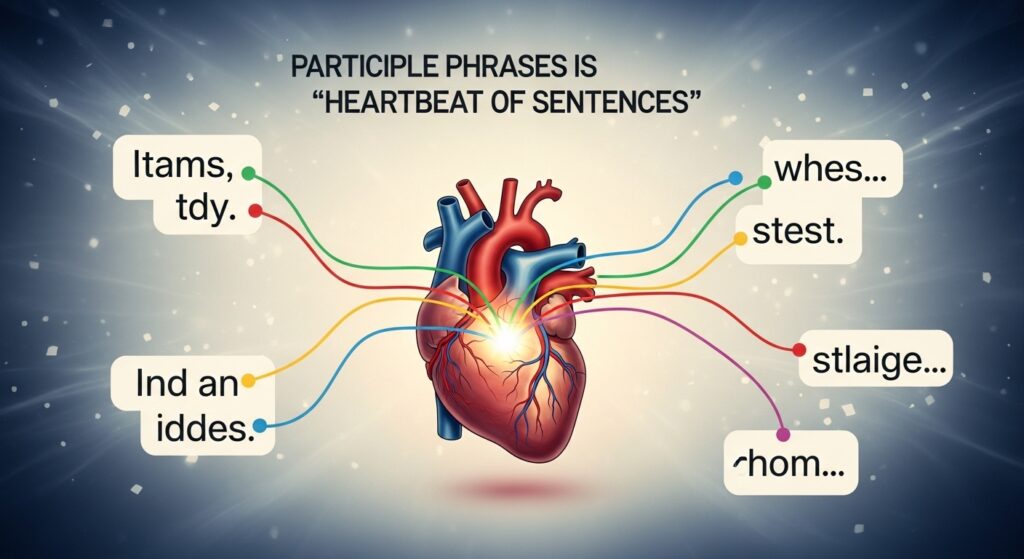
At its core, a participle phrase is a group of words beginning with a present participle (-ing), a past participle (-ed, -en), or even a perfect participle (having + past participle) that acts like an adjective.
Yup, adjectives in disguise! They modify nouns or pronouns, giving extra detail, like seasoning on a story. Imagine: “The girl, singing in the choir, smiled shyly.” That part about singing in the choir? It’s not the main event, but it’s painting her, giving her texture.
- A present participle phrase shows ongoing action: Walking down the street, I noticed the tiny bookstore.
- A past participle phrase usually indicates something already done or experienced: Destroyed by the earthquake, the city looked haunting.
- A perfect participle phrase shows completed action with relation to another: Having studied all night, I finally understood the grammar rules.
- A passive participle phrase emphasizes the noun being acted upon: Being implemented next month, the new policy will surprise everyone.
Notice how each phrase folds neatly into the sentence, enriching sentence structure, clarifying subject-verb relations, or giving additional information without starting a new sentence. Writers who master this can juggle action and result, characteristics, and even subtle cause and effect.
How Participle Phrases Work in Everyday Writing
You might think participle phrases belong only in fancy books or essays your teacher forced you to read, but nah they sneak into emails, texts, and casual chats more than you realize.
For instance, “Having previously worked in marketing, she understood why clients panic.” Or in storytelling: “The dog, wagging its tail furiously, bounded towards me.” See? It’s the little dance that makes sentences alive.
Participle phrases help with:
- Descriptive phrase creation
- Nuanced idea expression
- Complex sentence crafting
- Maintaining engagement through varied sentence structure
Even the simplest story benefits. Imagine writing a letter to welcome a friend’s newborn tiny details like “rocking in the cradle, she cooed softly” make your sentences vivid and your communication style feel personal.
Examples from Real Life: Participial Phrases in Action
Sometimes we underestimate their power. Here are some real-world sneaky uses:
- In parenting: The baby girl, clutching her tiny blanket, dozed peacefully.
- In business: The employee, having expanded its operations, earned unexpected praise.
- In travel writing: The city, buzzing with early morning energy, felt alive and endless.
Notice the rhythm? The phrase often tells when, why, or how, without making the main verb fight for attention. They are the ultimate sentence modifiers, giving richness and clarity.
Even cultural storytelling leans on this. In some parts of India, grandparents describe newborns with phrases like “sleeping under the garlanded cradle, she brings joy to the house.” English or not, the essence is participial: action + noun = emotion + imagery.
Playing with Present Participle Phrases
A present participle phrase always ends in -ing, and usually depicts ongoing action. It’s like the heartbeat while the main story runs. Example:
- Walking along the quiet riverside, I felt the city’s pulse slowing down.
- Smiling shyly, she handed me the invitation.
Tips for using them:
- Place them near the noun/pronoun they modify for clarity.
- Watch for dangling participles: Walking down the street, the rain soaked me. Uh-oh, rain can’t walk! Needs adjustment.
- Mix with main verb phrases for dynamic storytelling.
These little phrases can be sentence functions superheroes, giving additional information, action description, and characteristic description in one neat bundle.
Mastering Past Participle Phrases
The past participle phrase (-ed, -en) often shows completed action or a state of being. It’s ideal for cause-and-effect and reflection. For example:
- The letter, written by my favorite author, inspired generations.
- Destroyed by the hurricane, the village required months of rebuilding.
Notice how it gives context without bogging down the sentence structure. You can even combine with perfect participles for advanced nuance: Having expanded its operations, the company thrived unexpectedly.
Pro tip: these phrases can also serve as passive participle phrases, focusing on the object rather than the actor. This is particularly useful in formal writing or when your goal is clarity over flair.
Perfect Participle Phrases: The Secret Ingredient
Perfect participle phrases are a goldmine for temporal relationships. They emphasize an action completed before another. Examples:
- Having studied all night, she walked into the exam confident.
- Having finished the project, the team celebrated heartily.
See the subtle difference? You’re showing sequence, cause-and-effect, and nuance in one smooth phrase. Perfect participles are your linguistic Swiss Army knife for complex sentences.
Passive Participle Phrases: Shining a Light on Objects
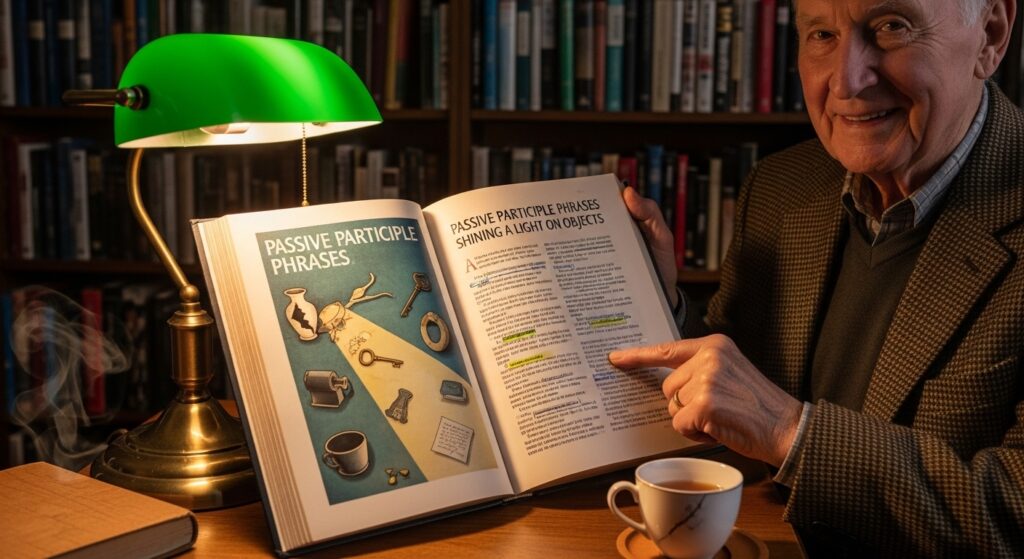
Sometimes the action is more interesting than the actor. Enter passive participle phrases:
- Being performed tonight, the play attracted a curious crowd.
- Being implemented next month, the new policy created a buzz among employees.
It’s a neat trick to shift focus without changing the sentence’s energy. Combine with sentence modifiers to pack additional info without clutter.
Creative Writing Applications: Beyond the Grammar Book
If you’re a creative writer or just love to text in dramatic flair participial phrases make your style pop. They help:
- Build suspense: Hiding behind the curtain, she waited for the knock.
- Deepen character: Exhausted from her journey, she slumped into the chair.
- Show cause and effect: Having lost all hope, he finally asked for help.
Even humor sneaks in: Eating pizza at midnight, he wondered why his jeans felt tight. Small, everyday, but with variety in sentence structure, suddenly mundane scenes breathe.
Tips for Effective Communication Using Participle Phrases
- Mix them with clauses: Combine main verb phrases and participle phrases to avoid flat sentences.
- Vary your verb forms: Use present participle (-ing), past participle (-ed, -en), and perfect participles to convey different temporal relationships.
- Mind the subject: Participial phrases must clearly relate to the subject to avoid confusion.
- Use commas wisely: For clarity, especially in complex sentences, commas guide the reader through sentence functions and syntax.
- Adapt to style: In formal writing, they add sophistication; in informal writing, they add rhythm and voice.
Participial Phrases in Cultural & Personal Storytelling
Across cultures, these phrases help convey emotion, ceremony, and tradition. Think of describing the arrival of a baby girl: The newborn, wrapped in a pink blanket, captured every heart in the room. Or narrating a festival: Dancers, wearing vibrant costumes, filled the streets with music.
Grandparents, parents, storytellers they all intuitively use present and past participle phrases to weave rich narratives. One grandmother once said to me, “When you describe them in action, you make them live forever.” Simple, but profound.
Bringing It All Together: Why Participle Phrases Matter
So, why care about these sneaky, adjectival verb forms? Because they transform plain sentences into dynamic, engaging, and nuanced statements. They let you:
- Convey action and state simultaneously
- Add additional info without extra sentences
- Clarify cause-and-effect relationships
- Highlight characteristics subtly
- Elevate writing and communication skills with style, clarity, and engagement
It’s grammar that feels like poetry.
Practical Takeaways: Making Participial Phrases Your Own
- Experiment in personal messages: “Rocking in her cradle, she already stole our hearts” sounds way more alive than “She is in the cradle.”
- Combine with anecdotes: Short cultural or personal mini-stories create memorable sentences.
- Engage readers: Ask friends/family to contribute participial examples from their lives.
- Play with tone: Use humor, warmth, or inspiration depending on your audience.
By practicing, you’ll find that sentence structure becomes a playground. A participle phrase here, a perfect participle phrase there, and suddenly even mundane events have nuanced ideas and storytelling magic.
Frequently Asked Questions
what is a participial phrase
A participial phrase is a group of words that begins with a participle and acts as an adjective, modifying a noun or pronoun.
what’s a participle phrase
A participle phrase starts with a verb form ending in -ing or -ed and provides additional information about a noun or pronoun.
participial phrase definition
A participial phrase is a phrase that functions as an adjective, describing the characteristics, actions, or state of a noun or pronoun.
what is a participle phrase
It is a phrase beginning with a participle that modifies a noun or pronoun and often adds detail about an action or condition.
participal phrase
A participial phrase contains a participle and any modifiers, functioning as an adjective to describe nouns or pronouns in a sentence.
Read this Blog: https://marketbellione.com/positive-and-negative-numbers/
Conclusion: A Celebration of Words
Learning about participle phrases isn’t just a grammar exercise it’s about seeing the world in motion, catching the flutter of actions, the whisper of states, and the elegance of cause and effect.
Every noun and pronoun, every main verb phrase, is a character. And the participle phrases? They’re the little sparks that make them alive.
Next time you write, look for opportunities to use a present participle phrase, a past participle phrase, or a perfect participle phrase. Try subtle passive participle phrases to shift focus.
Mix, match, play with verb forms, clauses, and descriptive phrases. You’ll notice sentences suddenly feel like friends walking beside you, telling their story in real time.
And just like welcoming a baby girl into the world, a well-crafted sentence with participle phrases carries warmth, movement, and life soft, subtle, unforgettable.